The Restoration Profit Estimator

Restoration Profit Estimator 800

Let’s be clear from the start: The Restoration Profit Estimator is not trying to replace Xactimate. The artificial intelligence (AI) tool is not writing scopes, handling compliance, or touching the Institute of Inspection, Cleaning and Restoration Certification (IICRC) standards. It is not an accounting system either. All it does is calculate estimated job profitability in under 60 seconds. That’s it.
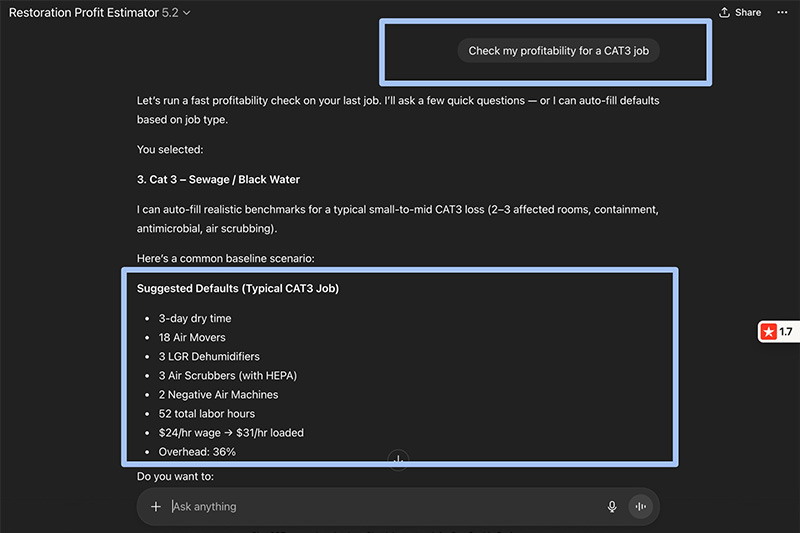
Most restoration contractors already understand the difference between revenue and profit. A strong invoice does not automatically mean a strong job. The issue usually is not knowledge. It is timing. In the middle of production, when crews are moving, and equipment is cycling in and out, nobody stops to open up a spreadsheet and calculate net margin. That clarity often comes later when accounting closes the month. By then, the job is done, and the lessons are harder to apply.

This tool is built for that gap. It gives you visibility at speed. You enter the invoice amount, labor hours, loaded labor rate, equipment counts and days, material costs, and your typical overhead percentage. If you do not have exact numbers, you can use benchmark defaults and adjust them as needed. Within seconds, it estimates gross profit, overhead allocation, and net margin. Clean output. No complicated setup. No long learning curve.

How it works
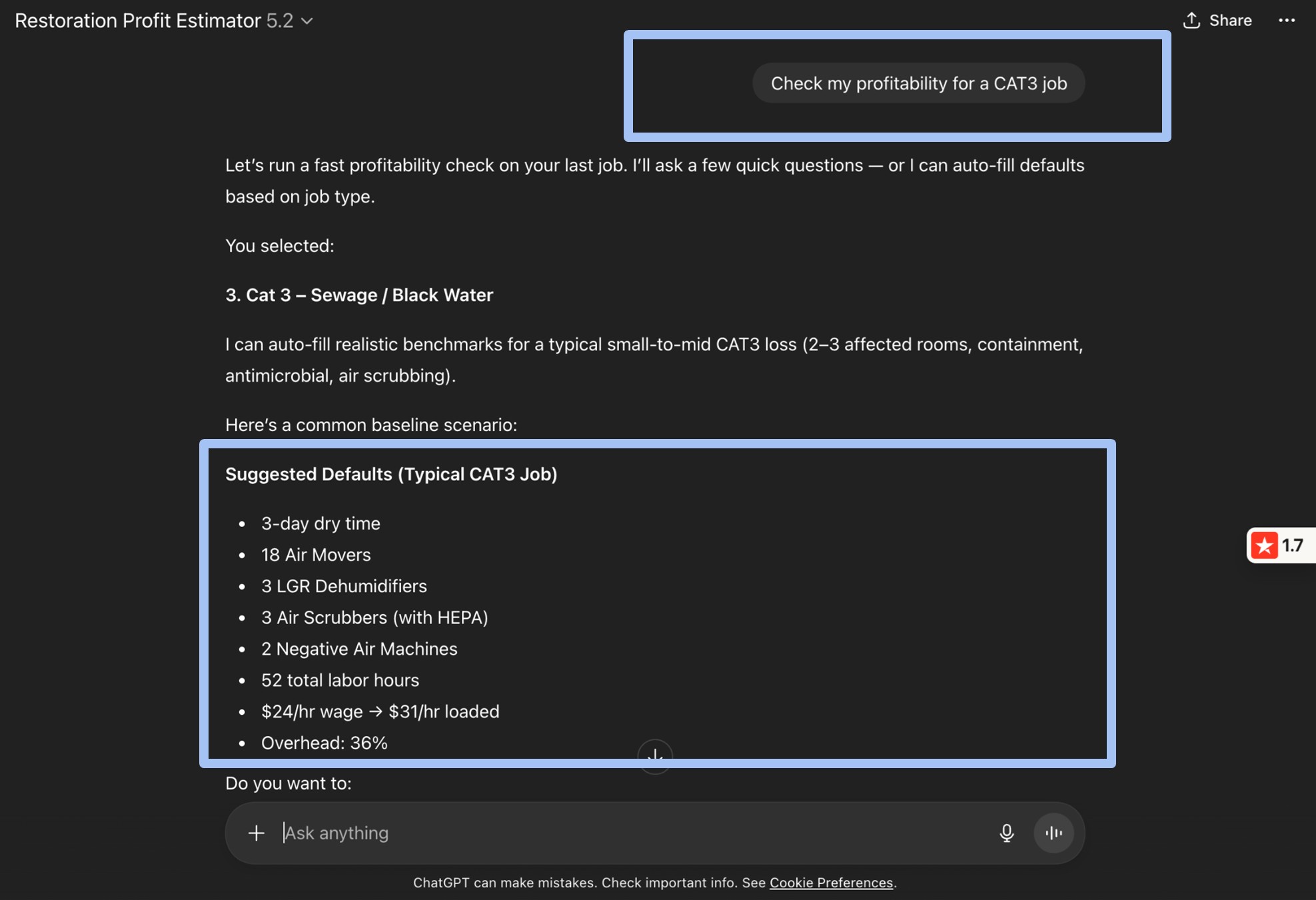
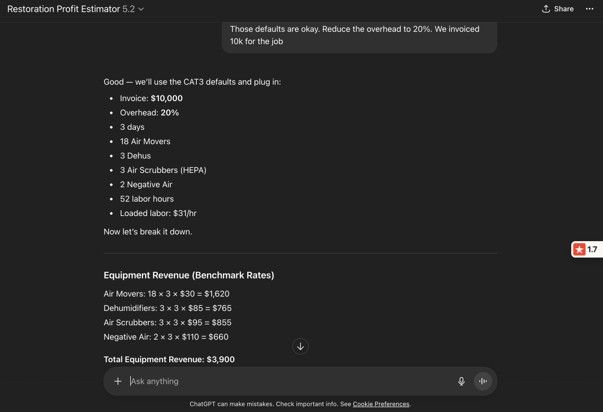
The first step is simple. Click the link at the bottom of this article and open the Restoration Profit Estimator. When it loads, you will be asked what type of job you want to check. For example, you can select a Category 3 sewage or black water loss. The tool will immediately offer realistic benchmark defaults for a typical small-to-midsize loss, such as three days of dry time, a set number of air movers, dehumidifiers, air scrubbers, negative air machines, total labor hours, a loaded labor rate, and a standard overhead percentage. You can accept those defaults or adjust them to match your actual job. Think of this as setting the baseline.
Restoration Profit Estimator
Next, you plug in your real job numbers. Enter the invoice total. Adjust the overhead percentage if yours runs leaner or heavier. Modify labor hours if the crew stayed longer than expected. Change equipment counts if you deployed more units than the baseline scenario. The interface walks you through it in a clean sequence. There is no spreadsheet to build and no formulas to manage. You are just answering direct questions about the job you have already completed.
Restoration Profit Estimator
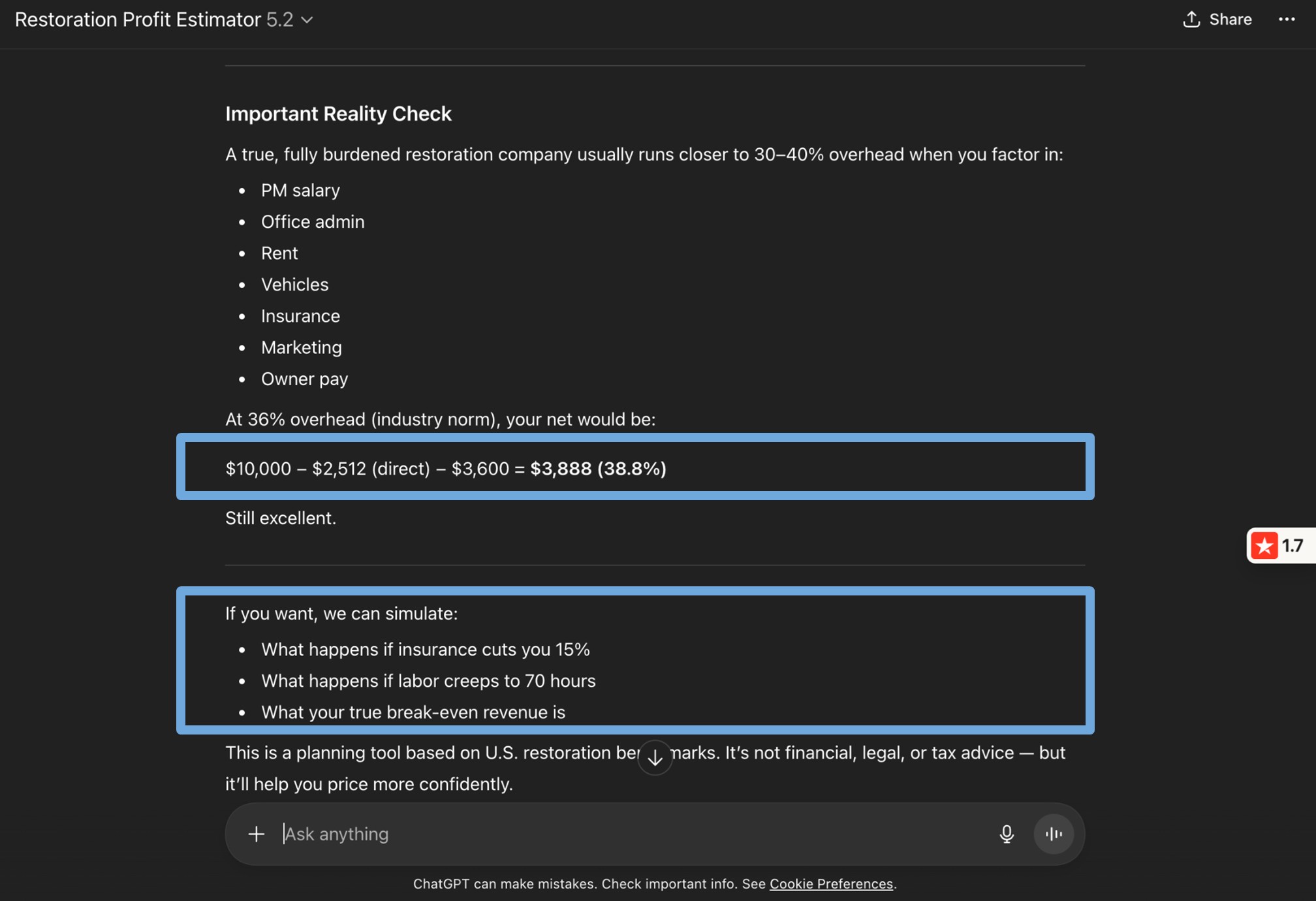
Once your inputs are in, the tool breaks everything down for you. It calculates equipment revenue based on benchmark rates, applies your labor cost using the loaded hourly rate, factors in materials, and then applies overhead. It clearly shows the structure, so you can see where the money is coming from and where it is going. This is not buried in accounting language. It is presented in plain numbers.
Restoration Profit Estimator

Finally, you get the output that matters. The system displays gross profit, gross margin percentage, overhead allocation, net profit, and net margin percentage. If the job came in strong, you would see it immediately. If it landed below your internal target, you would see that too. From there, you can even simulate small changes. What if labor had run ten hours higher? What if insurance cut the invoice by 15%? It gives you quick visibility without opening another system.

A plus in your restoration business

For some companies, this will be a nice tool to have on the side, something you use occasionally when you are curious about a job. For others, it might become part of a quick debrief process. Either way, it is not trying to overhaul your systems. It is bringing margin awareness closer to the field and into real time.

You can test it with numbers from recent jobs and compare the results to your internal reports. See how close it lands. If nothing else, it gives you a faster way to think about profitability while the job is still fresh.


Here’s the link to access the tool.

Anishwaar Pal

Anish Pal is the founder of Compound Labs, helping restoration businesses use automation and AI without losing their human touch.

Follow Anishwaar Pal

Related Posts

Share This Article

Join Our Newsletter

Expert Videos

Popular Content

Screenshot

Concrete Wars: Go to Battle With Ameripolish on Your Side

CoreLogic Straighttalk 800

Efficiency Meets Innovation: CoreLogic Revolutionizes Water Damage Restoration With Mitigate

ServiceMonster

ServiceMonster: All-in-One Client and Job Management Platform Built for Carpet and Floor Cleaners

Masters in Restoration Pricing & Documentation

Masters in Restoration Pricing & Documentation: How to Turbocharge Your Restoration Project Strategies

Erin Hynum

Revolutionizing Restoration: Introducing the DryMAX XL Pro Dehumidifier

Polls

What STARTING wage (under one year of employment) do you pay a carpet cleaning technician, per hour?

View Results

Loading ... Loading ...