Policy in Motion
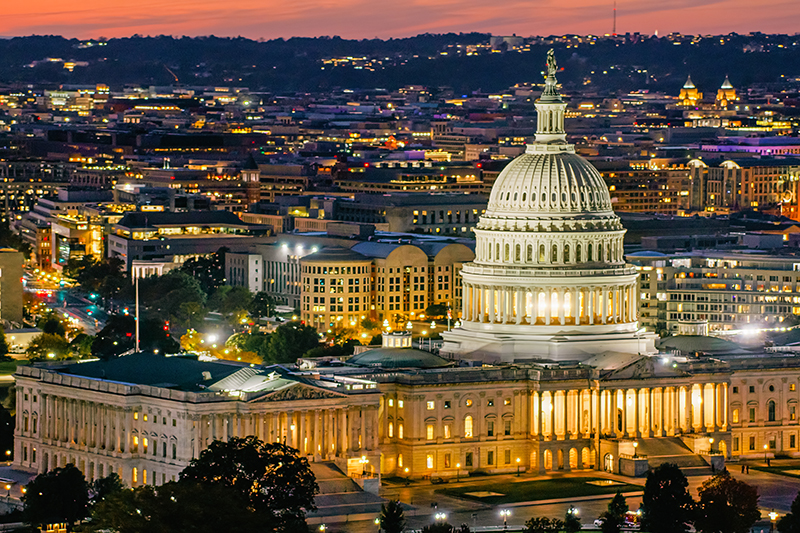
Most people in the cleaning and restoration industries are focused on the job at hand—the water loss, the commercial account, the crew, etc. Washington, D.C., rarely enters the picture. But decisions made on Capitol Hill and in state and local government directly shape how the industry operates, grows, and serves customers.
The Institute of Inspection, Cleaning, and Restoration Certification (IICRC) is working to change that disconnect, and its inaugural legislative fly-in is the centerpiece of those efforts.
Creating the table
For much of its history, the restoration side of the industry has had little presence in policy conversations. Robbie Bradshaw, IICRC director of government relations, said that has changed in recent years, but significant ground still needs to be covered.
“For the longest time, our industry, at least from the restoration standpoint, really didn’t have a seat at the table, didn’t have anybody advocating on behalf of it,” Bradshaw admitted. “The best way to ensure that is to have conversations with the people who create the table. So next time they do create the table, they’ll ensure that our industries have a seat at it.”
Craig Powers, the second vice president of the IICRC board, echoed that framing—with some bluntness about where things stand.
“Our industry is not really recognized by the federal government,” Powers, who has operated in the industry since the 1980s and works closely with insurance carriers, acknowledged. “Most of these legislators have never been on a water loss. There’s a lot of legislation, a lot of regulation—it’s happening today, and it’s historically happened to us. By having a voice and a seat at that table, we can now help direct how this legislation is going to impact our industry.”
What the experience looks like
For contractors and company owners who have never set foot in a congressional office, the idea can feel intimidating. Both Bradshaw and Powers pushed back on that concern.
The fly-in runs for two days. The first is dedicated to preparation—talking points, issue briefings, and a walk-through of how conversations with congressional offices typically unfold. Attendees then go to Capitol Hill as part
of a group representing their state, so no one must navigate the process alone. Most meetings are with staffers rather than the legislators themselves, which Powers said is a strength.
“Everything is planned out,” he explained. “Every meeting is scheduled for you. All of the talking points are given to you. It’s so easy to just show up, be present, and tell your story. And that’s really what they want to hear.”
Powers recently returned from a separate Washington, D.C., advocacy event with ISSA, the association for cleaning and facility solutions, where one participant—a business owner who had recently become a U.S. citizen and was transitioning from subcontractors to her own workforce—held the room with her story.
“Her story was so captivating,” Powers said. “All the staffers just really honed in on that. Tell your story. It hits home with them.”
General registration for the full event is US$199 per attendee and includes 14 continuing education credits.
Real results, real legislation
The case for showing up is not theoretical. Bradshaw pointed to two recent wins that came directly from sustained advocacy work.
The first is the Tomorrow’s Workforce Act, which expanded 529 savings plans to cover industry certifications. Bradshaw said multiple lawmakers who attended ISSA and IICRC advocacy sessions became co-sponsors, and the bill ultimately passed.
The second is the Military Occupancy Living Defense Act (MOLD Act), which Bradshaw has been building over the past four to five years through consistent conversations about mold remediation in military housing and the adoption of the ANSI/IICRC S520 Standard for Professional Mold Remediation.
“We said we need to make sure that folks performing this work are certified—it’s not just the standard being adopted, but the people who have actually taken a class and been trained,” Bradshaw shared. “Our certifications, as well as other industry certifications, found their way into brand new legislation called the MOLD Act. And that was simply because we had been having these conversations over and over and over again on Capitol Hill about the same topic.”
Bradshaw said a broader focus on disaster recovery legislation is emerging in Congress—and that the cleaning and restoration industry is not yet part of those conversations. When drafting large-scale disaster bills, the goal is to ensure that industry standards and certifications are included from the start.
Why contractors need to be in the room
For working contractors who assume policy is someone else’s problem, Powers had a direct response.
“Our voice really does matter,” Powers said. “For me, at this point in my career, to spend time volunteering and advocating—in my mind, there’s no better way to spend my efforts. We’ve seen problems in our industry. Anyone watching this has known, heard about, or experienced a problem. And there’s probably some legislation behind it. Somebody advocated for it. For us as an industry, forming our group and our voice in Washington, D.C., is critical. It’s more critical now than it ever has been.”
Bradshaw framed the takeaway in terms of what attendees will understand when they leave: that legislators and their staff want to hear from constituents, and that those conversations move legislation.
“I hope they walk away with the confidence that it’s not that difficult to talk to your policymaker,” Bradshaw said. “You are a constituent. You have the ability to vote for this legislator or not. They work for you, and they want to hear your stories.”
Powers closed with a straightforward appeal: “We need to unify our industry. When you show up, and you participate, and you engage, all it’s going to do is elevate our profession. You will meet other cleaning and restoration professionals from your state. You will gain those contacts. And it’s just going to make our industry so much stronger.”
The IICRC legislative fly-in takes place on Sept. 1-2 in Washington, D.C. Details and registration information are available at iicrc.org/legislative-fly-in.
BONUS VIDEO CONTENT
EDITOR’S NOTE: Cleanfax produces this media program in partnership with the Institute of Inspection, Cleaning, and Restoration Certification (IICRC). The program, Unscripted, features what the IICRC is doing, what the industry needs to know about IICRC Standards, certifications, events, technical tips, management, marketing strategies, and more. If you have a topic you would like to see featured in a future edition of Unscripted, email Jeff Cross, ISSA media director, at [email protected].

Jeff Cross
Jeff Cross is the ISSA media director, with publications including Cleanfax, Cleaning & Maintenance Management, and ISSA Today, as well as multimedia programs such as Straight Talk! and Take 5 With Cleanfax in video and podcast format. He can be reached at [email protected].