Meet the Youngest-Ever Female IICRC Certified Restoration Technician
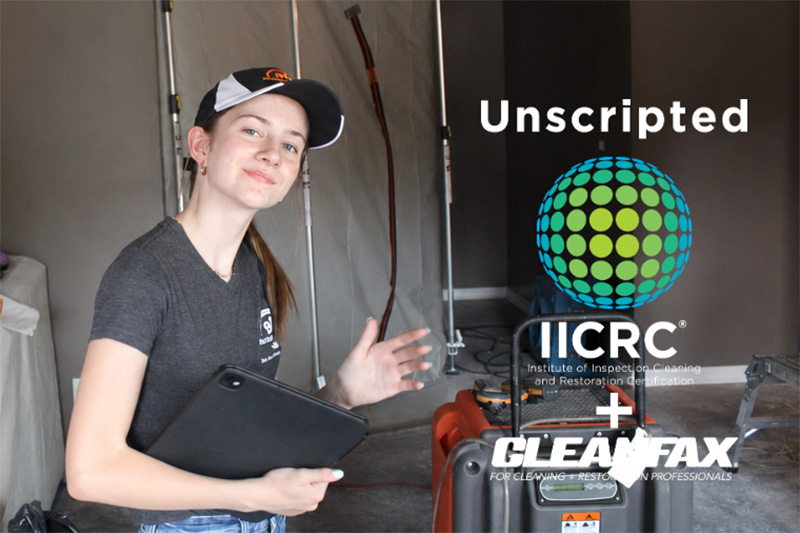
She is too young to drive, but not too young to dry.
Olivia Haynes spent part of last winter with days of intense classroom instruction, hands-on work in a flood house, and a certification exam waiting at the end of it.
The only thing that set her apart from everyone else in the room was her age. She was 12 at the time, now 13.
Olivia is the youngest female ever to obtain dual restoration IICRC certifications in Water Damage Restoration Technician (WRT) and Applied Structural Drying (ASD). By IICRC’s own account, officials could not say with full certainty, since the organization doesn’t require applicants to disclose their age, but every documented case they could find put Olivia at the top of the list.
She trains and works alongside her father, Chad Haynes, who operates 911 Restoration locations in Central and Northwest Arkansas. Haynes partnered with the brand eight years ago, opening a location in Central Arkansas before adding a second one in Northwest Arkansas two years later. Between running two branches and raising three daughters, he wasn’t exactly shopping for a pint-sized apprentice. Olivia found her own way into the business.
A father notices genuine curiosity
Haynes said the shift from a kid riding along to someone genuinely invested in the work happened gradually, and it showed up in the questions Olivia started asking on job sites.
“She was started asking detailed questions. It wasn’t so much general questions,” Haynes said. “She wanted to know what the purpose and what each machine did. She wanted to know why there was so much equipment in there.”
That curiosity followed her into a moisture reading on a job site, and eventually into a conversation about getting certified. Haynes called his own instructor, Kevin Fisher of the Restoration Science Academy, to ask whether there was an age requirement. Fisher told him there wasn’t one, with a caveat.
“He was like, ‘I can’t change the course, though, for her. It’s got to be what it is, so I don’t know if she can handle it,'” Haynes recalled. Fisher checked in after the first day. There were no issues to report.
Haynes had a personal reason to trust Fisher’s teaching. He had taken the same course from Fisher eight years earlier, in the same flood house Olivia would later train in.
Sitting in a room full of adults
Walking into a classroom of experienced adult technicians as a 12-year-old wasn’t entirely comfortable at first, Olivia admitted.
“It was a neat experience. I did feel a little bit intimidated by everyone else, because everyone’s older than me, they all had a lot more experience than me,” Olivia said. “But we did have an awesome instructor that was very helpful.”
A cousin taking the course alongside her helped, too. So did the format itself, which paired classroom lessons with immediate hands-on practice in the flood house rather than saving all the fieldwork for later.
“I think I probably liked the hands-on portion of it, the flood house and stuff, because you would learn and then do the flood house, so you wouldn’t have to learn it all in three days and then go,” Olivia said. “It’s nice to retain the knowledge in my brain.”
Her classmates, she added, treated her like an equal rather than an outsider. Haynes noticed the same thing from the sidelines. Each day, the class picked a new group leader, and when it was Olivia’s turn, she ran the group.
“She wasn’t sitting there in a corner just kind of absorbing it. She was actually involved in it,” Haynes said. “She asked really good questions. She answered a lot of questions that were given.”
Into the crawl space, spiders and all
If there’s a single moment that captures what the course asked of Olivia, it’s the crawl space.
Haynes described watching his daughter, who is afraid of spiders, climb into a crawl space to take moisture readings because the job required it.
“She’s scared to death of spiders, so I didn’t think that was going to happen. I’m very proud of her, because she made it happen,” Haynes said.
Olivia also ran extraction equipment and pulled daily readings throughout the flood house training, the same tasks any adult technician would be expected to handle.
Outside of restoration, Olivia’s interests run in a typical direction for a 13-year-old: swimming, golf, horseback riding, time at the lake with friends. She said restoration doesn’t come up much in conversations with classmates back at school.
“Whenever I do try to bring it up, they don’t seem as interested as I am,” Olivia said. “But I think if they would have done the same thing I did, they would have really enjoyed it.”
What happens next is up to her
Neither Haynes nor Olivia is claiming she’s locked into a restoration career at 13. She mentioned an interest in computers and painting and said she’s not drawn to jobs that keep her outside in Arkansas heat. But she also doesn’t rule the industry out.
“It’s never going to be taken over by AI,” Olivia said, echoing something her father has told her. “There will always be a need for it. So as long as I really work at it and try, then I can provide for what I’ll need in the future.”
For Haynes, the certifications aren’t really the point. What matters is that his daughter found something she wanted to work at and followed through on it in a room full of people twice her age.
“To do what you love, and then to do it with someone that you really love, is an awesome, amazing feeling,” Haynes said. “I don’t know if Olivia’s going to stay in this industry as a career, but I want to be able to cherish every moment I can to help her find out what makes her happy in the future.”
For an industry that spends a lot of time talking about how to attract young people into the trades, Olivia Haynes offers a rare, live example of what that actually looks like up close: curiosity, a supportive push from an instructor and a parent, and a willingness to climb into a crawl space when the job calls for it.
Learn more about IICRC certification at iicrc.org.
Watch the full episode here:
Listen to the podcast version here:

Jeff Cross
Jeff Cross is the ISSA media director, with publications including Cleanfax, Cleaning & Maintenance Management, and ISSA Today, as well as multimedia programs such as Straight Talk! and Take 5 With Cleanfax in video and podcast format. He can be reached at [email protected].