The Titans of Rug Washing: How MOR and Centrum Force Advance a Legacy
In the cleaning industry, technology shapes production, profitability, and reputation. Nowhere is that more evident than in the world of rug washing, where innovation has historically moved slowly—until a remarkable company changed everything.
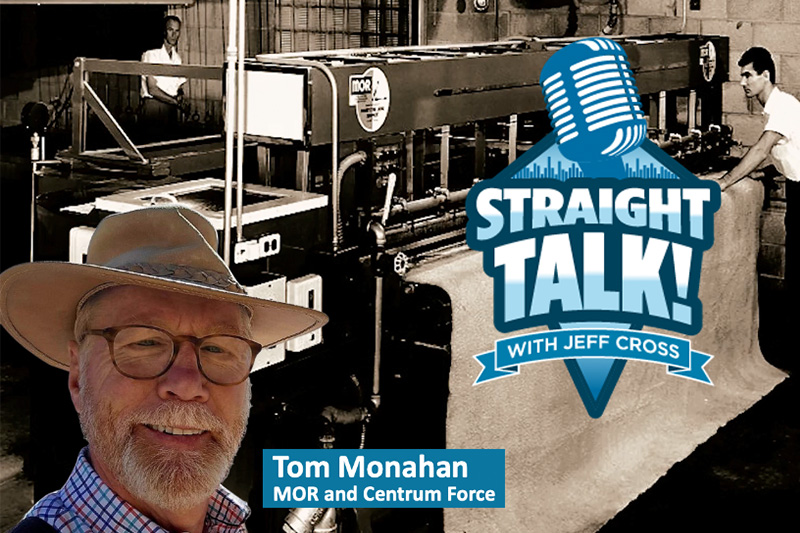
That company was MOR Time-Saving Equipment, the most influential rug-washing equipment manufacturer of the last 75 years. Its anniversary saga spans the Great Depression, engineering breakthroughs, industry-shifting automation, and ultimately a rebirth under Centrum Force, led by founder and fabricator Tom Monahan.
Today, as the rug-cleaning industry grows more sophisticated and labor costs continue to rise, the MOR legacy is more relevant than ever.
Born in hard times
The extraordinary company started at the most unlikely moment imaginable.
“It was in the first week in February 1930, when the Moore brothers, Arthur and Gregg, decided to purchase a small dry-cleaning business,” Monahan said. “What a time to buy a business, right? With the stock market crash in 1929, the Great Depression was in full swing, and people everywhere were hurting for money.”
Arthur and Gregg Moore had never operated such a business. Yet they kept at it for about six years. Their persistence under economic strain forged two traits that would define their company’s future: “Thick skin and an abundance of courage.”
As the country emerged from the Depression, in 1936 the brothers made the choice to add rug cleaning services—an addition that would change the industry.
Necessary problem-solving
The leap into rug washing created a need for better tools that didn’t exist yet. Their first significant step into automation came unexpectedly.
“The first real adventure in this business occurred on the day when Gregg Moore purchased a new rotary brush scrubbing machine for $150, without telling his brother Arthur,” Monahan explained. “Luckily, this purchase proved to be of great value.”
But the brothers quickly realized that if they wanted actual throughput, they needed more than off-the-shelf solutions.
“A small automatic washer and conveyor were installed,” Monahan said. “This set the stage to produce high volume and lots of new sales revenue. Everything was fine except for one important thing. The equipment they had found could only produce 10 rugs per hour. For an automated production, this was unacceptable.”
There was only one solution.
“Their situation caused them to conceive of equipment that would furnish a high-speed rug cleaning production line,” Monahan said. “But it simply didn’t exist. They would have to build it themselves.”
The Moore brothers built their own automated washing machine. It delivered a level of production that was “unheard of in the business.”
Industry adoption
Word of the effective automated washing machine traveled quickly. In 1949, Cecil Treadway, who owned Bouchelle’s Rug Cleaning, a well-known and respected plant in Chicago, visited the automated rug washing machine that they had built. That moment lit the fuse for decades of expansion.
Ellen Amirkhan, current Bouchelle Rug Co. CEO, shared the story: “They were looking for ways to save money and get more production. They heard of a company that was building its own equipment because it was also in the rug-cleaning business in Indiana. So, when Cecil Treadway heard about this, he went and investigated it and was there for no more than an hour. He already said, ‘I want one.’”
Once Bouchelle installed their machine, “other rug cleaners quickly lined up to buy their own,” Monahan said.
During the following decades, the company—now known as MOR Time-Saving Equipment—began manufacturing dusters, washers, ringers, conveyors, drying-room systems, and rolling/wrapping machines.
A small Depression-era startup had become “the number one rug washing equipment manufacturer in the world,” Monahan said.
The Roll-A-Jet era
As MOR expanded, the next generation stepped in. Ron Moore, son of Arthur and nephew of Gregg, graduated from Purdue University with an engineering degree. His contribution was historic.
“Ron invented the MOR Roll-A-Jet,” Monahan said. “This was an innovative machine that would wash a rug and ring it out after rinsing it with no brushes.”
Ron filed his first patent at age 27 and eventually became president and CEO. Under his leadership, MOR equipment became the backbone of high-production rug plants across North America and beyond.
Monahan’s personal history with MOR began with a single phone call. In 2004, Monahan owned an area rug cleaning company and was ramping up to do more business. Monahan made a call to the MOR Time-Saving Equipment Co. looking for a used machine.
A long-time employee of the Moore Co., Kay Mabie, connected Monahan with Ron, and they helped Monahan secure a refurbished 16-foot MOR Roll-A-Jet. It was a turning point.
“Buying this piece of equipment really marked the beginning of what became a great relationship,” Monahan said.
Over the next several years, Monahan co-founded Centrum Force. He and Ron spoke often “on the benefits of his machine, the capabilities, the potentialities, and ideas of improvement,” he explained. Ron took a keen interest in Centrum Force’s innovations, including their patented horizontal rug-ringing centrifuge.
“It became really clear during those years—Centrum Force and MOR Time-Saving Equipment Co. had a strong synergy,” Monahan said. “We both were about leveraging automation to save time, reduce labor, and increase throughput.”
Succession planning
By 2012, MOR’s manufacturing operations had stopped, and Ron was ready to retire. Monahan traveled to MOR’s facility with his foreman to explore a possible acquisition.
“It was at that time that Ron looked right at him and pointed at me and said, ‘I’m not going to sell my company to anybody but him,’” Monahan said. “Frankly, it seemed like the natural next step for both our companies.”
The agreement was signed in 2012, and Mabie was part of the deal, now working for Monahan.
“There was concern in the last 10 or so years,” Amirkhan said. “’What are we going to do when we have parts that can’t be generically replaced? How are we going to keep these machines running?’ I was extremely pleased to learn that Tom Monahan and Centrum Force have purchased the MOR company so that the legacy will be available for future generations.”
Next chapter of innovation
The source of most of the company’s modernization and improvement develops in the field. “This organic, collaborative way of innovating ends up producing machines that immediately create the kind of throughput and quality that have been hallmarks of every modern machine for 75 years,” Monahan said.
One such collaboration involved upgrading legacy MOR machines with advanced spray-jet technology. “We ended up sort of entering into some experiments,” Robert Mann, owner of Robert Mann Rugs, recalled with the result being the developed of this effective equipment.
Centrum Force also transformed MOR’s original hand-drawn blueprints into modern computer-aided design (CAD) files—ushering in a new era of precision fabrication.
“Our use of the latest computer technologies lets us design and fabricate new innovations into these machines with more ease and speed than was ever possible before,” Monahan said.
Today, Centrum Force preserves MOR’s heritage while building tomorrow’s breakthroughs. From the Great Depression to global industry leadership, from early automation to modern CAD engineering, from the Moore brothers’ courage to Centrum Force’s renewed vision—the MOR story continues to shape the rug-cleaning industry.

Jeff Cross
Jeff Cross is the ISSA media director, with publications including Cleanfax, Cleaning & Maintenance Management, and ISSA Today, as well as multimedia programs such as Straight Talk! and Take 5 With Cleanfax in video and podcast format. He can be reached at [email protected].