The Science of Sequence
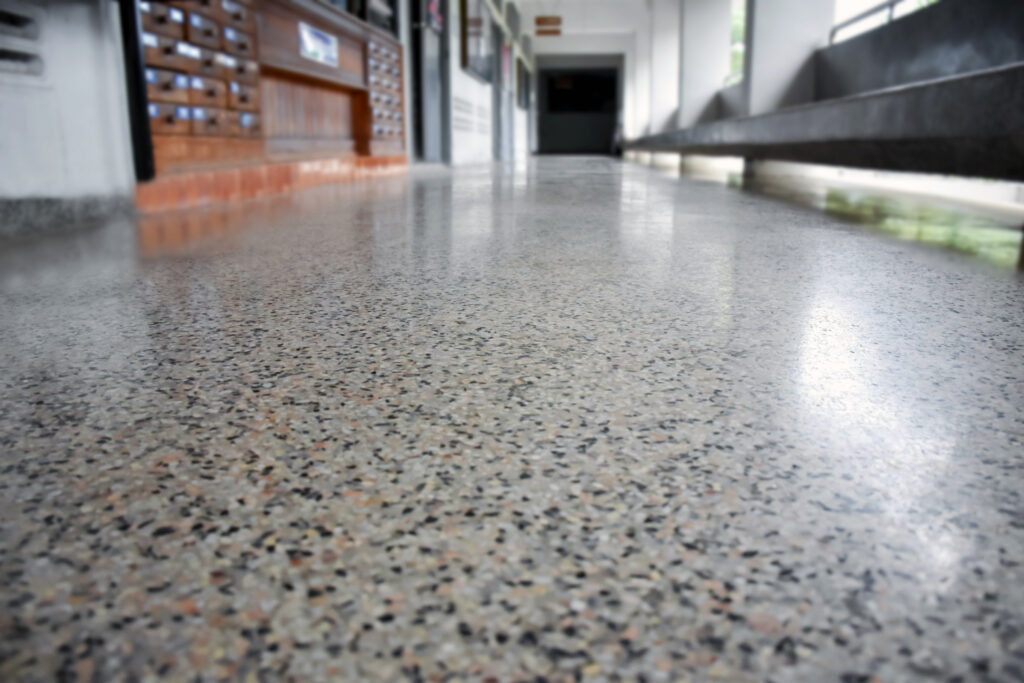
One common problem in architectural conservation is that, in repeated heavy traffic and/or high-use areas, such as hard surfaces and countertops, surfaces continue to exhibit streaks, inconsistent gloss, and a decline in overall surface performance. This is despite multiple attempts with increasing amounts of chemicals and aggressive cleaning techniques.
When all else fails, people often fall into what I call the “escalation trap,” a misguided cycle of increased agitation, longer dwell times, and harsher detergents. Unfortunately, the results of the “escalation trap” usually yield little to no improvement in appearance and a continued loss of surface functionality.
Most failures of cleaning techniques on surfaces are caused by a lack of understanding of the “science of sequence.” Conservationists use a process called stabilization to avoid this type of failure when treating surfaces.
Stabilization is an important and often misunderstood step in the surface care process. Stabilization establishes a scientific basis for treating the surface by determining the condition of the substrate, how the contaminant attaches to the surface, and the local environmental conditions before introducing a cleaning agent to the system. Once you transition your thought process from trial and error to a science-based approach to diagnosing a problem, you will stop trying to fight the surface and start influencing the molecular behavior of the system.
The following summarizes why most traditional cleaning sequences contribute to surface failure and how stabilization concepts can turn guesswork into reliable, professional results.
Takeaway 1: Your surface has a history
In technical surface care, there is a distinction between identifying a material, determining the type of substrate a surface is made of (marble, wood, etc.), and assessing the surface’s condition. Knowing the identity of a surface allows you to understand the designer’s intent and some basic characteristics of the surface.
Still, it is the condition of the surface, which is a function of history (wear patterns, past chemical treatments, and environmental damage), that is most revealing. While a surface may be properly identified as a certain stone, it may behave erratically due to years of damaged interfacial tension caused by the accumulation of residues.
To move beyond assumptions, the conservator needs to “hear” the substrate using three main diagnostic methods:
- Water droplet tests: Placing a small, controlled amount of water on the surface gives the conservator an idea of the material’s porosity and whether the surface still has a protective coating that functions properly, or if the substrate is exposed and absorbing.
- Directional lighting: Using directional lighting creates shadows on the surface, making visible inconsistencies in the finish, micro-abrasions, and repairs that would be difficult to see under flat, overhead lighting.
- Spot tests: Performing small-scale, inconspicuous tests to find out how the surface and the contaminant react to a cleaning agent before developing a complete cleaning protocol.
Understanding the condition of a surface is more critical than just knowing what type of surface it is, because it shows whether the surface is performing to its original specifications or has failed to the point that it should be restored rather than maintained.
The substrate tells you what you’re working with. The contaminant tells you what you are working against.
Takeaway 2: When the cleaner becomes the contaminant
Most likely, the major cause of “perpetual dirtiness” is the residual surfactant left behind by the cleaner. Almost all cleaners today use surfactants to remove soil, but if these surfactants are not completely rinsed off the surface, they do not vanish once the cleaning agent dries. Rather, they remain as an unevenly distributed film consisting of partially broken-down surfactants, binders, fragrances, and other polymers. When the surfactants dry, they become concentrated and reassociate themselves with the substrate through weak chemical bonds.
Surfactants create a molecular problem, not a mechanical problem. This film is typically hygroscopic, meaning it attracts moisture and particulate contamination from the air, binding the new contamination to the surface. Importantly, this film is chemically active; it will reactivate upon contact with water or other cleaning agents. When you clean a surface already coated with surfactant residue with additional cleaning agents, you are not cleaning the surface; you are reinforcing failure by adding more substance to the film and mobilizing the residue without a clear path for removal.
Takeaway 3: Stop scaling up, begin changing sequence

When a surface rapidly soils or continues to streak after cleaning, escalating the level of chemistry and agitation is a tactical mistake. Since the problem is a built-up film of chemical residue, the answer is to change the sequence of operations to focus on decontamination rather than traditional cleaning.
The answer is not stronger chemistry. The answer is sequence.
The correction process involves a drastic shift to “controlled decontamination” with the following criteria:
- Eliminate surfactant input: Do not introduce additional cleaning agents that increase the thickness of the film.
- Water as a transport medium: Use pure water only to mobilize existing residues. In this sequence, water is not a solvent; it is a medium for transporting residue.
- Prioritize physical removal and media turnover: Clean in confined areas and make frequent media turns, i.e., change rags or pads frequently. If a residue is mobilized but lacks a defined removal pathway, it will redistribute into low points, pores, and finish irregularities. The objective is to trap the mobilized residue before it evaporates and reassociates itself with the substrate.
Takeaway 4: The “wick-back” myth and subsurface migration
In porous substrates, such as stone, grout, and wood, or even in micro-abraded resilient flooring and deteriorated coatings, contamination will frequently migrate beneath the surface plane. This is where typical surface agitation fails. Because contamination is located where physical effort is being expended, scrubbing merely redistributes it.
This phenomenon is typically misinterpreted as “wick-back” or inadequate cleaning, but is more accurately referred to as “delayed migration.” As moisture moves internally due to variations in pressure and drying, the contamination will reappear at the surface.
To correct this, immediately reduce the water volume to prevent further moisture movement within the substrate and control the direction of drying. Since the direction of moisture movement dictates where the contamination will finally accumulate, both the initial mobilization of soil and the subsequent drying phase are equally critical to the sequence.
Takeaway 5: The hidden force of environmental variables
Technical surface care is influenced by an unseen array of environmental variables, including humidity, temperature, airflow, and even the presence of nearby materials. Chemistry is never isolated; it operates within a local environment that influences its effectiveness.
- Humidity: High levels of humidity slow evaporation and allow residue to be transported for longer periods of time and possibly into deeper layers of the substrate.
- Temperature: Affects the rate of reaction and viscosity of cleaning agents, thus affecting their interaction with the soil bond.
- Adjacent materials: The chemical compatibility of a tile is irrelevant if the cleaning agent damages the grout or metals adjacent to the tile.
- Air flow: Controls the velocity of the drying front, thereby controlling whether the mobilized particulate is successfully removed or simply redistributed.
Stabilization involves considering these factors first. Chemistry is often blamed for failure to consider the environmental conditions in which chemistry was applied.
From trial-and-error to control
Stabilization fundamentally alters the maintenance process by converting the first stages from “beginning the project” to “evaluating the system.” Stabilization enables control over the rate of reaction, movement, and outcome. By evaluating the condition of the substrate, the nature of the contaminant bond, and the environmental conditions surrounding the surface, you move away from the frustrations of trial-and-error and toward a consistent, professional standard.

Emily Dodds
Emily Dodds is the founder of Immaculate Collective, a leading material science educator and consultant dedicated to elevating industry standards through specialized material science training. She empowers professionals with the knowledge to preserve and protect surfaces at the highest level, transforming practices and raising the bar for excellence across the industry. She can be reached at [email protected].