Poor Tile Installation
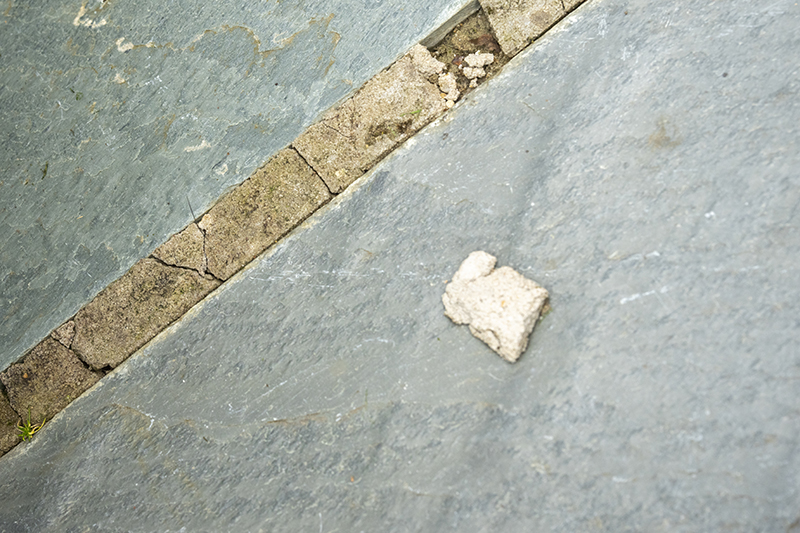
When we get a customer’s call about tile concerns, the most common issue is cracked or missing grout. In some cases, the grout may have started to crack within a few months or even years after the tile was installed.
If the cracked and missing grout is bad, more than likely, some tiles will have lost their bond to the thinset.
The homeowner will state that the installer blamed the grout, deflecting the blame. In some cases, to try to fix the issue, the installer will remove the cracked and loose grout and regrout the area. That may work for a few months, and then the grout cracks again. The consumer calls the installer once again, and the installer continues to blame the grout.
After further investigation, the issue has nothing to do with the grout or how the grout was placed; it has to do with how the tile was installed.
Cracking and missing grout
Grout cracking is the first indication that there is something wrong with the tile installation. Grout is the weakest link and will be the first thing to fail.
One important step that is often missed in tile installations is the use of movement joints (expansion spacing), which include soft joints every 25 feet in either direction. Picture an open floor plan kitchen/dining area and adjoining hallway. There needs to be a soft joint in the doorway to the hallway, which is a change of plane. The floor in the kitchen/dining area expands and contracts at a different rate than the hallway.
In showers, changes of plane are at the tub or shower pan, at the inside/outside corners, and in other areas, such as seats and niches. Color-coordinated silicone caulk is to be used instead of grout in those areas. Don’t forget that walls in homes and commercial applications move ever so slightly, and when they do, not if, the grout will crack if not installed properly.
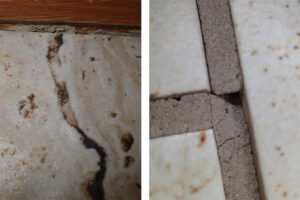
Grout in the expansion space can cause cracked grout in other areas.
Are you aware that grout has less compressive strength than drywall? And did you know the sheer strength of thinset is less than the compressive strength of drywall? Cracking grout can start in one area and affect only that area, or it can spread to the entire installation.
Tile needs to be able to expand and contract, especially when exposed to direct sunlight. Some years ago, I was asked to inspect the floor of a kitchen/dining area in a home where the tile floor had heaved. The homeowners said it sounded like a shotgun had gone off. This floor in a home in Northeast Ohio had been installed for years with no issues at all until January/February.
During my investigation, I found that the tile had been grouted in net to the drywall and thresholds to other rooms. I noticed a great deal of direct sunlight exposure on the floor. I looked out the south-facing windows and noticed stumps left in the ground from evergreen trees that had been cut down.
I asked more questions: When did you have the trees cut down? “In the fall,” they said.
In years past, have you ever had direct sunlight exposure on the floor? They said, “No, we love it.”
When the floor was installed, the installer did not leave the proper expansion space. The first time the floor received direct sunlight exposure, it generated enough thermal expansion to cause the floor to heave, having nowhere else to go. What feels like a minor change (cutting down trees) had a significant impact on the flooring.
Proper bonding
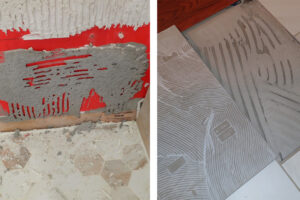
Poor thinset application, like these, can lead to cracked grout.
Poor tile installation can result from many factors. One is that the tile was not set properly. In this installation, the tile never bonded properly to the thinset because the beads of thinset overlapped. When this happens, air is trapped under the tile, preventing the back of the tile from properly bonding to the thinset. These installation failures do not just occur with tile on floors; they also occur with tile on shower walls.
Industry standards
A properly installed tile or stone floor will last a lifetime, provided industry standards and guidelines are followed during installation. These can be found in:
- American National Specifications for the Installation of Ceramic Tile, ANSI A108/A118/A136.1:2024.
- The Tile Council of North America (TCNA) Handbook for Ceramic, Glass, and Stone Tile Installation.
- The National Tile Contractors Association (NTCA) Reference Manual.
Cracked grout, while it can be corrected, does not address the underlying concerns of a poor tile installation. A poor tile installation will continue to degrade over time and continue to fail. This is especially of concern in a wet area like a shower, as water can get behind the tile and cause unseen issues, such as mold and mildew. If the shower was not waterproofed correctly, rot can happen on studs and joists.
Tile installation is almost as much an art as a skill. Good tile installers are worth their weight in gold.

Mark Violand
Mark Violand has been in the cleaning and restoration industry more than 40 years. He is an IICRC-certified carpet inspector and approved instructor. His reputation precedes him as Northeast Ohio’s go-to floor covering inspector, working for carpet, resilient, wood, and laminate manufacturers, and floorcovering retailers. He teaches the Carpet Cleaning Technician, Commercial Carpet Maintenance Technician, and Carpet Repair and Reinstallation Technician courses and serves as chairman of the ANSI⁄ IICRC S800 Standard and Reference guide for professional Inspection of Textile Floorcovering. Contact him at [email protected].