The Landscape of Floor Care: Why the Environment Dictates the Process
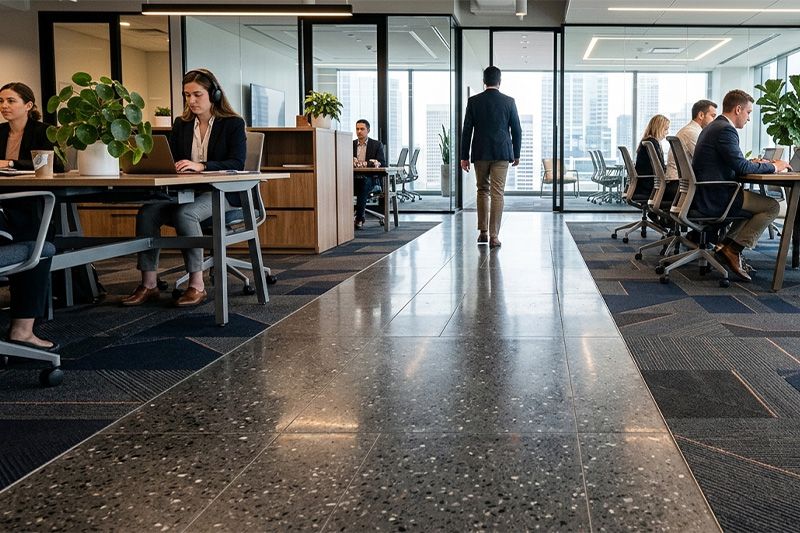
In the world of commercial floor care, people hold a dangerous misconception that a floor is just a floor. Whether you are looking at luxury vinyl tile (LVT) in a corporate corridor or sheet vinyl in a sterile hospital suite, the chemistry and the mechanics required to maintain them are worlds apart. I have found, over decades in floor care, that if you don’t respect the specific demands of the environment, you aren’t just cleaning—you’re likely accelerating the asset’s lifecycle failure.
To truly manage the care of flooring in a facility, you have to look past the surface and understand the “occupancy DNA” of the space. Regardless of the environment, every successful program is built on five core principles of cleaning. If you skip a step, you aren’t just being inefficient; you’re leaving soil behind.
The Five Pillars of the Cleaning Process
- Dry Soil Removal: This is the most critical step (on both soft and hard surfaces), yet it is most often skipped or rushed. Up to 75% of the soil in a building is dry particulate (sand, grit, dust). If you apply wet chemistry before removing this, you’re wasting chemistry. Chemistry is designed to work on the remaining 25% of soil, which are the binders that hold the soil to the surface.
- Application of Chemistry: This isn’t about more is better. It’s about the type with the right pH and the correct dilution for the specific floor type and soil load.
- Dwell Time: Chemistry needs time to work. You cannot apply and immediately remove. Dwell time allows the chemistry to work, whether it’s surfactants lowering the surface tension of the water or emulsifying oils and soils.
- Agitation: We need to mechanically assist the chemistry, breaking the bond between the soil and the surface. Whether it’s a cylindrical brush, a rotary pad, or oscillation, agitation supports the chemistry and ensures it reaches the entire floor’s texture.
- Removal (Extraction): Once the soil is suspended in the solution (or dried for encapsulation chemistry), it must be physically removed from the environment. If you apply chemistry and let the floor “air dry” with the solution containing the soil suspended in it, the soil simply settles back down, often more stuck than before.
1. Corporate: Managing the Expected Appearance
- The Approach: We focus on a service visit program designed around low-moisture cleaning. Because these spaces are occupied by people sensitive to noise, we prioritize Dry Soil Removal with high-efficiency vacuums during off-hours.
- The Technical (Carpet): Technology advancements in chemistry and equipment have shifted away from traditional hot-water extraction toward encapsulation technology, using systems like the fast foamer or other low-moisture systems. The ability to effectively clean triple the square footage while removing the same amount of soil—and returning the space to use in under 45 minutes—is what separates today’s floor care professional.
- The Technical (Resilient/Hard Surface): With the rise of LVT, rubber, and woven vinyl, maintenance must be adaptive. For natural stone, we have moved from “old world” powders to diamond-impregnated pads (DIPs), mechanically polishing the stone to maintain a beautiful shine without the need for restorative acrylic finishes.
2. Healthcare: Beyond Visual Cleanliness
- The Approach: Dry soil removal here must use high-efficiency particulate air (HEPA) filtration to prevent aerosolization of pathogens.
- The Technical: Dwell time is the king of healthcare. We must leverage chemistry to provide deep cleaning so that disinfection or sanitization can actually occur. Crucially, the final step in the disinfection process is removal. Without extraction, the cationic-charged surfactants found in most disinfectants build up, causing “sticky floor syndrome” on resilient surfaces and reverse saponification on carpet.
3. Hospitality: The “First Impression” Gauntlet
- The Approach: Because of the constant traffic, we emphasize high-frequency care.
- The Technical: In a hotel lobby, we might vacuum three to four times throughout the day and utilize encapsulation technology every evening. This provides high-production cleaning with a rapid return to service, ensuring the lobby never looks neglected.
4. Industrial: The War on Porosity
- The Approach: We move to heavy-duty mechanical scrubbing.
- The Technical: In large areas, the use of ride-on equipment to perform all five steps. The machine pre-sweeps, lays down chemistry, allows dwell time, uses large-format agitation (rotary or oscillation) with downward pressure, and then rinses with a squeegee vacuum for immediate removal.
- Preservation: We advocate reapplying coatings or densifier sealers as needed to protect porous flooring from deep-seated contaminants.
5. Retail: Combating the “Sandpaper Effect”
- The Approach: Daily Dry Soil Removal—multiple times a day during slow periods—via dust mopping or battery-operated vacuums is vital to keeping soiling at bay.
- The Technical: We use compact, self-contained equipment with cleaning solutions to agitate textured surfaces, keeping soil from micro-scratching the finish and dulling the store’s appearance.
6. Food Service: Greases are the Enemy
- The Approach: This is a battle requiring specific chemical degreasing.
- The Technical: We leverage chemistry to emulsify or digest the oils and greases. Dwell time cannot be shortened and often needs to be extended. Agitation is essential to suspension. Once suspended, I have found that a “Rinse and Remove single-step process via a portable extractor and hard surface wand is the most effective (and efficient) way to remove the slurry and finish the job, ensuring a safe, slip-resistant floor.
7. Education: The “Summer Reset” Strategy
- The Approach: The annual restoration is the ultimate expression of the five principles.
- The Technical: During the summer, a “strip and finish” is typically performed because periodic maintenance cannot be done. An appropriate pH-stripping chemistry, depending on the floor material being worked on, is applied, allowing sufficient dwell time to emulsify the old finish. Scrub with an appropriate level of aggressiveness, using either a pad or a brush, depending on whether the material is smooth or textured. Agitate and perform a rinse and removal. Always ensure the post-stripped flooring is pH-neutral, providing the correct foundation for the new finish application.
The Bottom Line

Bill Luallen
Bill Luallen, the technical director for XL North, a division of the Textile Rubber and Chemical Co., has more than 25 years of experience in the floor care industry. He is the IICRC Technical Advisory Committee (TAC) Chair of the Commercial Carpet Maintenance Technician (CCMT) Committee and participates on the CRI 204/205 Carpet Maintenance and Cleaning Standards. Contact Luallen at 401-633-4656 or [email protected].