How Bedside Manner Can Become Restoration’s Competitive Advantage

Insurance claims in the restoration industry have grown more complicated over the past decade, with more documentation, more layers of review, and less direct conversation between the people making decisions.
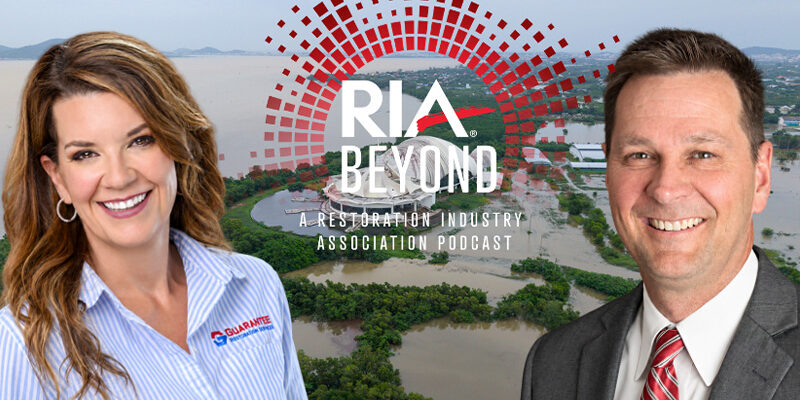
Heather Minnick, a business growth strategist with Violand Management Associates (VMA), said the shift is not unique to restoration—it is the same pattern she watched play out years earlier in healthcare, where she worked before joining Violand last year.
Minnick spent her early career at a physical rehabilitation hospital, working with patients recovering from strokes, heart attacks and other serious injuries. She said watching patients and their families struggle with insurance companies, and often fall through the cracks, is what eventually pushed her out of healthcare and toward a role where she could still help people.
She sees the same risk facing homeowners today if the restoration industry does not adapt.
Standardization drove the shift
Asked what has fundamentally changed in the insurance industry over the past decade, Minnick pointed to one word: standardization.
“The biggest change is definitely the standardization,” Minnick said. “That is exactly what I saw in healthcare. It starts from the top. They say that we need to control costs. It trickles down to everyone else. So, everyone on that side, the carrier side, the adjuster side, they’re doing a job just like we are.”
Minnick said that framing matters, because many restorers experience the added scrutiny as personal. “It’s harder because there’s a business, and that business is trying to control that cost, and they’re doing that any way that they can,” she said. “So, the way that they do that is through the standardization of these claims.”
She added that the frustration restorers feel is legitimate and even a sign of pride in their work. “You’re absolutely valid in feeling that way, because it is difficult, and it means that you genuinely take pride in your craft,” she said.
Technology should assist, not replace
Minnick was asked how the industry can balance data-driven oversight with practical decision-making in the field as more technology enters the claims process. She compared it to a step healthcare already took, when providers began sharing with each other the specific language needed to get a claim approved.
She pointed to Xactimate as an example restorers already understand. “Years ago, the insurance companies did similar to what they’re doing now, which is hire a third-party administrator to come in and move through those claims,” Minnick said. “That’s when Xactimate was born. We don’t hate Xactimate. We all like Xactimate. We just have to know how to use it properly.”
Minnick said the same principle applies to newer technology and AI tools entering claims handling today. “I don’t think it’s a leave-it-to-AI, set-it-and-forget-it type of technology,” she said. “I think there should still be the human aspect of those claims. There still needs to be someone moving through these things and making sure everything is correct. Technology should definitely be a resource, not a solution.”
Trust starts with education
Minnick said restorers can look to healthcare for a model of how to rebuild trust without sacrificing accountability. She noted that nurses and doctors consistently rank among the most trusted professions in the country, while restorers rank far lower.
“A doctor walks in and, for the most part, you just trust them,” Minnick said. “If you look at where restorers are on that list, it is very far from the top.”
Her recommendation is to treat homeowners the way a good clinician treats a patient. “Treat the homeowner as if they were a patient,” she said. “Treat them as if they were your family member that was going through a loss.”
Minnick said most homeowners are not looking for technical explanations so much as reassurance. “A lot of it is they just want to be heard,” she said. “They’re just frustrated. They’re scared. They have no idea what’s going on, and so many people are calling them that they don’t even know who to trust.”
She suggested restoration companies consider creating a simple one-page explainer for homeowners that lays out what to expect and why, similar to materials used in healthcare settings. Being upfront early, she said, builds the kind of trust that keeps a homeowner calling the restoration company first instead of the insurance carrier.
The bedside manner
Minnick said the comparison between restorers and doctors extends to how each profession communicates. “The adjusters have a job to do. We also have a job to do,” she said. “But we work for you—that’s where our contract comes in.”
She said a homeowner meeting a technician after a storm is often experiencing the same confusion and fear as a patient meeting a new doctor, and that a few minutes of honest explanation can change the entire relationship. Sitting with a homeowner, acknowledging the frustration of the process and explaining what the company plans to do goes further than any amount of paperwork, she said.
More structure is coming, not less
Looking five to 10 years ahead, Minnick does not expect claims handling to become less automated. She again drew on the healthcare timeline, noting that standardization initiatives there were piloted in a few states before becoming the norm nationwide.
“I don’t think it’s going to go away,” she said of the trend toward standardization. “I think technology is absolutely going to standardize a little bit more. Right now, we’re at a tough spot. We’re in a little bit of a growing pain here, because we’re sort of in the middle of them trying to
implement this standardization and figure out how that’s going to work with the new technology that we have.”
Still, she said carriers are recognizing the limits of removing people from the process entirely. “A lot of carriers are also seeing that they can’t remove that human component,” Minnick said. “There are truly too many moving parts, and these people are going through a loss, going through something severe. When you take that human component away, you’re going to make a lot of people upset.”
Minnick said the restoration industry’s best resource going forward will be the relationships restorers build with one another and with the homeowners they serve.
“I think the biggest asset we will have as an industry is truly each other,” she said. “If we keep advocating in the restoration industry for the homeowner, I think that we’ll find a happy medium of technology being used to help us move through these claims faster, but there should absolutely still be a human component to the review of those claims.”
Watch the complete interview or listen to the podcast

Jeff Cross
Jeff Cross is the ISSA media director, with publications including Cleanfax, Cleaning & Maintenance Management, and ISSA Today, as well as multimedia programs such as Straight Talk! and Take 5 With Cleanfax in video and podcast format. He can be reached at [email protected].