Inside RIA’s Fight for Restoration Recognition
For decades, restoration companies have filed their paperwork, bought their insurance, and reported their payroll under federal classification codes written for other industries. A firm doing fire and water mitigation can land under construction. A company handling mold remediation can get grouped in with hazardous waste and asbestos abatement. None of the standard North American Industry Classification System (NAICS) codes was ever built with emergency restoration in mind.
The Restoration Industry Association (RIA) is trying to change that. Working alongside the Institute of Inspection, Cleaning and Restoration Certification (IICRC), the association has formally petitioned the federal government to create a new six-digit code — 624231, Emergency Restoration Services — as part of the 2027 NAICS revision cycle. The request went to the Office of Management and Budget (OMB) in February 2025.
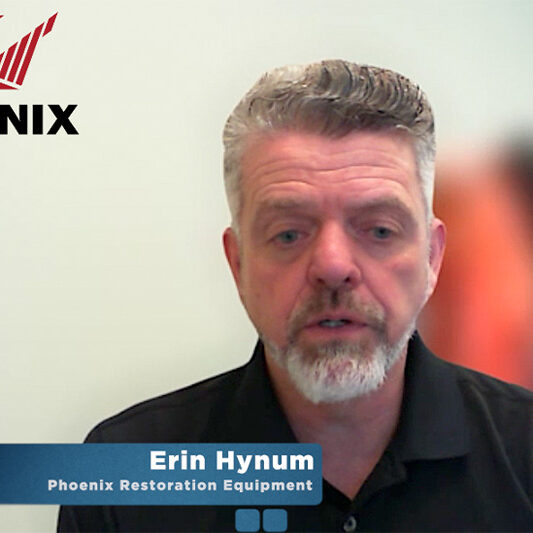
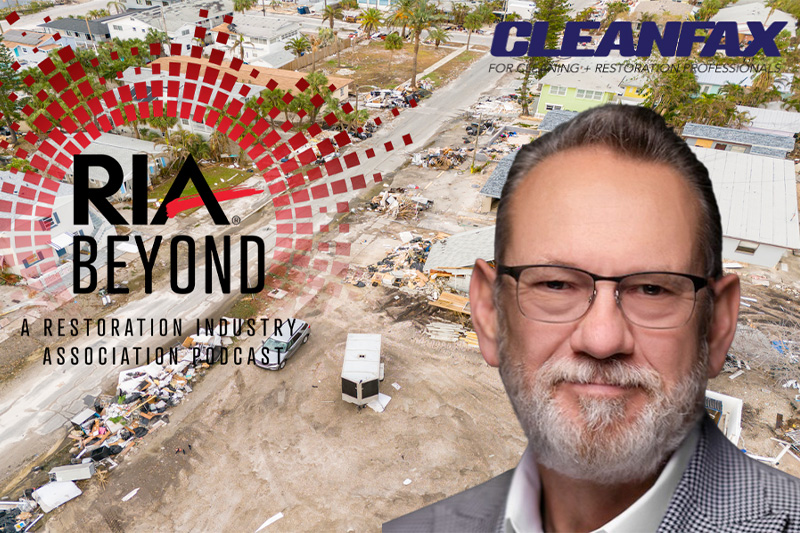
Darren Hudema, WLS, MTC, MFSR, MWR, director of training and technical services at PuroClean, has sat on the RIA’s NAICS Code Task Force since the effort began. He said the push grew out of a problem he hears about constantly in his other role as director of training for PuroClean, where new franchise owners are shopping for insurance for the first time.
“One of the first questions they get asked is, what NAICS code do you fall into? What kind of work are you performing?” Hudema said. “Some may do janitorial — well, there is a code for janitorial. Some may do carpet cleaning — well, there isn’t necessarily one for carpet cleaning, but it goes to the janitorial code.”
A classification gap shapes insurance costs
The mismatch goes deeper than paperwork. Fire and flood restoration of buildings currently falls under NAICS subsector 236, Construction of Buildings. Water extraction, microbial mitigation, and odor control often land under NAICS 562910, Remediation Services — a code built for Superfund and hazardous-waste cleanup, not disaster response.
Hudema said that distinction matters because it drives what business owners pay for general liability and workers’ compensation coverage. A mold remediation job, for example, can get priced against the risk profile of asbestos abatement, even though the two are governed by different standards and involve different exposures.
“All these different codes essentially start to affect business owners in the type of insurance they get, the cost of the insurance they get, the workers’ comp that they end up having to also get for their employees,” Hudema said.
Task force built its case with data
An application for a new NAICS code isn’t a quick ask. The Economic Classification Policy Committee (ECPC), which oversees NAICS on OMB’s behalf, requires any proposal to document a distinct production process, define the code’s relationship to existing six-digit codes, and provide data on the size and growth of the industry — along with whether Canada and Mexico should recognize it too, since NAICS is a shared North American system.
The task force spent more than a year building that case. Early on, members considered naming the proposed code “Emergency Mitigation Services” before a consultant’s research pointed them elsewhere: a review of 41 restoration RFPs from around the country found that clients consistently referred to the work as “emergency restoration services.” That became the name in the formal submission.
Hudema credited a group of volunteers for doing the legwork: Vince Scarfo, RIA’s director of advocacy and government affairs; Mark Owens; John Isaacson; Wyatt Cox; Alec Freed; Brian Edlin; and Vince Brockman, along with then-RIA CEO Kristy Cohen and RIA staff member Daniel Knights. James Toole, now president and chairman of the IICRC board, was also involved, as was Robbie Bradshaw before he moved on to a new opportunity.
To make the case for scale, the task force pulled figures from outside sources. The National Oceanic and Atmospheric Administration recorded more than $27 billion in weather-related disasters in the United States in 2024, and water damage was the highest-volume peril in homeowners’ claims that year, costing insurers more than $13 billion. Data from claims-analytics firms Verisk and Cotality point to roughly 2.7 million restoration-related claims annually. Yet because that activity is scattered across construction and waste-management codes, estimates of the industry’s actual size range anywhere from $7 billion to $200 billion — a spread Hudema said reflects how little reliable data currently exists.
Why the code matters for safety
Beyond dollars, Hudema pointed to worker safety as a core reason the industry needs its own code. Restoration technicians face hazards — contamination exposure, structural instability, fire residue — that don’t match the injury profiles of general construction or hazardous-waste work, the categories many restoration firms are currently grouped under for federal statistics.
A dedicated code would let the industry track its own injury and safety data instead of borrowing figures from unrelated fields, according to Hudema. That, in turn, could shape more targeted Environmental, Health and Safety programs and better inform the workers’ compensation risk pools restoration companies are placed into.
“These NAICS codes affect our employees directly,” Hudema said. “If that NAICS code is not in the right category, it’s going to drive the business owner’s insurance in a certain direction.”
A federal notice complicates the timeline
The path forward isn’t guaranteed. A Federal Register notice published July 13 showed that NAICS 624231 was not included among the ECPC’s recommended codes for the 2027 update. Under OMB’s published schedule, the ECPC’s final recommendations are expected to reach OMB by March 2026, with the revised NAICS structure taking effect in January 2027 — a process that includes another public comment period before anything is finalized.
That gap between the RIA’s request and the ECPC’s current recommendation is why the association and the IICRC are asking the industry to weigh in before the public comment window closes. Hudema was direct about what’s at stake if the industry doesn’t respond.
“Approval alone doesn’t just flip the switch,” Hudema said. “The benefit becomes real, but gradual, and it depends on the sustained outreach of both the restoration firms and the federal agencies — not just changing the rule but influencing it.”
What approval could open up
If the code is ultimately adopted, Hudema described a slower, cumulative payoff rather than an immediate one. A recognized code could give the industry a documented identity to build career pathways around, from trade school partnerships to apprenticeship funding, at a time when many companies struggle to explain what the job even involves to prospective hires.
It could also change how restoration firms interact with federal disaster contracting and Small Business Administration size standards, both of which currently sort companies by codes that weren’t built for the work they do. Hudema drew a comparison to NAICS 624230, Emergency and Other Relief Services — an existing code that covers organizations providing direct relief to disaster victims, but not the contractors who restore their property.
“We’re not guessing the size — we’re trying to determine the size, and make sure we’ve got the right data when it comes to what code we get put into,” Hudema said.
How to comment
To engage with this important project and be heard with your official comment, visit this document page, or go to regulations.gov, put USBC-2026-0133 in the search field, open the document entitled “Statistical Policy Directive No.8…” and add your comment there. You can type in or paste a comment, or upload a file per the site’s instructions.
Comment window closes soon
RIA and IICRC members have until August 12, 2026, to submit public comments on the NAICS proposal. Hudema laid out several steps restoration professionals and companies can take before then:
- Learn the number. Code 624231, Emergency Restoration Services, is the one the industry is asking OMB to adopt. If it’s published, plan to use it as your primary NAICS code.
- Keep safety records current. Clean OSHA logs and a tracked total recordable incident rate (TRIR) will matter once a code-specific data set exists to compare against.
- Get involved with RIA and IICRC advocacy efforts and stay on top of communications about the campaign.
- Talk with peers and competitors across the industry — the outcome affects the whole sector, not just individual companies.
- Submit a comment. Comments must go through regulations.gov and be tied to the correct docket rather than sent directly to OMB or the Census Bureau, which don’t count as official input. Hudema cited the relevant docket as USBC-206-013, under Statistical Policy Directive No. 8.
- Spread the word beyond your own company. Hudema said the effort reaches national brands — including Servpro, PuroClean, Belfor, BMS CAT, Blue Sky, Rainbow International, Restoration 1, Polygon, and Voda — as well as the private equity firms that increasingly own restoration companies and the commercial properties they service.
RIA is tracking participation directly, according to Hudema, and has said it wants to know not just how many members intend to comment, but how many actually do.
“The industry doesn’t have accurate data about itself yet,” Hudema said. “Owners, employees, investors, equity holders all have a reason to comment, and the reason is the same one.”
Restoration professionals who want to learn more about the task force’s work can contact Vince Scarfo at [email protected] or visit restorationindustry.org.
Watch the complete interview or listen to the podcast

Jeff Cross
Jeff Cross is the ISSA media director, with publications including Cleanfax, Cleaning & Maintenance Management, and ISSA Today, as well as multimedia programs such as Straight Talk! and Take 5 With Cleanfax in video and podcast format. He can be reached at [email protected].