The High Cost of ‘Lost in Translation’
In the world of commercial floor maintenance, we spend a lot of time discussing chemistry, agitation, and dwell time. But one tool is just as critical as any low-moisture machine or high-performance coating: the dictionary.
Serving as technical director at XL North for close to twenty years, I have seen it happen a thousand times. A manufacturer specifies a process, a contractor executes what they think they heard, and a facility manager (FM) is left with a floor that doesn’t meet expectations. Most of the time, failure isn’t due to a subpar product; it’s due to a breakdown in language.
The “clean” disconnect
Take the word “clean.” It sounds simple, right? But look at how the perspective shifts:
- The manufacturer: Defines “clean” as the complete removal of foreign contaminants without compromising the physical integrity of the material.
- The contractor: Often sees “clean” as a visual result—removing spots and traffic patterns so the client is happy during the walk-through.
- The facility manager: Defines “clean” as a sanitized environment that smells fresh and protects their capital investment for the next decade.
If the FM wants longevity but the contractor is chasing a visual “pop” with aggressive chemicals, the floor might look great on Friday, but its lifespan will be stripped away by Monday.
Manufacturer’s spotlight: The shift from finish to factory coating
Jim Toth Jr., corporate care and support specialist with Mannington Commercial, noted that this linguistic disconnect is further complicated by a massive shift in how floor coverings are manufactured today. In the past, the flooring manufacturer was “sidelined” in maintenance conversations.
“Historically, most hard surface flooring—such as vinyl composition tile (VCT), wood, and terrazzo—relied on applied finishes,” Toth said. “Because of this, the focus of cleaning and maintenance was rarely on the flooring itself. Instead, it centered on maintaining the finish layer applied on top.”
According to Toth, this created a culture in which cleaning practices were shaped by chemicals, equipment, and pad manufacturers rather than by the people who made the floor. However, the introduction of factory-applied coatings has changed the stakes of the conversation:
- Integrated performance: Most factory-coated floors do not need a temporary finish; they have a coating that is an integral part of the product.
- Engineered precision: Modern urethane systems are engineered for specific wearability, sheens, and coefficient of friction.
- The risk of tradition: Using “traditional” aggressive pads or coatings on these advanced surfaces can unintentionally compromise the floor’s longevity and appearance.
The takeaway is clear: Aligning your vocabulary with the flooring manufacturer’s guidelines is no longer optional; it is the only way to ensure the product performs as promised.
A contractor’s perspective: Why intent isn’t execution
Jason Ruppel, national technical manager with SOLID Surface Care Inc., pointed out that this breakdown is where the most significant field issues begin:
“Most of the time, the issue isn’t execution; it’s that everyone involved thought they agreed on the scope but didn’t,” he explained. “Terms like ‘deep clean,’ ‘polish,’ or ‘maintenance’ get interpreted differently.”
Ruppel noted several common high-stakes examples:
- VCT: “Stripping” vs. a simple scrub and recoat.
- Terrazzo: “Polishing” meaning intensive diamond work vs. applying a topical coating.
- Scope creep: “Deep clean” being used to describe anything from routine maintenance to full restoration.
The maintenance and warranty trap
Another culprit is “maintenance.” To a manufacturer, this is a rigid, scheduled frequency required to uphold a warranty. To an FM, it’s often a budget line item that gets squeezed.
As Ruppel observed, “If the terminology being used in the field does not match how the manufacturer defines the process, you end up outside of spec. That’s where warranties get put at risk.”
Steve Starcher, technical support for MilliCare Franchise and vice chair of the IICRC-S-250, emphasized that the right words are a professional safeguard: “Clear communication with the correct word choices… can prevent lost profitability when a return trip to correct a miscommunicated situation is the unintended consequence of those choices.”
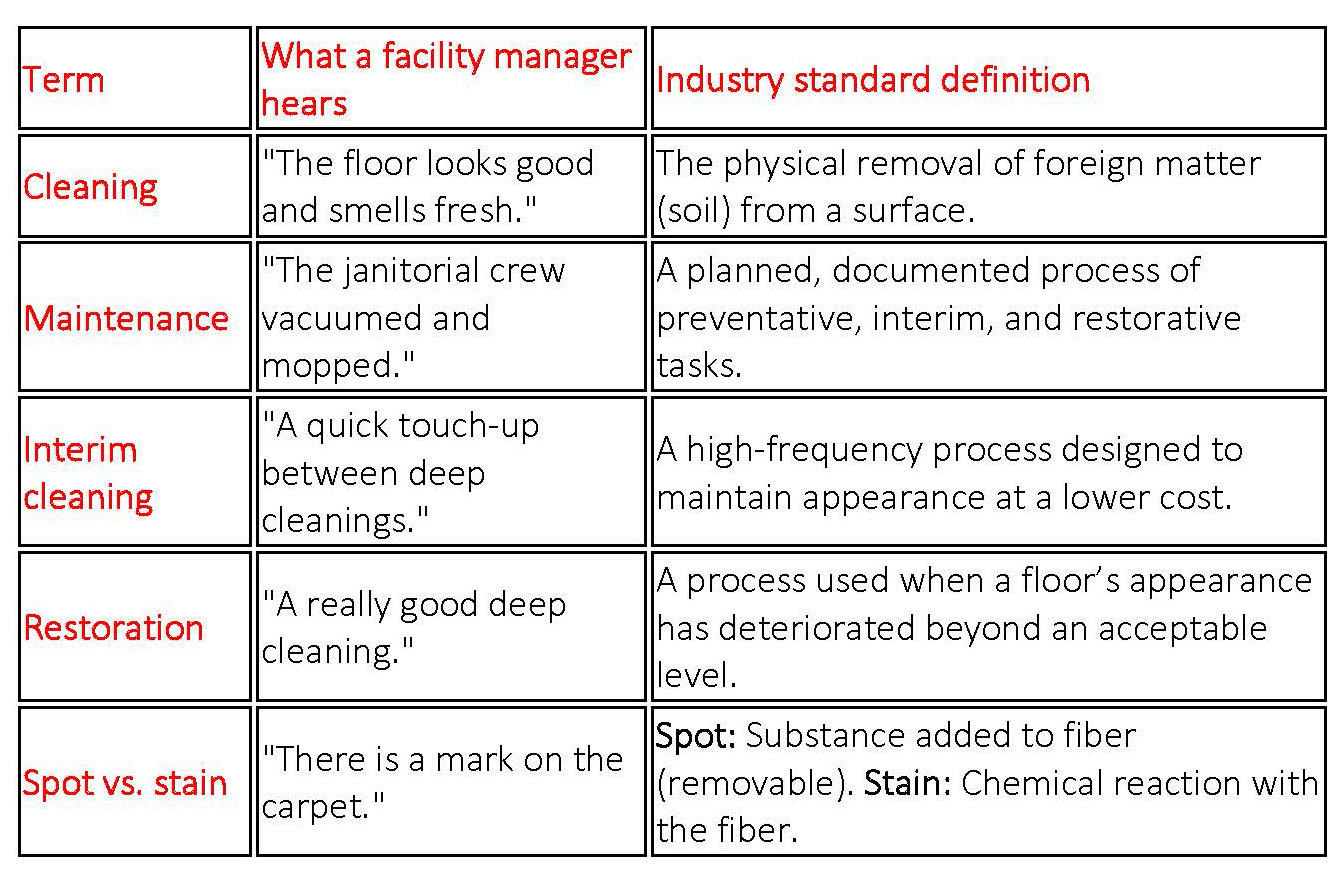
Industry terminology vs. common perception
Precision yields performance
To eliminate the “gray areas” where reworks and shortened floor life exist, follow these three steps:
- Standardize the vocabulary: Before a drop of water hits the floor, ensure everyone agrees on definitions for restoration, interim cleaning, and scrub/recoat.
- Align expectations: If an FM asks for a “shiny” floor, clarify whether they mean a high-gloss topical finish or a mechanically polished surface.
- Document the “why”: Explain to crews why the specific terminology in the spec—especially regarding factory coatings—matters to the long-term health of the floor.
We can have the best chemistry in the world, but if we aren’t communicating clearly, we’re just making a mess. As Jason Ruppel concluded: “The failure usually isn’t the product; it’s that everyone meant something different when they used the same word.”
Let’s start using our words as carefully as we use our chemicals.

Bill Luallen
Bill Luallen, the technical director for XL North, a division of the Textile Rubber and Chemical Co., has more than 25 years of experience in the floor care industry. He is the IICRC Technical Advisory Committee (TAC) Chair of the Commercial Carpet Maintenance Technician (CCMT) Committee and participates on the CRI 204/205 Carpet Maintenance and Cleaning Standards. Contact Luallen at 401-633-4656 or [email protected].