When AI Guesses Wrong, Floors Pay the Price
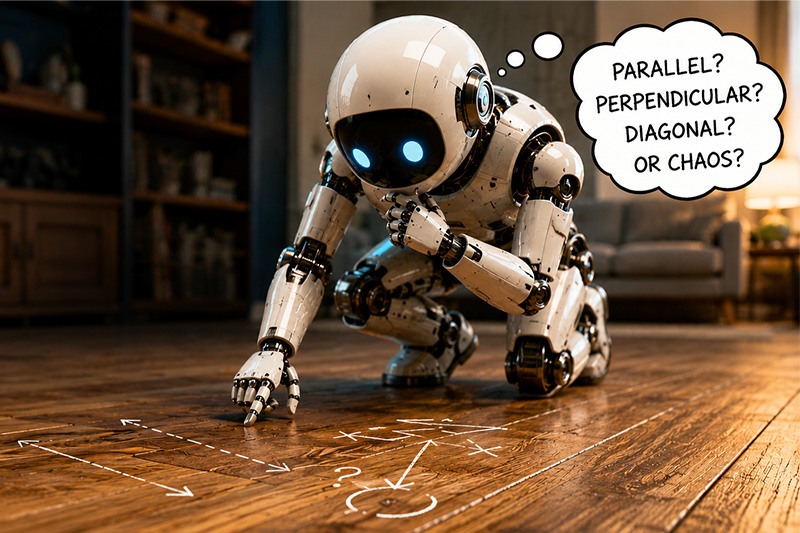
Just how smart is artificial intelligence these days? It depends on whom you ask. And when it comes to resilient flooring, AI may not be as smart as some people think.
That was the starting point for a recent Cleanfax conversation with three floor care professionals who have watched confident, incorrect AI advice creep into their world: Bill Luallen, technical director for XL North and an IICRC instructor; Andy Bayler, maintenance and care specialist for flooring manufacturer Tarkett; and Steve Starcher, franchise advisor and technical support specialist for MilliCare. Together, they have decades of hands-on experience, a long list of IICRC certifications, and a growing pile of stories about floors damaged because someone trusted a screen over a specialist.
Their message is not that AI has no place in floor care. It is that AI, used without verification, can turn an educated guess into an expensive mistake.
Generational knowledge is leaving the industry
Luallen traces the problem to a shift he has watched accelerate over the past five or six years. Customers and random callers find him, Bayler, and Starcher with questions about flooring, and the situation is almost always the same.
“They look something up online,” Luallen said. “They believe that they might have this type of flooring or that type of flooring. They snap a picture. AI says, oh, it’s terrazzo, or oh, it’s this. And what happens is that they go through the recommended process that AI might share, and they don’t get the results they want, or they sometimes damage it.”
The deeper issue, he said, is that the people who used to answer those questions are retiring. “That generational knowledge, it’s leaving us,” Luallen said. “Go ask Tom, you know, and he’ll tell you what that flooring is and how to maintain it. He’s gone. And so now we’re left with a really big void.”
The generation entering floor care is tech savvy, Luallen noted, so rather than ask a colleague or do the research, they go straight to a search engine or an AI tool—and they assume a lot.
Confident answers, real damage
Bayler has seen a sharp uptick in do-it-yourself research over the last six to eight months, with end users acting as their own internet doctor instead of contacting the manufacturer. The results, he said, can be costly.
“We’ve got folks using window cleaner to try to get carpet stains out, hardwood floor cleaner and polish to clean resilient materials with, and then heavy-duty degreaser to clean rubber flooring with,” Bayler said. “And each one of those poses its own unique problems.”
In each case, he added, the AI recommended a specific brand, which raised a flag. “That leads me to believe that maybe there’s no brand neutrality in the AI,” Bayler said. “There’s probably somewhere somebody is paying for product placement into the AI suggestions, whether it’s the right chemistry or not.”
None of those products are approved by the IICRC or the Carpet and Rug Institute, Bayler confirmed. One caller told him the window cleaner suggestion made sense because of a movie. “My Big Fat Greek Wedding, where the dad in that show didn’t matter what the problem was, he was going to solve it with Windex,” Bayler recalled. “He was like, it just made sense because I had seen, you know, in pop culture, the use of Windex for so many different things.”
Bayler’s unspoken response captured the gap between confidence and chemistry. “Is it made of glass? Is your carpet made of glass? Of course it’s not. Why would you use glass cleaner on it?”
Starcher framed the pattern more broadly. “We seem to now skip tried and true methods for help and assistance,” he said. When he talks to people who have been led astray, he added, “I find that there’s been no consultation into the sources that were used.”
Why resilient flooring fools AI
Resilient flooring is uniquely difficult for AI to identify, Starcher said, and he pointed to three reasons. The first is mimicry. “Most resilient flooring that’s currently popular typically mimics hard surface flooring,” he said. Even experienced technicians can be fooled by sheet vinyl that looks like marble. “That mimicking aspect makes it difficult in the field, let alone using pixels on a screen.”
The second reason is that the mimicry extends within the resilient category itself, with rubber tile resembling vinyl tile. “You have two products that require different processes, different materials, different chemicals,” Starcher said, “and the mistake has been made within the resilient category itself.”
The third problem is language. Terms like resilient quartz tile or hybrid terrazzo can send a search “down an even worse path,” Starcher said.
Bayler offered a recent example. Someone caring for a resilient material with terrazzo in its name asked AI how to maintain a terrazzo floor, then bought diamond pads to grind, hone, and polish it. “That ended up obviously resulting in a lot of damage to that material,” Bayler said, “and you can’t go back from that, unfortunately.”
Luallen said Starcher hit the nail on the head: words matter. Manufacturers build to ASTM standards, he explained, and renaming or remarketing a material does it a disservice from the architectural specification all the way through maintenance. “People don’t understand what they actually have in their hands.”
Lost in translation
AI translation creates its own hazard, Bayler said. In cases where a custodian received correct English maintenance instructions, then ran them through an AI translator into another language, the output did not match the original.
In one recent instance, a Russian translation left a technician baffled. “Sorry, boss, this does not make any sense to me,” Bayler recounted the worker saying. “Maybe I would be better off reading the English version.”
Tarkett offers a vetted, human translation service rather than relying on a scan-and-hope approach, Bayler said, with output reviewed for legal accuracy. A bad translation, he warned, could lead a technician to damage a floor or do something dangerous.
No one to take responsibility
For Luallen, one of the sharpest distinctions between AI and a professional is accountability. He cited a recent case involving a calcite-based natural stone that was misidentified, leading a contractor to use an acid that caused damage while removing soap scum and efflorescence.
“There is nothing, there’s no responsibility taken by AI,” Luallen said. “If one of us makes a recommendation on a situation, we’re owning that response. There’s nobody to back up one of the AI software programs. It’s like, yeah, well, you did it. And there’s a problem now. Better luck next time.”
Bayler compared overreliance on AI to confirmation bias at a casino. “You may gamble with AI a few times and get it right and think, well, this is just foolproof and just keep going on down the road,” he said. “There needs to be a human element. There needs to be stopgap measures to prevent potential catastrophe in some cases.”
Garbage in, garbage out
Sometimes the AI is not entirely to blame, Starcher said. The prompt matters. He offered a real scenario: asking whether to polish a floor. “It could mean applying an acrylic floor finish to a floor, or it could be the mechanical action of making a floor shiny,” he said. Pair an ambiguous word like polish with a misidentified image, “and now you’re creating a really nasty brew of problematic situations.”
Bayler pointed to industry shorthand as another trap. A 175-rpm single-disc rotary floor machine is a “175” to him, but elsewhere it is a swing machine or a side-by-side. “Does AI really understand that all of those different terms might mean one specific thing? And I doubt it at this point in time,” he said.
Does AI belong in the toolbox?
Despite the cautionary tales, all three see a role for AI as a support tool. Luallen uses it to check grammar and sentence structure when he writes, and he finds it can produce decent protocols. But its limits are fundamental.
“What it can’t do, and this is the most important thing, it can’t touch the floor. It can’t physically see the floor,” Luallen said. “It has no sense of smell, and most importantly, it doesn’t have any curiosity.”
Curiosity, he said, is what industry expert mentors Stan Hulin and Bob DeWeese taught him was essential to building a craft. “You have to educate yourself, but also, why is something happening? And AI doesn’t do that.”
Starcher, who used AI to help build a presentation about being cautious with AI, sees a tool the industry has barely begun to understand. “I don’t want anyone to think that I’m standing here going, don’t ever type anything in and use a prompt to help you,” he said. “What I’m saying is, for now, we need to keep the human element there.”
He also flagged two moving targets: the same model can give different answers hours apart, and hallucinations are becoming more apparent as the technology evolves. “We just need to get better with it,” Starcher said, “not get rid of.”
A warning for the next generation
Bayler, the father of 20-year-old twin sons, worries that younger technicians may treat a device as a security blanket and accept first-glance answers as gospel. His prescription is to blend AI with institutional knowledge.
“Pin him down for a lunch sometime and say, Tom, how do you do X, Y, and Z,” Bayler said of the veteran nearing retirement. “There are three sides to every story. There’s your side, there’s my side, and then there’s the truth. And somewhere in the middle of all of that is going to be some accurate information.”
Striking the right balance
AI tools may be cheaper than people, but Starcher cautioned against treating them as a substitute. “Don’t stop your current training program. Don’t stop getting IICRC certifications,” he said. “Don’t expect the AI right now to be a substitute for what you’re currently doing that’s successful.”
He also urged companies that pay for premium AI versions to put those tools in their technicians’ hands rather than leaving field staff on free versions. A paid business version, the group noted, can be trained on a company’s own input and learn over time instead of starting over with every question. Still, the limits remain physical: AI cannot perform a burn test to confirm whether a fiber is nylon. “That’s coming,” Starcher said. “It has to be.”
Trust, but verify
Luallen’s closing advice for contractors and facility managers came back to fundamentals. “It starts with training,” he said. “We all here on this call have got a lot of scar tissue. You need to be able to trust but verify. And the only real way you can trust the information that you’re receiving from AI is have some verification behind that. And that’s your training. That’s your practice.”
He compares the work to a profession. “Doctors, they have a practice. Lawyers have a practice. We’re professional floor care providers, and we really should be practicing our craft on a daily basis.”
In his resilient floor classes, Luallen shows a single image and asks students to distinguish a homogeneous vinyl, a heterogeneous vinyl, a homogeneous rubber, a homogeneous sheet rubber with a coating, and a quartz tile that all share basically the same pattern. The point lands every time.
“You have to have more than just an image to figure that out,” Luallen said. “You have to have a little scar tissue, a little basic knowledge.”
AI is going to be used—there is no stopping it. The challenge, these experts agree, is balancing a powerful tool with the human curiosity, hands-on judgment, and accountability that no algorithm can replace. Until a model can touch the floor, smell the chemistry, and own its mistakes, the experts behind the floor remain the final word.

Jeff Cross
Jeff Cross is the ISSA media director, with publications including Cleanfax, Cleaning & Maintenance Management, and ISSA Today, as well as multimedia programs such as Straight Talk! and Take 5 With Cleanfax in video and podcast format. He can be reached at [email protected].