
The 2015 Restoration Industry Leaders Review

| RENUE SYSTEMS |
|
|
| NEW CRYSTAL RESTORATION |
 Six decades ago there was no one in the New York Hudson Valley for victims of disasters to call on in their time of need. There simply was no one to turn to when the laundry room flooded or the attic fire was out.Enter New Crystal Restoration of Westchester County, NY.Opened in 1960 by Louis Cordasco, Crystal has always focused on being more than just a business and has devoted its efforts to helping the people in its community.Servicing the NY Metro area, it offers 24/7 emergency fire and water damage restoration, mold remediation and asbestos abatement services with a 15-person core staff and an expanded team of more than 50 when needed.Family legacy Six decades ago there was no one in the New York Hudson Valley for victims of disasters to call on in their time of need. There simply was no one to turn to when the laundry room flooded or the attic fire was out.Enter New Crystal Restoration of Westchester County, NY.Opened in 1960 by Louis Cordasco, Crystal has always focused on being more than just a business and has devoted its efforts to helping the people in its community.Servicing the NY Metro area, it offers 24/7 emergency fire and water damage restoration, mold remediation and asbestos abatement services with a 15-person core staff and an expanded team of more than 50 when needed.Family legacy
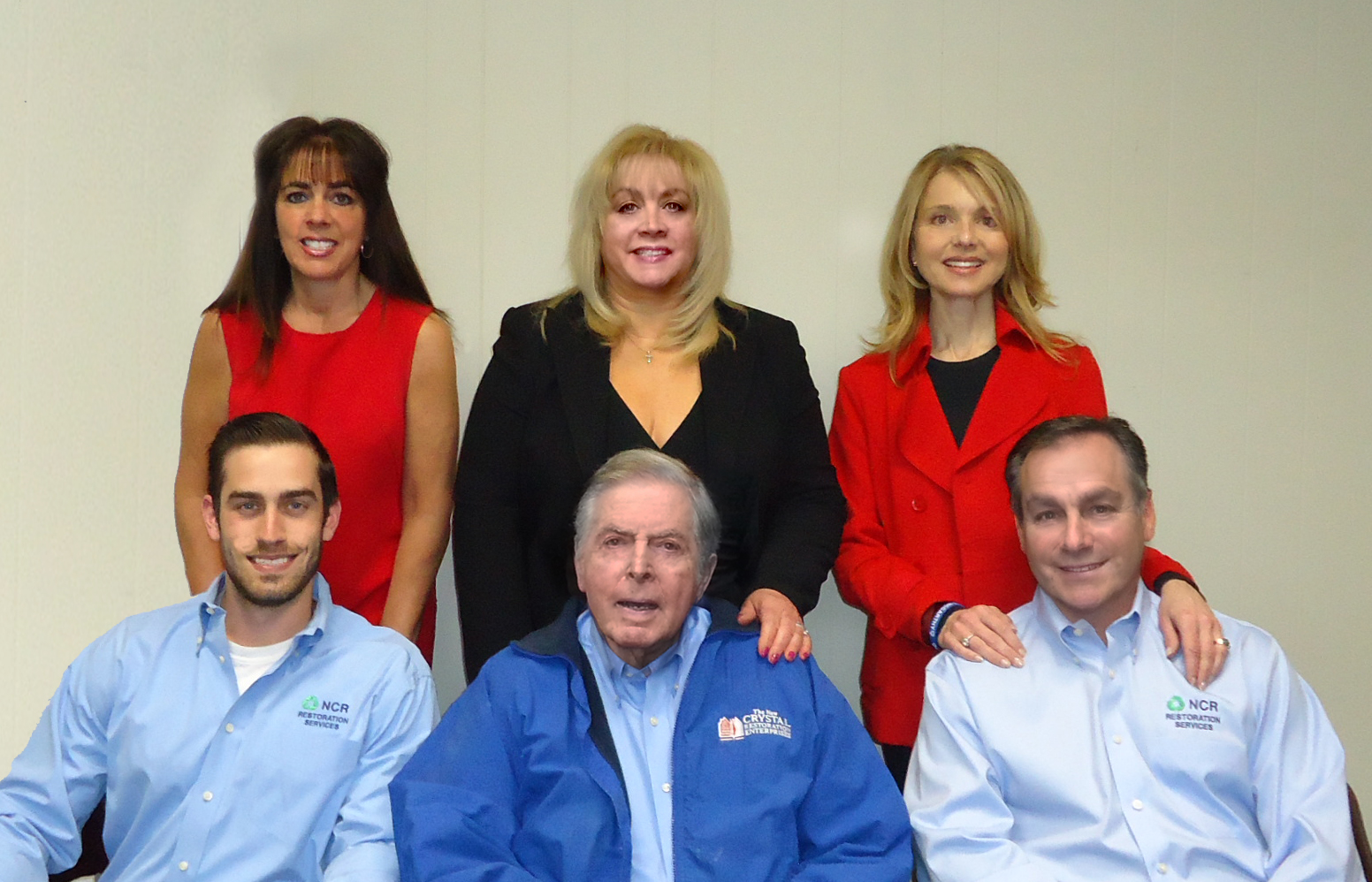 The New Crystal Restoration family team. Lisa Cordasco grew up in her father’s business, where he did most of the cleaning himself, and saw how the company’s work helped turn disasters around for people. She says, “Growing up in a family business I heard stories around the dinner table of the company’s trials and tribulations, and it made a lasting impression that my dad did more that save property. [He actually] helped people in their hour of need.” After choosing a different career path at first, Lisa Cordasco returned to the family business after giving birth to a special needs son. “My dad offered me a position in sales, so I jumped at the chance nearly 20 years ago and never looked back,” Lisa Cordasco says. “I learned by listening as to what customers, companies and the insurance industry wanted in a restoration company, and I committed to delivering such.” In 2008, when Louis Cordasco decided to retire, Lisa Cordasco took the helm and saw a chance to send the company in a progressive direction. “I had an opportunity as the second generation in the business to run things my way,” she explains, and her changes have brought substantial growth to the company. A new path Lisa Cordasco’s “way” included making New Crystal Restoration the first restoration company in the Hudson Valley to go completely green, which stemmed from experiences with her autistic son, who has adverse reactions to chemicals, odors and harsh products. “I decided that I would break out of the traditional box and not use the toxic products, which are the gold standard of most restoration companies,” Cordasco says. The switch has been very good for business. The company is now a multi-million dollar business with sales up by 47 percent last year. New Crystal Restoration sees customers’ choices in restoration companies like this: “Our prices are comparable to those charged by companies who use toxic chemicals, so why not go green? If you could eat organic food for the same price as pesticide-laced foods, what would you select to eat?” Holding their own Despite the success the company has seen since its creation and again after its reinvention, Crystal still has to work to keep a foothold in its market, especially up against franchised restoration companies with the ability to launch large-scale advertising campaigns and comes with a certain amount of brand recognition.
Cordasco says Crystal has the ability to “customize responses and services” because it is an independent company, which she feels allows them the maximum flexibility needed to help out in times of disaster. “We would like to get the message out that, although we are not grand in size, old world values like dependability, consistency of workmanship and dedication are valuable commodities when choosing a restoration company,” Cordasco adds regarding its future plans. The company currently is working on expanding even more and is specifically concentrating on helping special needs members of the community. “We are hoping that since we are knowledgeable about the autism and special needs communities, when that population needs restoration services they will select New Crystal Restoration since we can accommodate them better because of our green products and familiarity with their challenges.” Not just a business “I too share the belief my father held that what we do every day is more than a pay check; it’s a way to make families and business whole again, and that’s important work,” Cordasco stresses. Crystal has always made an effort to go beyond simply providing a service in the area. It sees the inherent philanthropy involved in restoration work. “What I like most about what we do is that we professionally and compassionately help those in a disaster,” shares Cordasco. “Each client is special. Their project is more than just another job, so we do and must remember each and every day to give it our all so that we can make what is a horrible experience into a pleasant one.” Given the chance, Cordasco says she wouldn’t do anything differently in developing the family business. She has the perfect team of employees who enjoy working with one another and “believe that united we are strong, and if we make a difference in the lives of the property owners we service, we are doing something right.” The Cordasco family’s belief in the work it does and devotion to the people around them will continue for the foreseeable future, as the company recently added a third-generation family member to its staff. Cordasco says, “My advice [to other restoration owners] is to be yourself; be true to who you are; and don’t ever forget that your clients are in distress, requiring a combination of professionalism and empathy.” |
| RAINBOW INTERNATIONAL OF NORTHEASTERN
MARYLAND
|
 Jay Van Deusen spent nearly three decades honing his design-build remodeling skills with his construction company before venturing into the unknown restoration market.But in the five years since he began Rainbow International of Northeastern Maryland, he’s flooded himself with the skills necessary to be successful in the industry.Come about Jay Van Deusen spent nearly three decades honing his design-build remodeling skills with his construction company before venturing into the unknown restoration market.But in the five years since he began Rainbow International of Northeastern Maryland, he’s flooded himself with the skills necessary to be successful in the industry.Come about
 Jay Van Deusen (second from left) with part of the Rainbow International staff who serve the Northeastern Maryland area. After 27 years as a construction company owner, moving into the restoration industry wasn’t a decision Van Deusen took lightly. “[The construction company] was trending down in job size with the downturn of the national and local economy,” he says. “A fellow remodeler from Kentucky suggested I get with Rainbow International.” Van Deusen found what he learned about the industry, especially fire restoration and contents, intriguing, and he liked the idea of learning an entirely new industry. But the move wasn’t immediately easy. He says, “I had a hard time trying to blend the numbers of construction and mitigation together.” But in the end, he found pairing a restoration company with his existing construction company just made sense. “Flood it, we will extract it, dry it and make it ready for reconstruction. Need reconstruction? That is our specialty! (Sounds like Bob the builder, but it was a good fit, with good reason!)” Weigh anchor Van Deusen decided it was the time to get into the market. He looked into different franchises, but ultimately chose to move forward with Rainbow International. The company now covers an approximate 780,000-person territory and has a 15,000-square-foot facility boasting a new 10,000-square-foot warehouse and contents processing area. Things began fairly small back in 2008 doing about $600,000 in mitigation sales, and now the company specializes in contents restoration, but also does about half its work in water losses and mold remediation. Van Deusen says his company is small — running “lean” with only four techs, a part-time CSR, a part-time office manager and a bookkeeper, as well as a BDA and Van Deusen who performs management and sales duties — but growing — the company expects to do between $1.1 and $1.3 million in sales this year. Moving forward, Van Deusen he’s focusing on reaching out to claims agents who really want to work for their insured during the claims process. “I refuse to stuff candy in jars and put magnets and paper cubes on agents’ desks,” he shares. “Instead, why couldn’t we partner and help build [the agents’] business and mine by referring work.” In the bilge “It has not been a golden path and we have had our minor bumps, but I have no regrets about getting into this business. It is very different than what I thought it would be,” Van Deusen confesses. The first major hurdle entering the industry was the sheer amount OF knowledge and training needed to be successful — the “acronym game” as he jokingly refers to it. “[You start] out with IICRC where you need to get your WRT, ASD and then your AMRT, followed shortly by your FSRT and ORT. Then you learn about TPA’s and FNOL, and move out from there,” he says. “But really, I loved taking on a whole new stream of knowledge.” Another issue Van Heusen has struggled with in the industry is unscrupulous business practices and pricing, explaining, “One of the things people said was great about this industry (as compared to remodeling or construction) was there are ‘barriers to entry’ — it is damned expensive to buy trucks, buy equipment, hire employees and purchase what we need to get the job done… But I still see people who operate in an unprofessional, price-only mode.” Van Deusen says restorers have to act as advocates for the insured, going beyond the expected and step in “when the adjuster is not being fully compliant with a standard not being met, educate the client about what he or she should fairly expect, and work with the insurance company to be sure we get paid for the work.” Sea chantey When asked what he likes most about the industry, Van Deusen says jokingly, “I think this is where everyone says they love helping folks.” Then he turns more serious. Like others in the industry, Van Deusen doesn’t take the job of a restorer lightly. “We have the chance to really help folks put their lives back together by first helping them through the steps of the loss and acting as a source of information and direction and ultimately holding on to their items (huge amount of trust placed there) and restoring them to pre-loss condition,” he shares. For those without sea legs Van Deusen says he has a list of things he either wishes he would have done more or less of to share with others. More: Being merciless on collections; setting financial goals and adjusting based on numbers; being the salesman; mentoring employees; praising employees and others. Less: Being critical before complimentary; being only focused on business in discussions with employees; worrying about the cost of education; taking care of himself and spending time with his family; bringing balance to work life. He recommends, “Do a staff meeting… and talk like a pirate with one eye. Arr.” Van Deusen also offers more concrete advice to new owners: Educate, get smart and share your experiences. He says, “One of the things I want to bring to this industry is to get involved — we spend all of this money on credentialing and professionalism, and then lock ourselves inside of our territory, never to share it again, afraid it might come back and bite you.” Van Deusen recommends classes, both credited and non-credited (especially non-credited). Gaining and sharing knowledge is so important to him, he’s set up an education facility in his newly built facility, not just for his employees, but for anyone who wants to learn. “This learning approach works well for those we are getting referrals from too. This makes us the professional we are in their eyes,” Van Deusen adds. “It helps in getting them, too.” |










 Loading ...