Restoration Efficiency and Profitability: Managing the Decisions That Drive the Outcome
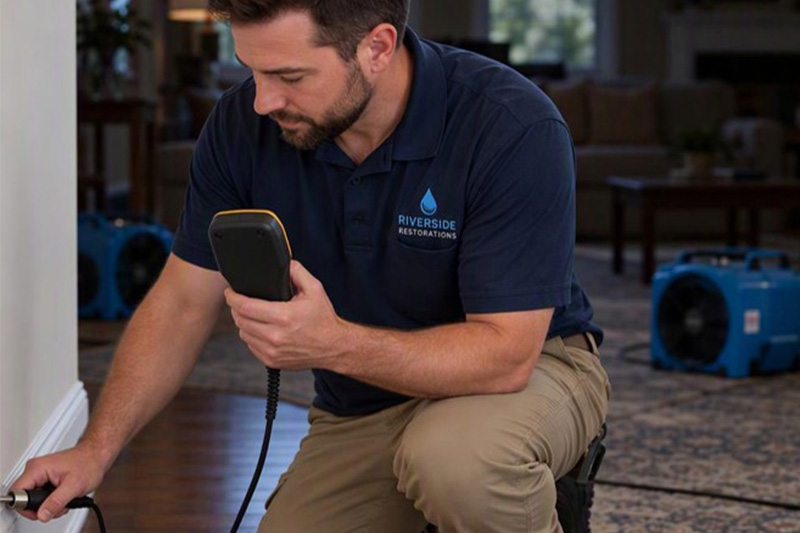
Efficiency is not simply doing the work faster. Profitability is not simply charging more. In water damage restoration, both are the result of making the right determination at the right point in the workflow—and documenting why that determination serves the project. The contractor who consistently manages those decisions can protect margin while reducing disruption for the property owner and controlling claim cost and cycle time for the insurance carrier.
The decision path behind an efficient job
Every water loss creates competing pressures to act quickly, protect health and materials, satisfy documentation requirements, limit costs and keep the project moving. The best way to reconcile those pressures is to treat restoration as a managed decision process rather than a sequence of equipment deliveries and pickups. Three stages drive the decisions that most affect efficiency and profitability:
- Initial inspection and determinations
- Structural drying: Setup
- Structural drying: Monitoring.
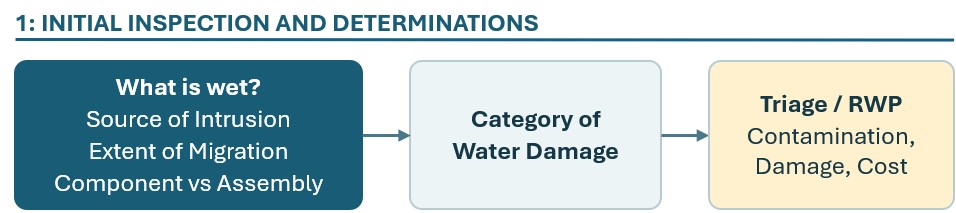
During the initial inspection, the technician must define what is wet at the material (i.e., component–NOT assembly) level, confirm the source and extent of migration, establish the category of water damage and triage each affected material. Triage should answer three questions: Is the material contaminated beyond effective remediation? Has it been permanently altered by damage? Is drying it in place cost-effective? Cost should not be answered in dollars-and-cents; instead, evaluate the complexities that drive drying costs higher. The most common factors that will drive drying cost higher are vapor barriers, excessive built-up layers and trapped bulk water in or beneath an assembly.
The triage determinations define the reasonable work plan (RWP) and prevent two expensive errors—removing material that could have been restored or attempting to dry material that should have been removed.
No material should be removed or altered in the initial visit to the project unless the triage identifies a clear and documentable reason. If the triage does not indicate an issue, drying should be attempted.
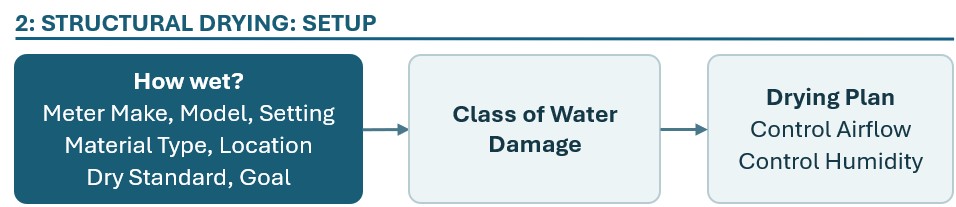
The setup stage converts inspection data into a drying plan. “How wet?” must be answered with repeatable measurements that identify the meter make, model, setting, material type and location, along with an appropriate dry standard and drying goal. The material and assembly profile, degree of absorption and estimated evaporation load then inform the drying plan (i.e., air movement and humidity control). The plan should address the materials that remain after cleaning, controlled demolition, extraction and any remediation—not the conditions that existed before those procedures were completed.
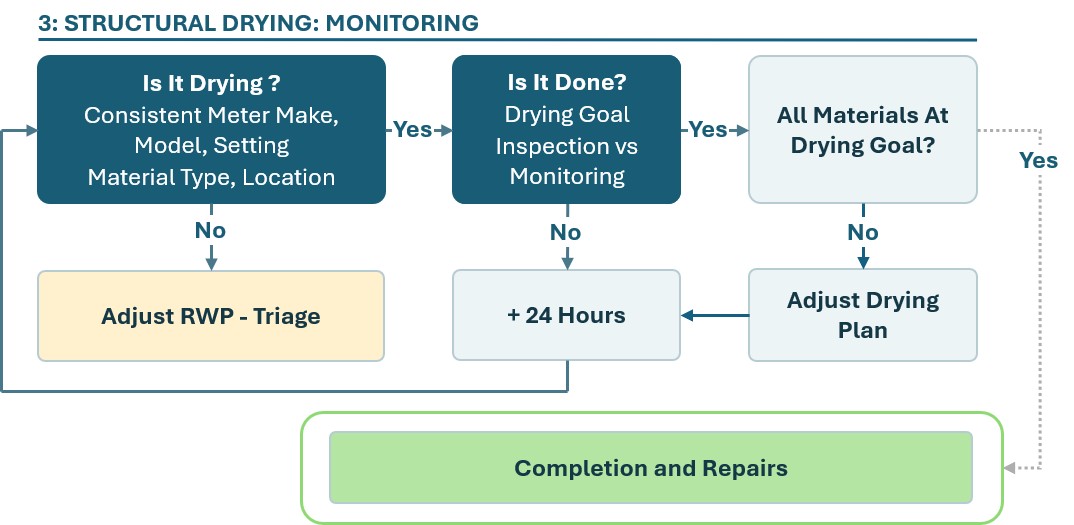
The final critical phase, monitoring, then turns the plan into a feedback loop. The same measurement method used to establish the baseline must be used to evaluate progress. If a material is not drying, the team revisits triage, access, airflow, humidity control and the reasonable work plan (RWP). If the material is drying but has not reached its goal, the job continues and the team re-evaluates it after additional drying time. If some materials have reached their goal, the team may reposition or remove equipment, and the drying chamber may potentially be reduced. Completion is reached only when inspection confirms that all affected materials have met their drying goals.
Why the process matters to every stakeholder
For the restoration contractor, disciplined decision-making shifts revenue toward technically justified restoration work and away from avoidable labor, material handling, rework and disputes. A smaller project can still produce a healthier gross profit when the work mix rewards skilled drying, monitoring and adjustment rather than unnecessary removal and reconstruction. Consistency also makes estimating, scheduling, equipment utilization and technician accountability easier to manage.
For the property owner, restoring more and removing less can mean fewer matching problems, less invasive work, a shorter period of disruption and faster return to normal use. Those benefits depend on sound triage; “dry in place” is not a universal answer. Materials that cannot be remediated, have been permanently damaged or cannot be dried economically still need to be removed.
For the insurance carrier, an effective restoration plan can reduce overall claim cost, shorten the claim cycle, limit the number of vendors involved and lower the likelihood that the file must be reopened. Clear records also make the contractor’s decisions easier to review because the documentation connects observed conditions to the chosen scope, equipment, labor and duration.
The key point is alignment. Efficiency and profitability improve when the project deliverables valued by each stakeholder reinforce one another: a technically defensible scope, less unnecessary disruption, a controlled claim cost and a documented path to completion.
Practical ways to build the process into the business
- Create a day-one decision record. Require technicians to document the source, migration boundaries, affected components, category, material-by-material triage, dry standards, drying goals and the rationale for restore-versus-remove decisions before the initial visit is closed.
- Standardize moisture documentation. Use consistent meter make, model, setting, material naming and measurement locations. Build these fields into forms and software so a later reading can be compared with the baseline without interpretation.
- Separate components from assemblies. Inventory individual materials, then record how they are assembled. This exposes vapor barriers, built-up assemblies and trapped bulk water that may require access, invasive drying or removal.
- Make triage a production gate. Do not allow equipment placement or demolition to become the default next step. Require a contamination, damage and cost determination first, with supervisor review for high-cost or ambiguous assemblies.
- Connect the drying plan to measured load. Base air movement and humidity control on the materials that remain, their moisture condition, the drying environment and the estimated evaporation load. Record the purpose of each equipment group.
- Manage monitoring by exception. Train technicians to ask, in order: Is it drying? Has it reached the drying goal? Have all materials reached goal? Each “no” should trigger a defined response rather than another day of unchanged equipment.
- Right-size the plan as conditions change. Reposition air movers, remove equipment that no longer serves a wet material and reduce the drying chamber when portions of the project are complete. This improves equipment turns and reduces unnecessary rental days.
- Measure decision quality, not just job totals. Track time to first complete inspection, percentage of materials restored versus removed, monitoring visits with documented progress, equipment days by affected area, cycle time, gross margin by work type, supplements and reopened files.
- Explain stakeholder value in the file. Pair the technical record with a concise narrative showing how the selected approach protects the owner’s use of the property, controls total claim cost and supports a profitable, defensible restoration effort.
Call to action: Put the decisions on rails
The goal is not to make every project follow the same physical scope. It is to make every project follow the same disciplined logic. When the decision path is consistent, the scope becomes easier to defend, production becomes easier to control, stakeholders receive more of what they value and profitability becomes the product of a better process—not a lucky outcome.

Brandon Burton
Brandon Burton, a longtime industry advocate, trainer, and standards volunteer, brings more than 30 years of experience on the technical side of the restoration industry. He is an approved IICRC instructor and a published author in the field. Burton currently serves as chair of the ANSI/IICRC Standards Committee and vice chair of the ANSI/IICRC S500 Standard for Professional Water Damage Restoration.