2026 Restoration Industry Leaders Review: Dayspring Restoration
Mark Springer did not set out to spend his life in restoration.
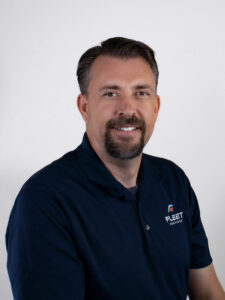
Mark Springer
His father founded Dayspring Restoration in 1989, when Mark was 11, and through his high school years, he figured he would do almost anything else. “I joke around that I was in indentured servitude,” Springer laughed.
He worked his way up through the dirtiest, hardest jobs in the company before moving into estimating and project management, and in 1998, he took the business over. A past Restoration Industry Association (RIA) president, he now leads FLEET Response, a national platform built on the company he once ran.
Growing up in the business
The early industry was a rough place to learn. Springer remembers mold remediation done in ankle-high rubber boots and a single pair of gloves, before the standards shifted in the early 2000s.
Montana, though, turned out to be a good place to build. Costs were low enough that Dayspring could advertise on television, something a company in the Bay Area or Miami could never afford. By the time he sold in 2020, Dayspring had grown to seven locations and about 150 people, with revenue near $22 million and a roster of employees who had been there 20 years or more.
A sale, a stall, and a comeback

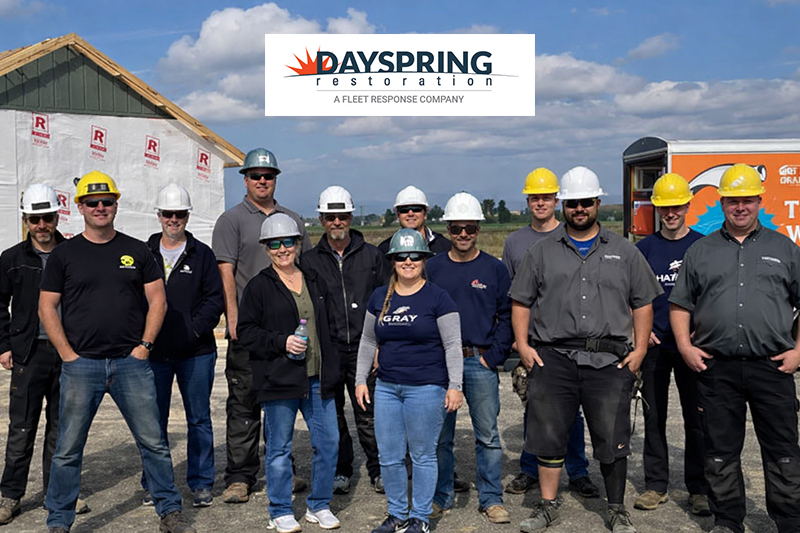
Dayspring has the team and equipment to handle any loss.
That year, Dayspring was sold to a Texas private equity firm and became the first platform company in FLEET Response, now a national network of about 400 employees across roughly 20 locations. It is a network, not a franchisor, made up of established names like Dalworth Restoration in the Dallas market, led for generations by the Hobbs family, along with Cousino Restoration & Environmental in Northwest Ohio, RestorePro Reconstruction and First Restoration Services (FRS) in the Southeast, and Alpha Omega Disaster Restoration in Montana.
The story did not run in a straight line. A slowdown in the restoration market collided with heavy debt, and the cost of carrying it grew steeply. Over about six months, Springer and several former owners worked with the lender, Monroe Capital LLC, to restructure the company. The debt was converted to equity, the original founders returned as owners, and roughly 20 other leaders became equity holders. FLEET is now one of the few operator-led national companies in the industry, and Springer said that getting back to what made the member companies great has already led to a fast turnaround.
He is candid about how these deals can go. National roll-ups backed by private equity do not always work, he said, and owners weighing a sale should know it. “Entrepreneurs need to be very cautious,” Springer mentioned, and go in with their eyes open to the downside, not just the promises. Some of the trouble is market-driven, he said, but the pattern is common enough that he expects to see more of it.
Everything rises and falls
Springer is quick to own his mistakes, and the lesson underlying most of them, he acknowledged, was about him. When things went wrong, it was usually because of a decision he had made, and the company’s growth was directly tied to his own growth as a leader. In his mid-20s, he set out to study leadership in earnest. “Leadership expert John C. Maxwell is credited with saying: ‘Everything rises and falls on leadership,’” Springer said. “As much of a cliché as that is, it’s 100% true.”
The second lesson was financial. Leaning on the idea that everything rises and falls on leadership, he learned to run the company by the numbers—revenue recognition, work in progress, budgeting, and the overhead math most owners would rather avoid. He has watched plenty of companies overextend on a line of credit and chase the shiny new equipment they see advertised, before the business is ready to carry it.
Integrity

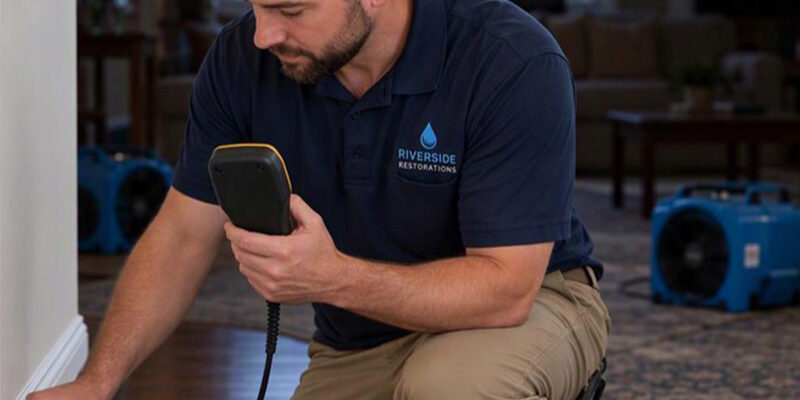
When disaster strikes and the homeowner feels there is no hope … (see picture below)
The principle his father drilled into him most was integrity. Restorers occupy an unusual position of trust, Springer said: They walk into a stranger’s home during an emergency, get an authorization signed, and send the bill to an insurer.
“The key to integrity is: What do we do when no one else is watching?” he shared. That cuts both ways, neither trimming scope to protect a carrier relationship nor padding it at the customer’s expense. The same standard applies inside the company. Keep your promises to your people, he advised, or risk the one thing a restoration business cannot run without: their trust.
Faith sits underneath all of it. Springer believes he is accountable to God, which amplifies his father’s lesson—it is not only what he does when no one is watching, but the conviction that someone always is. In no-win moments, he prays for guidance, and he keeps the stakes in perspective.
FLEET and Dayspring matter, he said, but measured against anything eternal, “It’s still just stuff.” The work, as he sees it, is stewardship: Treat people well, stay honest, and try not to let his life contradict what he believes.
A plan you use

… Dayspring puts its expertise to work, bringing real meaning to the word “restoration.”
Culture, in Springer’s telling, comes from a few things repeated until they stick. Dayspring built its core values around the acronym CARE, and he said any employee in the state could recite them. The company has hired, promoted, and parted ways with people based on them.
The other piece is planning. While away from the company, he earned a Certified Exit Planning Advisor credential and coached owners on the fact that almost everyone exits eventually. “An exit-ready business is a valuable business,” he explained, even if it never sells. At a conference of about 200 entrepreneurs, only a handful raised their hands when he asked who had a strategic plan; when he asked who had reviewed it in the last 90 days, one hand stayed up. Build a three-to-five-year plan and work it, he urged, and “you’re ahead of over 99% of the competition.”
Show up every day
For a young entrepreneur looking for one element of the business on which to focus, Springer points to consistency. Team members need to know that the leader running the company is stable and can be counted on, no matter what kind of morning he has had.
Consistency also must hold over the long haul. Too many owners quit, he said, right before a breakthrough.
It works like exercise: Show up twice a year, and you will hate it, but invest day in and day out, and the results come, Springer explained.
For Dayspring Restoration, the goal is simple: “Restore hope, strengthen communities, and make a meaningful difference where it’s needed most,” Springer said.
BONUS VIDEO CONTENT

Jeff Cross
Jeff Cross is the ISSA media director, with publications including Cleanfax, Cleaning & Maintenance Management, and ISSA Today, as well as multimedia programs such as Straight Talk! and Take 5 With Cleanfax in video and podcast format. He can be reached at [email protected].