Everything Is Asbestos Until Proven Otherwise
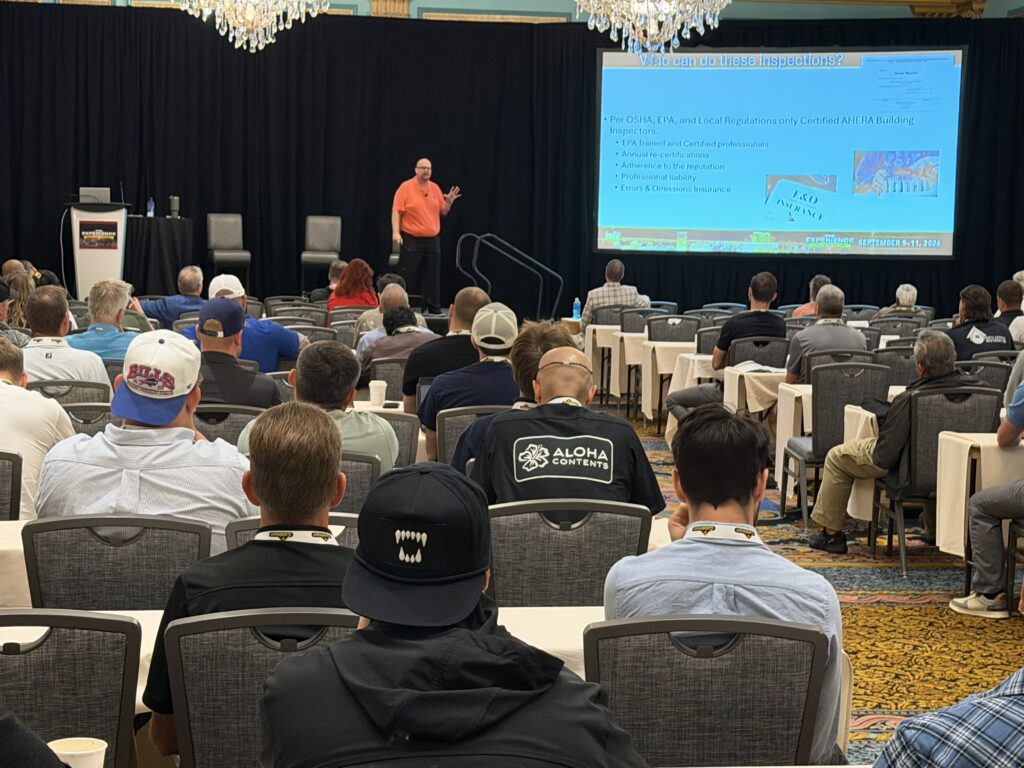
Restoration crews cut into walls, ceilings and flooring every day, and Andre Zwanenburg, owner of the Asbestos Institute, wants them to treat everything they cut into as containing asbestos until testing proves otherwise.
Zwanenburg, a chemist and trainer with 33 years in the field, laid out the myths, the regulations and the material itself during a recent industry presentation on asbestos and its relationship to the restoration trade.
A mineral older than the pyramids
Asbestos is not a manufactured chemical. It’s a naturally occurring mineral that comes straight out of the ground, and it’s found all over the world, Zwanenburg said. Serpentine, the rock that yields chrysotile asbestos, is California’s official state rock. The world’s largest asbestos mine sits in the town of Asbest, Russia—a pit 7.5 miles long, 2.5 miles wide, and 1 mile deep that still produces more than 500,000 tons of the mineral a year. The United States stopped domestic mining in 2005, Zwanenburg said, but plenty of countries never did.
Chrysotile, also called white asbestos, is the type most found in products made in the U.S., Canada, Mexico, Brazil and Russia. Amosite and crocidolite show up far less often. Asbestos use itself goes back further than most people assume: Egyptians wrapped mummies, including King Tut, in asbestos cloth thousands of years ago.
No cutoff date, no federal ban
One of the most persistent myths in the industry is that buildings constructed after some magic year, 1980 in most versions of the story, don’t need testing. Zwanenburg said he has never traced that date to an actual regulation, and some jurisdictions have invented their own version. Asbestos-containing products are still sold in the U.S. today. Zwanenburg cited a 2024-built condominium complex where the mastic under a bathroom mirror tested at 8% asbestos.
Despite decades of regulatory efforts, the U.S. has never enacted a full ban. Of the 70 developed nations tracked by the United Nations, 69 have banned asbestos outright; the US is the exception, Zwanenburg said. A 2019 rule restricted new uses rather than banning existing ones, and a narrower 2023 restriction on chrysotile use cases immediately drew more than one hundred lawsuits. A federal circuit court heard arguments this past June, with a ruling expected by winter. Meanwhile, the U.S. imported roughly 1 million pounds of raw asbestos in 2024, most of it destined for gaskets, friction products used in industrial and mining equipment and asphalt roofing materials.
The bigger concern for restoration contractors, Zwanenburg said, is joint compound imported from China. He said every imported joint compound sample he has tested has come back positive, while domestically produced joint compound has tested clean.
Where crews find it
Vermiculite attic insulation is a particular hazard. Roughly 98% of vermiculite insulation installed before 1995 traces back to a single mine near Libby, Montana, and that ore was heavily contaminated with tremolite and actinolite asbestos, Zwanenburg said. Sampling it correctly requires the Environmental Protection Agency’s (EPA) specific vermiculite insulation protocol rather than a standard surface sample, and a proper sample runs about US$250. Popcorn ceiling texture, vinyl floor tile and its mastic, pipe insulation and joint compound round out the usual suspects. Wood, metal and glass are about the only materials a crew can safely assume are asbestos-free, he added.
Budget is not an exemption
OSHA requires employers to determine the presence, location, and quantity of asbestos before any work that could disturb a building material. That requirement doesn’t bend for a tight budget or an adjuster who won’t authorize testing, Zwanenburg said. National Emission Standards for Hazardous Air Pollutants (NESHAP) regulations apply to any work classified as commercial, including apartment complexes, even when contractors treat the work as residential. A compliant inspection must be thorough enough to identify every asbestos-containing material on site, and a lab result alone doesn’t satisfy the documentation requirement. A full report needs sample locations and quantities, material condition, supporting photographs and the inspector’s certification. Occupational Safety and Health Administration fines for skipping a survey can reach $75,000, and Zwanenburg said he has testified in cases where company owners faced potential jail time over asbestos violations.
Choosing an inspector and a lab
Anyone with EPA training and certification can legally perform an asbestos inspection, and a handful of states, including Nevada, also require a state license. Zwanenburg encouraged restoration companies to ask prospective inspectors about their insurance coverage and their quality assurance program, and to send samples only to labs accredited through the National Voluntary Laboratory Accreditation Program, which subjects analysts to ongoing, rigorous review.
“Price is not always the indicator of what you get,” Zwanenburg said. For restoration contractors, a properly documented inspection costs less upfront than a missed asbestos hazard costs later.

Jeff Cross
Jeff Cross is the ISSA media director, with publications including Cleanfax, Cleaning & Maintenance Management, and ISSA Today, as well as multimedia programs such as Straight Talk! and Take 5 With Cleanfax in video and podcast format. He can be reached at [email protected].