Most Are Concerned About Infectious Disease Risk in Public Settings

As infectious disease threats, including reported hantavirus cases in the U.S., continue to draw public attention, a new First Onsite survey found six in 10 Americans are concerned about the risk of infectious disease spread in public settings. This reflects a benchmark in how Americans think about the built environments where they work, travel, and gather—and what they expect from those responsible for keeping those spaces safe.
The survey reported that concern about infectious disease and future pandemics is a central concern of Americans of all ages and regions. Beyond infectious disease, respondents also reported concerns around indoor air quality, hidden building damage, hazardous substance exposure, drug exposure, and the long-term health effects from environmental contamination.
“Concern about indoor environmental risk is no longer episodic—it is baseline,” said Norris Gearhart, executive vice president of regulatory business practice and director at First Onsite’s First Onsite Academy. “What this data shows is that Americans have moved from awareness to expectation. They expect the buildings they occupy to be safe, and they expect the people responsible for those buildings to have a plan.”
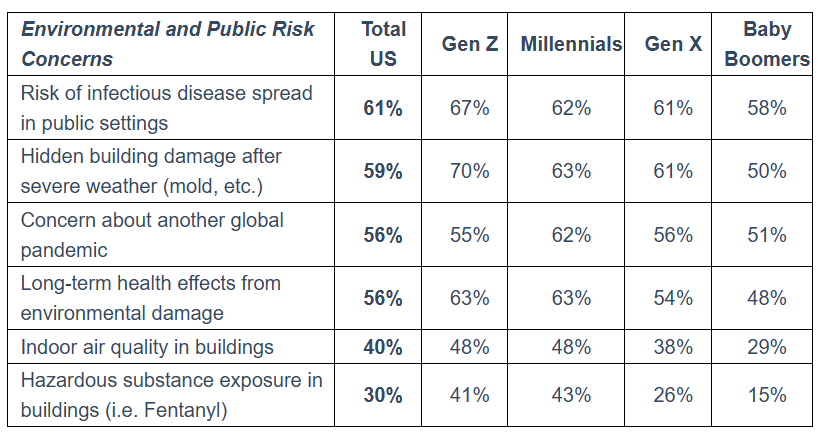
Infectious disease concern tops the survey at 61%, underscoring how firmly public health risk remains embedded in how Americans think about shared indoor environments. Concern about another global pandemic remains widespread at 56%, reinforcing the durability of post-COVID risk awareness.
Hidden building damage (59%) and long-term health effects from smoke, mold, or water damage (56%) follow closely behind, while indoor air quality (40%) and hazardous substance and drug exposure in buildings (30%) represent lower but still meaningful concern levels.
When it comes to hazardous substance and drug exposure in buildings, parents are the most concerned of any group—specifically, respondents with children in the home report concern at nearly double the rate of those without (44% vs. 24%). The generational divide is equally stark. Gen Z (41%) and millennials (43%) express concern at nearly three times the rate of baby boomers (15%), with Gen X (26%) sitting closer to the older end of that spectrum.
While concern levels remain high nationwide, the risks that feel most immediate vary by region. The Midwest reported the highest concern about infectious disease spread in public settings (65%), while the West led concern about long-term environmental health effects (61%), reflecting ongoing wildfire and smoke exposure concerns.
“The buildings people occupy every day carry real environmental risk—biological, chemical, and structural—and most facility cleaning programs are not designed with that in mind,” Gearhart said. “The difference between routine cleaning and genuine contamination control is significant.”

Cleanfax Staff
Cleanfax provides cleaning and restoration professionals with information designed to help them manage and grow their businesses. https://cleanfax.com/