
Margins Under Pressure: Inside the Realities Reshaping Restoration
If you lead a restoration company, you already feel the pressure—rising labor costs, volatile materials, overhead that refuses to settle, and pricing structures that are constantly squeezed.
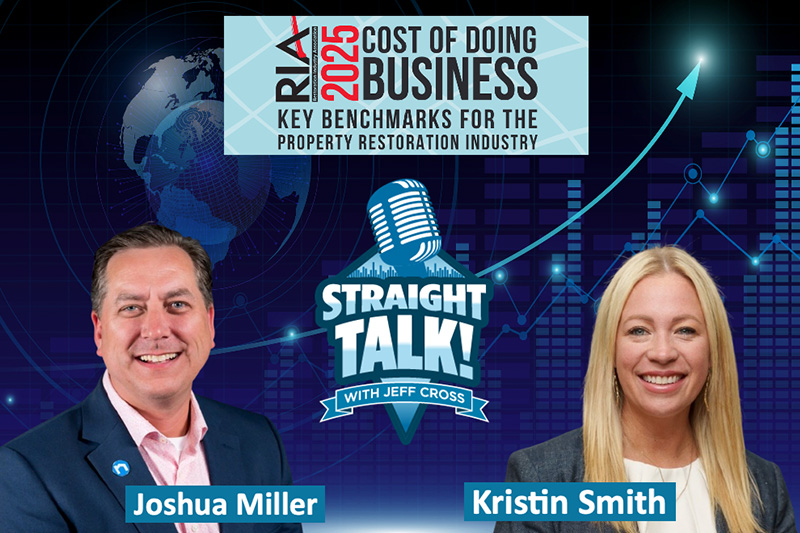
The Restoration Industry Association’s new Cost of Doing Business (CODB) report, in conjunction with KnowHow, quantifies the industry’s current state and highlights the strategies of the most successful operators.
Access the RIA Cost of Doing Business Report here.
In a discussion analyzing the findings, Josh Miller, president of Rainbow Restoration, and Kristin Smith, president of Mooring USA, examined the report’s key indicators and offered practical steps that leaders can implement immediately. One key takeaway: Companies that view data as a compass—rather than a burden—will be best equipped to navigate volatility, stabilize cash flow, and scale responsibly.
The experts
Smith joined Mooring Recovery Services two and a half years ago after a career in the oil and gas industry, which she says has conditioned her to “crave data.” Mooring’s name is deeply rooted in restoration, with over 75 years of experience and a third generation currently leading the company. Their operations include mitigation, restoration, and full-service recovery, making the CODB report a valuable tool for understanding how their metrics compare with those of industry peers.
Miller has dedicated nearly 30 years to restoration, starting in 1996 with hands-on work in water mitigation and carpet cleaning. He currently serves as the president of Rainbow Restoration, which is part of Neighborly’s global home service franchise network. He noted that even Neighborly’s new chief financial officer, who previously worked in the oil and gas sector, was surprised by “the lack of data you guys have compared to other industries.” This highlights the importance of the Cost of Doing Business (CODB) report as a vital resource for owners who have historically operated without strong industry benchmarks.
The three biggest findings
Smith pointed to three themes that immediately jumped out: an overhead crisis, long collection cycles, and the dangers of scaling too quickly.
She said the report made the impact of inflation unmistakable. “We’re all very aware of inflation, what it’s done to our labor rates, and how it’s impacting the profitability of the business,” Smith said. “And that was very clear in this report.” Overhead as a percentage of revenue continues to climb, pushing companies to reevaluate labor utilization, automation, and operational efficiency.
The second direct signal: Collections. “You cannot ignore or avoid the fact that collections are taking 60 to 80 days,” Smith said. That timeline places any restoration company—large or small—into a precarious cash position. Without a strong financial partner or disciplined cash-management practices, companies risk being unable to weather slow payment cycles.
Her third insight was the need to “scale cautiously.” The report surfaced metrics showing that profitability tends to decline as companies open additional locations. As Mooring enters growth mode, the data makes her more thoughtful about scaling strategies that could destabilize cash flow in a volatile, event-driven business.
Miller’s takeaways intersected with Smith’s but added new dimensions. He noted dramatic swings in mitigation profitability by job size—something that defies conventional industry wisdom. Jobs under $5,000 saw profitability “jump way up,” while jobs between $20,000 and $50,000 saw a sharp decrease. That finding made him hungry for even more segmented data: Were those larger jobs commercial? Were consultants involved? What factors were dragging margins?
Overhead, too, stood out. Miller pointed to the industry’s long-held “10 and 10” model—10% overhead, 10% profit—as increasingly unrealistic. “The industry average rose up to 38%,” he said. Inflation, tariffs, and inefficiencies all contribute to a rising overhead burden that companies must scrutinize more aggressively.
But the biggest challenge, he emphasized, is cash. The report showed accounts receivable representing a median of 16.5% of annual gross revenue. In his words: “If you don’t have cash, you can’t stay in business.”
Year-to-year shifts
One of the most noteworthy trends in this year’s CODB report was a decreased dependence on third-party administrators (TPAs). “Fifty-three percent of firms this year reported zero revenue from TPAs,” Miller said, up from 45% the previous year. He wondered aloud whether firms were withdrawing from program work because of “margin compression, additional documentation required, which raises overhead, and then it takes longer to get paid.”
Smith had similar observations. Mooring has deliberately stayed out of TPA programs, and the report affirmed that decision. TPAs may promise consistent work, but not consistently profitable work. “It has not made sense to get back into program work,” she said, emphasizing that Mooring has found more stability and healthier margins in adjacent services instead of depending on TPA volume.
Margin compression across service lines also concerned Smith. Inflation continues to push costs upward, but commercial customers show little appetite for price increases. “It seems like our peers are getting even more competitive,” she said, making it difficult to pass along rising labor expenses. The industry continues absorbing the pressure, and she wondered aloud when—or whether—that imbalance will stabilize.
Using benchmarks the right way
Smith warned leaders against treating benchmarks as plug-and-play rules. The more innovative approach, she said, is to start by understanding your own trends: What has historically worked or not worked for your business? From there, the CODB benchmarks become a diagnostic tool—a compass, not a prescription. She also stressed the importance of focusing on the revenue band and service mix most relevant to your business, rather than comparing your company to firms with different structures or markets.
Geography adds another layer of complication. “The cost of doing business varies wildly,” she said. A metric that works in Houston might not hold in Albuquerque. Multi-location companies must understand each market individually rather than treating their footprint as one blended portfolio.
Miller agreed, adding that benchmarking only works when the underlying data is clean. Many companies, he said, treat benchmark numbers as gospel without verifying the accuracy of what’s being compared. He urged owners to remember that the CODB report is a powerful indicator, not a fully audited financial standard. Companies should use it to contextualize performance, not to panic if they miss a number.
One of his favorite applications of the report is helping smaller franchise owners focus only on the metrics applicable to their stage of growth. A $2 million company should not benchmark itself against a $20 million operation. Instead, it should use the data to build a roadmap to the next tier.
The next two moves
When asked to choose two actions any restoration company can take in the next month, both experts landed in the same place: cash and job costing.
Miller’s first recommendation was simple but forceful: Establish a strict weekly cadence for reviewing accounts receivable. “I would just maniacally focus on that number,” he said. The second: measure the time between receiving a certificate of completion and sending the final invoice. Too many companies complain about slow payment cycles while simultaneously delaying their own billing.
His second recommended focus was accurate job costing. Restoration margins are often misunderstood because companies fail to allocate labor, equipment depreciation, project management time, and overhead. In some cases, the high margins companies brag about publicly may reflect incomplete accounting rather than true profitability.
Smith’s two moves were nearly identical but approached from the perspective of a commercial-only firm.
First: “Fix and stabilize the cash conversion cycle.” She outlined steps such as aligning business development incentives with payment timeliness, securing progress payments on significant losses, and maintaining a healthy mix of self-insured and insured clients.
Second: “Ruthlessly track costs as a percentage of revenue.” For Smith, labor utilization is the most powerful lever. If companies can keep field staff consistently busy through clean, recurring, and adjacent revenue streams, they can scale more confidently when disaster events hit.
Common traps
Smith warned owners about overextending overhead under the banner of growth. It’s easy, she said, to justify high costs by arguing that investments will pay off later. In reality, companies must carefully balance growth ambitions with seasonal cash realities.
She also critiqued the fear many small businesses have of credit lines. A well-structured line of credit, she said, is not a risk—it’s a lifeline. “Even if you never draw on it, it is worth the fee of having it available.”
What does she want to see in future CODB reports? Automation. With new tools reshaping overhead and efficiency, she wants the data to show how automation is affecting performance across the industry.
Miller echoed many of these points and added that greater clarity around owner and investor compensation would help companies better understand their long-term financial viability.
He also wants better insights into vendor payment timelines—not just how quickly restoration companies get paid, but also how quickly they pay the subcontractors who power much of the industry’s labor.

Jeff Cross
Jeff Cross is the ISSA media director, with publications that include Cleaning & Maintenance Management, ISSA Today, and Cleanfax magazines. He is the previous owner of a successful cleaning and restoration firm. He also works as a trainer and consultant for business owners, managers, and front-line technicians. He can be reached at [email protected].





 Loading ...