
Inside the S520: The Standard That Changed Mold Remediation
When conversations about mold surface, they usually focus on what went wrong. Who failed to follow the rules? Who is responsible? Who pays?
What often gets overlooked is the long, unglamorous behind-the-scenes work that raises the standards for an entire industry. That work is slow, deliberate, and driven by people who understand that mold is not just a technical issue but a public health, legal, and leadership challenge.
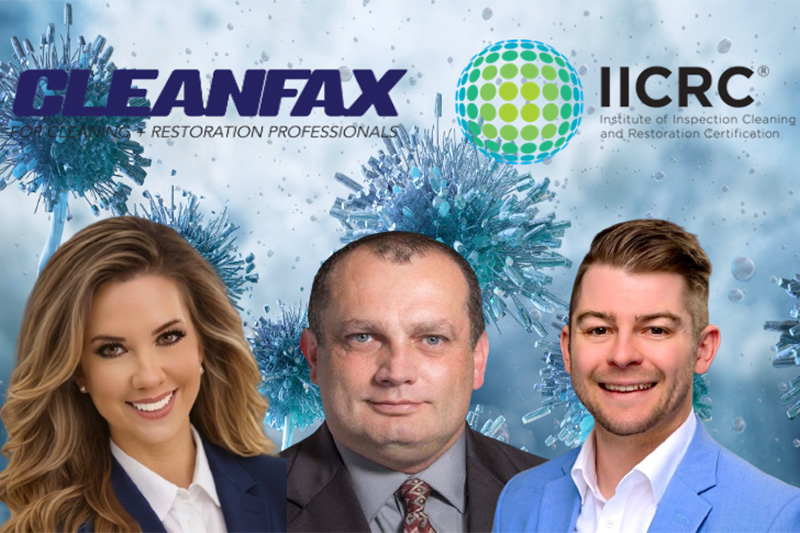
That truth shaped a recent discussion with three IICRC leaders whose work affects every aspect of mold remediation: Mark Cornelius, Dr. Holly Burns, and Robbie Bradshaw. Together, they described the development of the ANSI/IICRC S520 Standard for Professional Mold Remediation and its current influence beyond the job site.
How the S520 came to be
Cornelius, with over 40 years of experience in the cleaning and restoration industry, explained that the S520 was developed because earlier standards left an important gap. The ANSI/IICRC S500 Standard for Professional Water Damage Restoration recognized that mold begins with moisture, but it did not provide guidance on how to properly deal with mold once it appeared.
The S520, he said, was designed specifically for mold remediation contractors, with input from industrial hygienists, consultants, and other experts. Its goal was to establish a consistent approach grounded in building science and worker safety, rather than speculation or fear.
Mold itself is not a new issue. Cornelius noted that it has existed for centuries, but public concern in the United States grew during the 1970s and 1980s, alongside the rise of sick building syndrome. That concern heightened in the 1990s due to high-profile lawsuits, media sensationalism, and public confusion. Without a standard, remediation methods varied widely, costs increased substantially, and credibility was undermined.
The industry needed something to anchor it.
Creating consistency and accountability
Burns, with nearly 20 years of experience in restoration and now involved in indoor air assessments and training, described the pre-S520 landscape as inconsistent and risky. Practices varied among contractors, documentation was inconsistent, and little correlation existed between field methods and building science.
“The S520 was born out of necessity,” Burns said. It established a science-based consensus for what reasonable and appropriate remediation should look like, with an emphasis on exposure control, contamination management, and occupant safety.
She stressed that mold remediation is fundamentally about safeguarding people and their most prized possessions: their health and their home. The standard provides assessors and remediators with a shared framework to assess risk and support decision making, rather than relying on shortcuts or assumptions.
Standards evolve for a reason
Standards, however, are not fixed. Cornelius described the revision process as challenging and sometimes controversial. Consensus committees consist of dedicated professionals who combine research with practical experience. New science, emerging technologies, and updated health and safety guidelines all require thorough assessment.
“It can take years,” Cornelius said, noting that the original S520 took more than three years to complete. Revisions can also take that long, especially when changes impact worker safety or occupant vulnerability. New products or techniques are not automatically approved just because they are new.
Burns added that updates are intentionally deliberate rather than reactive. Research on aerosolization, containment effectiveness, and the impact on immunocompromised occupants must be discussed and integrated responsibly.
Training that builds defensibility
Both Cornelius and Burns stressed that training plays a critical role in the application of standards. IICRC-approved instructors are responsible for translating written principles into real-world applications.
Burns said she teaches students to justify each decision based on principles, not habits. She emphasizes that defensibility matters, especially when work is reviewed later.
Cornelius put it even more bluntly. He doesn’t use the standard to defend his work; he uses it to judge decisions before starting. If the work meets the standard from the beginning, there’s nothing to defend later.
From job sites to legislation
Bradshaw, the director of government relations for the IICRC, explained how the S520 has become a crucial tool in policy discussions. Legislators often hear from constituents about mold but frequently don’t know how to respond. Many mistakenly believe the industry is regulated when it isn’t.
When policymakers discover a recognized standard of care, the conversation shifts. Bradshaw noted that mold remediation accounts for most of his legislative discussions. The S520 and related certifications give lawmakers a reliable reference point.
That influence is already tangible. The S520 was incorporated into state law years ago, and more recently, Congress instructed the Department of Defense to create mold guidelines aligned with the standards for military housing. Bradshaw called that progress, especially for service members and their families.
Why standards matter
As mold remediation increasingly intersects with public health, housing policy, and legal accountability, expectations continue to rise. Burns observes a growing demand for qualified professionals and a decreasing tolerance for shortcuts. Accountability, she said, will lead to greater respect for those who do the work correctly.
Cornelius offered a warning. Overcomplicating remediation, expanding the scope, or chasing trends can make necessary work unaffordable. The guidance is already in place. Do the work correctly, control moisture, remove contamination, and avoid unnecessary theatrics.
Cornelius stated, “We are in an industry where we can hurt people if we do not do our job right.” Standards, he emphasized, exist to keep professionals, occupants, and communities safe.
To learn more about the IICRC, click here.

Jeff Cross
Jeff Cross is the ISSA media director, with publications that include Cleaning & Maintenance Management, ISSA Today, and Cleanfax magazines. He is the previous owner of a successful cleaning and restoration firm. He also works as a trainer and consultant for business owners, managers, and front-line technicians. He can be reached at [email protected].




 Loading ...