Beyond the Manual: The Hidden Work Behind IICRC Education
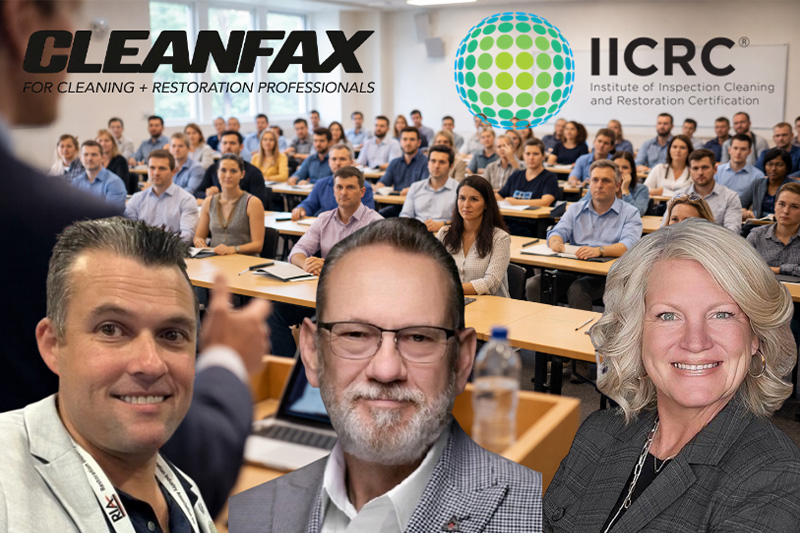
When technicians walk into an Institute of Inspection, Cleaning, and Restoration Certification (IICRC)-approved class, they see a manual, a schedule, and an instructor at the front of the room. What they don’t see is the years of industry experience, the hours of preparation, the careful classroom choreography, and the deep personal investment that go into delivering training at the highest level.
Three instructors recently pulled back the curtain on what it takes to teach at that level. Darren Hudema, Rachel Adams, and Chris Kissin are IICRC-approved instructors with a combined student count exceeding 30,000. Their motivations are strikingly similar and have almost nothing to do with revenue.
Why they do it
Adams, who founded Indoor Environmental Management and helped create both the IICRC Applied Microbial Remediation Technician (AMRT) and the ANSI/IICRC Standard for Professional Mold Remediation (S520), has been instructing since around 2002. She was direct about what drew her in.
“I think originally I did it because I thought it would be fun,” she said. “You get to make a difference in your industry, make a difference in people’s businesses. A lot of people think, oh, you’re going to get rich, become an instructor. It doesn’t really work that way. It’s a lot of work, and a lot of people don’t realize how much time and dedication it takes.”
Kissin came to instruction after two decades in carpet cleaning in Australia, where no IICRC Carpet Cleaning Technician (CCT) instructor was offering public courses. He saw a gap and moved to fill it.
“Carpet cleaning is still a passion for me, so I actually love being able to teach it to other people,” Kissin said. “A lot of people see carpet cleaners as just glorified cleaners, whereas I like the fact that there is a lot involved in it. I don’t do it for the money. I really enjoy the excitement. Each class is different.”
For Hudema, now director of training for PuroClean with more than 500 franchises across North America, the motivation runs deeper still. He came up through a family-owned cleaning business in the 1970s and watched the industry support his family over two generations. He was involved in writing what became the IICRC Applied Structural Drying (ASD) program and has been instructing since 1999.
“To now see individuals that have gone through classes that I’ve taught over the years that are now running successful multi-million-dollar businesses, they’re able to put food on their table, they’re able to help improve their communities,” Hudema said. “There is no other industry that you’re going to be able to come into where you have the ability to make six figures or more, or even maybe be your own business owner at some point.”
The setup nobody sees
All three instructors emphasized that preparation begins long before a student walks through the door, and that seating isn’t random.
“I actually look at who’s coming to my class, where they’re traveling from, are they adjusters, are they restorers, are they office people?” Adams said. “I give assigned seats. After the first day, I figure out whether I have any problem children in my class, or maybe someone who’s really not very vocal, and they fit better with someone else. I try to set them up so they’re comfortable and they want to engage.”
Hudema takes a similar approach at PuroClean’s academy, intentionally breaking up groups from the same company so technicians are forced to learn from people outside their own bubble. In his flood house setting, teams rotate through different areas of the house, inheriting the documentation left by the previous group.
“It forces them to go back and have a conversation with the previous team: what did you do, how did you do it, and why?” he said. “By the time they’re finished that week, they’ve gone through four or five different areas of that house, and they’ve had to interact with every table.”
Kissin, who relies heavily on props and hands-on demonstrations, said the physical layout of the room can make or break a session, especially when teaching at an unfamiliar facility.
“Every class is different, so I’ve got a setup that I like,” he said. “If I go to a different facility and they may not have that, I’ve got to try to maximize how I can teach without blocking someone or limiting their view.”
Problem students and real solutions
Every instructor deals with the student who doesn’t want to be there. Adams said she can usually identify them within the first hour.
“Sometimes they’ll tell you, I really don’t want to be here, I was forced to be here, or I was told if I didn’t do this class, I don’t get a raise,” she said. “That gives me insight into what your motivation is. And that a lot of times is their driving force for how successful they are.”
Adams also spoke candidly about earning respect as one of the first female AMRT instructors in a male-dominated industry. “I’ve got some old-school students who look up at me, and they’re like, what are you going to possibly teach me? I’ve been doing this for 30 years,” she said. “I have to earn their respect as their instructor.”
She also raised something many instructors may not openly address: the students who struggle not because of attitude, but because of learning differences. “They may not be able to read, it may not be their first language, or they have dyslexia,” she said. “Sometimes they’ve had a problematic educational experience their whole lives. I encourage people to come up and have private conversations because there are things we can do, giving them longer time for an exam, thinking about where you seat them.”
Hudema added that disruptive students affect the entire room, not just themselves, and that he’s not above calling an owner midweek if things aren’t adding up. “If I’ve spent money sending a technician to class and they come back energized, that’s first and foremost important to me,” he said. “But if they’re not actively engaged, they’re also taking time away from everyone else.”
After the class ends
For all three instructors, the relationship with students doesn’t end when the exam does. Kissin puts his contact details on the board at the start of every class.
“I want to elevate the industry and make it better,” he said. “I don’t give them answers. I ask, what did we learn in the class? What is your thought process? So that it sticks in their mind. And I think doing that is going to be more beneficial for me as an instructor eventually, I’ll have a larger database of students who, if they enjoy your class and you’re available for them, they’re going to keep referring other people.”
Hudema echoed that sentiment. He described getting text messages and calls long after classes end from former students looking for direction, and occasionally calling owners to flag a standout. “I’ll say, you’ve got a star right there,” he said. “Take advantage of what he brings to the table, because that one is going to take you places.”
Advice for the next generation of instructors
When asked what they’d tell someone considering becoming an instructor, all three circled back to motivation.
“My first question is, why?” Adams said. “Sometimes I get people who say, ‘I’m tired of doing field work, this is easier,’ or someone who just counted 30 people in the room at $1,000 a head and did the math. Becoming an IICRC-approved instructor is not easy, and it was never intended to be. Are you willing to commit? Because it is a process.”
Hudema, who serves on the IICRC board, emphasized giving back as the true north. “For me, it was about being able to change people’s lives,” he said. “Teach with passion, teach with skill, and teach like you’re continuing to learn yourself, because when you do that, it’s going to resonate with your students.”
Kissin, the newest instructor at the table, offered the question he’d ask any prospective instructor: Are they willing to keep learning?
“Don’t think that as soon as you become an instructor, you know everything you’re teaching,” he said. “I’ve had students in my classes who have been in the cleaning industry for 40 or 50 years. And when they come up to you at the end and say, ‘didn’t know this,’ those light-bulb moments are amazing. We’re all students as well.”
Between them, Hudema, Adams, and Kissin have certified more than 30,000 students. None of them sounds ready to stop.
“This industry is a great family,” Hudema said. “They care about one another, and we care about them. When I see that they’re successful, there’s no better occupation.”
Watch the interview and listen to the podcast:

Jeff Cross
Jeff Cross is the ISSA media director, with publications including Cleanfax, Cleaning & Maintenance Management, and ISSA Today, as well as multimedia programs such as Straight Talk! and Take 5 With Cleanfax in video and podcast format. He can be reached at [email protected].