
The Restoration Report: RIA’s Vision for Growth, Ethics, and Unity
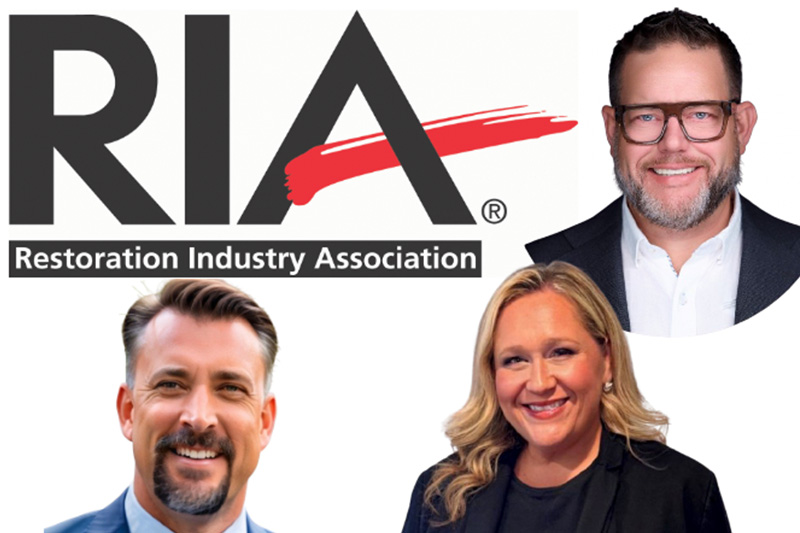
In a landmark conversation, three key leaders of the Restoration Industry Association (RIA) laid out with clarity, conviction, and a call to action the outlook for the restoration profession in 2025 and the years ahead.
RIA’s President Jeff Moore, former president and Carrier Relations Task Force lead Mark Springer, and CEO Kristy Cohen shared a sweeping overview of RIA’s evolution, current initiatives, and long-term ambitions that are already reshaping the industry’s identity and influence.
Restoring communication, clarity, and direction
Moore opened the discussion with a focus on what he sees as the association’s most critical priority: communication. “We are doing incredible things for contractors,” he said. “But we need to do a better job telling the story.”
Moore outlined a shift in RIA’s posture from reactive to proactive. Rather than simply responding to challenges as they arise, RIA now aims to shape the industry narrative. The association filters every initiative through a simple lens: If it helps all contractors, RIA is in. If it divides the industry, they pass.
This inclusive approach reflects the diversity of RIA’s membership base—from fiercely independent operators to program-aligned firms. Moore emphasized the importance of reducing friction between contractors and carriers. “Even if you never talk to a TPA or adjuster, your customer does,” he said. “And that matters.”
Moore painted a bold vision: A future where insurance carriers and TPAs consult with RIA before implementing new policies that affect restorers. “That future is possible,” he said, “but it takes time. We’re playing the long game.”
The rise of the Carrier Relations Task Force
Springer, former RIA president and now the head of the Carrier Relations Task Force, is leading the charge on what may be RIA’s most ambitious bridge-building effort yet.
“There’s never been a structured venue for contractors and carriers to communicate openly,” Springer said. “We’re changing that.”
Springer will engage monthly with a group of executive-level carriers and major players. The goal is to foster trust, clear up misunderstandings, and align on standards that benefit both contractors and policyholders.
But the initiative isn’t just about talk—it’s about standards. Springer detailed the 2026 launch of a new RIA Code of Ethics supported by mandatory training, a grievance escalation process, and a formal review board. “This isn’t a platitude,” he said. “We’re putting teeth behind ethics.”
Springer stressed that ethical contractors suffer when unscrupulous players manipulate estimates or cut corners. The new standards will set RIA members apart—and restore respect to the profession.
A new era of industry partnerships
RIA’s transformation from outsider to collaborator is perhaps most evident in its evolving relationships with long-standing industry giants. CEO Kristy Cohen highlighted the significant progress the association has made in just five years.
“Five years ago, we couldn’t get certain software vendors or TPAs to return our calls,” Cohen said. “Now, they reach out to us for feedback before rolling out changes.”
These collaborations have yielded concrete wins, including improved pricing descriptions, more flexible estimating tools, and meaningful seat-at-the-table conversations with platforms such as CotalityTM (formerly CoreLogic) and Xactware.
RIA also continues to work closely with the IICRC and legislative partners to secure long-needed industry recognition, such as the development of a dedicated North American Industry Classification System (NAICS) code for emergency restoration work.
Measuring what matters
Two of RIA’s most impactful initiatives—both rooted in data—are the TPA (Third Party Administrator) Scorecard and the Cost of Doing Business (CODB) Report.
The TPA Scorecard, now in its third version, allows contractors to rate anonymously TPAs across key areas like guidelines, communication, and support. The 2025 edition revealed an industry average rating of just 2.7 out of 5, sending a clear message: improvement is needed.
“If TPAs score contractors, then contractors should be able to score TPAs,” Cohen said. The goal isn’t to attack, she emphasized, but to improve the system through accountability. And it’s working. Several TPAs have already contacted RIA to understand their scores better and work toward solutions.
Meanwhile, the CODB Report provides essential financial benchmarking for restoration businesses. The 2024 report debunked myths about margins and revealed that many restoration firms operate with higher overhead than previously assumed.
“The idea that 10% overhead and 10% profit is the industry standard?” Moore said. “It’s just not true. This report gives restorers real numbers to back up their financial conversations.”
With participation up this year, the 2026 edition promises even deeper insight into labor costs, regional differences, and program versus non-program financial performance.
Membership momentum and regional engagement
Cohen reported that RIA membership has doubled in recent years, with record attendance and sellout crowds at its annual convention. Looking ahead to RIA’s 2026 International Restoration Convention & Industry Expo in Savannah, Georgia, the organization is already seeing strong early registration.
But RIA isn’t just focused on national events. Regional networking sessions—complete with facility tours, workshops, and roundtable discussions—are helping the association meet restorers where they are.
“These smaller events are where relationships are built,” Moore said. “They’re intimate, practical, and full of insight. You can actually sit down with the leaders shaping the future of the industry.”
A culture of contribution
RIA’s success is powered not by staff alone but by an army of volunteer leaders. From convention planning to legislative strategy, the association is contractor-led and mission-driven.
“Volunteering is the lifeblood of RIA,” Springer said. “We’ve gone from people venting on social media to people actually stepping up to create change.”
Cohen encouraged members to get involved in micro-volunteering, article writing, speaking engagements, and committee work. “This is where future board members and industry leaders come from.”
The road ahead: Advocacy, leadership, and legacy
As the conversation came to a close, Moore emphasized that RIA is a movement—not just a membership organization. With just over 1,800 members representing an industry of 15,000 contractors, the association still has room to grow.
But even with limited resources, RIA has achieved what once seemed impossible: influencing pricing software platforms, partnering with TPAs, and establishing ethical standards backed by enforceable policy.
“We are only as strong as our membership,” Moore said. “And we need the next generation of leaders to step forward. The future of the industry depends on it.”
If anything defines the restoration industry in 2025, it’s momentum. And if RIA’s current trajectory holds, the years ahead could see contractors not only claiming a seat at the table—but helping to build it.

Jeff Cross
Jeff Cross is the ISSA media director, with publications that include Cleaning & Maintenance Management, ISSA Today, and Cleanfax magazines. He is the previous owner of a successful cleaning and restoration firm. He also works as a trainer and consultant for business owners, managers, and front-line technicians. He can be reached at [email protected].






 Loading ...