
Lee Pemberton and the Generation That Built This Industry
On December 18, Leroy Edward “Lee” Pemberton went home to his eternal reward. Lee was 93 and among the last survivors of the founding generation of leaders in the professional carpet-cleaning industry. His generation has been called the Greatest Generation, and in Lee’s case, the description is certainly fitting.
I first met Lee in 1979 when I attended a Dyco Carpet Dyeing school he taught at his distributorship in McKeesport, Pennsylvania. My own father, another leader of that generation, went with me to the class. I don’t remember much about it other than the impression that our instructor was a smart and serious guy. (Interesting side note: Lee’s son Jim, about my age and an industry legend in his own right, remembers meeting us at that school. He tells the story that we were apparently the first intelligent carpet-cleaning business owners to decide not to use truckmounts in our businesses deliberately. He says it was a lesson he did not forget.)
Entering and shaping a new industry
Lee’s journey in the cleaning industry started when he went to work at a dry cleaning business in 1959, a company he purchased a few years later. While successful, the margins in dry cleaning weren’t what he hoped for. In 1963, he was introduced to on-location carpet cleaning, an industry still in its infancy. He looked into it and found that the margins were good and the opportunities immense. Soon thereafter, he added it to dry cleaning, and in 1977, he sold the dry cleaning business to focus on developing the carpet cleaning business.
In 1974, Lee happened across the Society of Cleaning Technicians (SCT), now known as the Society of Cleaning and Restoration Technicians (SCRT), and soon became acquainted with its colorful and enigmatic founder, Ed York. York, who Cleanfax recognized as the industry “Person of the 20th Century,” was an entertaining idea-a-minute man. Personality-wise, the men were about as different as one could imagine. York was bombastic and sometimes caustic; Lee was measured and agreeable. But both were smart, and both saw the opportunity to provide direction for this fledgling industry.
Building the foundations of training and certification
Among York’s many innovations was creation of a technician training and education organization, Fiber Cleaning Schools of America (FCSA); coupled with an organization that would certify successful completion of FCSA courses, the International Institute of Carpet and Upholstery Certification (IICUC), today’s Institute of Inspection, Cleaning and Restoration Certification (IICRC); and a pioneering distribution company, Steam Services. Each of these innovations—technical training, certification, and product distribution—had a profound impact on the direction of this fledgling industry and on Lee Pemberton. As Lee expanded the scope of his technical training, he became one of the first shareholders of the IICUC (and, at the time of his death, one of three surviving individual shareholders, Rodney and Darrell Paulson being the others), and he had already established a distributorship in McKeesport.
Lee was among a core group of men and women (including York’s wife, Wanda) who recognized the value of training and certification for those engaged in this infant industry. Others included Ron Toney, FCSA’s first instructor; Tom Hill, who, like Lee, was an early IICUC shareholder; and Kenway Mead, IICUC’s administrator during its uber growth period in the 1980s and 90s. And then there was Mike West, Eric Rottmeister, and Larry Cooper, who led the transition of the IICUC from an organization of private shareholders to one controlled by industry trade associations. And of course, Jeff Bishop, the south Alabama training dynamo who by sheer force of will dominated the thinking and actions of the IICUC’s most important constituent group, the instructors and schools, for more than a quarter century.
Outside of the IICUC, others were following a similar path. Many were suppliers of products to the trade, including KleenRite Chemical, led by Murray Cremer; Unsmoke Systems, founded by Cliff Zlotnik; Lloyd’s Inc., owned by Lloyd Weaver; Bane-Clene Systems, led by Bill Bane Sr.; HOST-Racine Industries, with Fritz Rench in charge; Dri-Eaz Products, founded by Claude Blackburn; SteamWay International, led by industry veteran Ralph Bloss; and Prochem and its founder Jim Roden. In addition, today’s Restoration Industry Association (RIA), which at the time was named the Association of Interior Décor Specialists (AIDS), an umbrella organization above a series of specialized cleaning institutes, established two rigorous certification programs of its own: Certified Restorer under the direction of Marty King and Carpet Inspector under Steve Spivak.
Pemberton was uniquely involved in all of it. Usually, he preferred a lower-key role. But make no mistake, his influence was massive. He never aspired to be “king,” but, in his wisdom and humility, his voice was heard, and his counsel was frequently heeded, or at least listened to. Usually, his counsel included the admonition to “not forget the little guy,” the independent mom-and-pop cleaner who formed and to this day continues to form the core of the industry.
In 1973, Lee established a distributorship. Although he initially was strictly a Prochem distributor, on the advice of Ken Hines, founder of Sun-Belt USA in Raleigh, NC, he soon expanded his product line to give his customers more choices. Of course, Pembertons Cleaning and Restoration Supply sold products. But the reason it has enjoyed enormous success for more than half a century is Lee’s passion for nurturing and mentoring the oftentimes rough-around-the-edges, salt-of-the-earth men and women who seize the opportunity to build a business in this specialty cleaning industry.
Nurture and mentor he did, including yours truly. Lee is one of three men I think of as my “industry fathers” (the others being Jim Harris, the founding chairman of the Cleaning Industry Research Institute [CIRI], and Dr. Michael A. Berry, the author of Protecting the Built Environment: Cleaning for Health). Lee saw the industry as a humble but certain path to respectability. Harris saw the industry as a key contributor to human health. And Berry, well, he literally wrote the book about cleaning and human health. Collectively, these men conveyed a compelling vision of an industry that contributes to the common good and is worthy of respect. All had a visionary view of the industry that transcended reality at the time. And Lee and Harris, in particular, helped lay the foundation for this industry, which was just becoming recognizable.
The pioneers who shaped an emerging industry
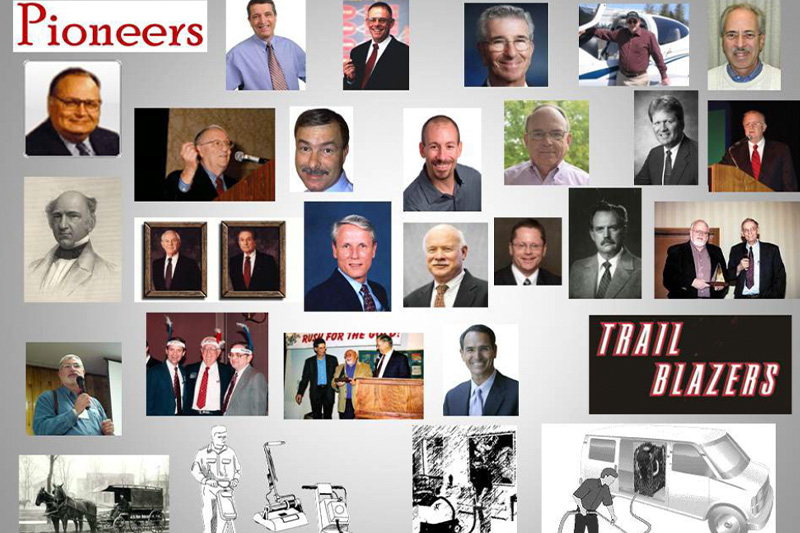
At risk of straying too far from my mission to pay homage to Lee Pemberton, allow me to invest a few more words in recognizing more of this founding generation. Above, I noted several who, like Lee, were especially influential in connecting the industry to training and education. A few more would include:
- David Burgin of Certified Chemical & Equipment and his father-in-law, Joseph Conway, who worked with my grandfather in the 1940s to develop a floor scrubber practical for use on installed carpet in the home.
- Bob Hughes and Dan Savanuck, founders of Chemspec.
- Mike Palmer, founder of HydraMaster.
- Gene Bates, a founder of Steam Genie and Bates Engineering.
- Major Long, a fire restoration pioneer and the first president (1978-1980) of the Association of Specialists in Cleaning and Restoration (ASCR), who was not an in-plant rug cleaner.
- Jack Bates, founder of Stanley Steemer.
- My father, John M. Downey, whom Jack Bates openly credited with many of the ideas he “stole” and used so well in building Stanley Steemer.
- Howard Olansky, publisher of Installation Specialist magazine (later renamed Installation & Cleaning Specialist), the original trade magazine serving the industry.
- Richard “Dick” Ragan and David Lowry, two of the early writers for Cleanfax who greatly contributed to its unique character.
There are many more, and I regret that I either do not recall or never knew some of them because they were gone before I arrived on the scene.
This diverse group of individuals collectively created the “soup” that spawned the on-location professional carpet cleaning industry and, somewhat later, the disaster restoration industry. As with all soups, a variety of ingredients was included.
- Engineering creativity in the development of cleaning systems, including both equipment and cleaning solutions.
- Marketing savvy in building awareness and demand for the services.
- Education and technical training, first on cleaning fundamentals and later on advanced techniques.
- Development of business management systems.
Every emerging industry includes a mix of these ingredients, and the particulars, in large part, determine how it develops. In the case of the professional carpet cleaning industry, innovative engineering was key, but education and technical training led the way. Also interesting is the fact that those who drove the industry forward, both the engineers and the educators and technical trainers, generally weren’t folks with college degrees, much less initials behind their names. This is and always has been an unrefined, earthy industry; one whose leaders rose through the ranks through talent, perseverance, and hard work.
Lee Pemberton, a reserved and modest man, nonetheless loved and identified with this rough-and-tumble industry. These were his people, and he loved them through good times and bad. He could see the inherent good, even noble, intentions of the thousands of mom-and-pop companies that made up the industry’s heart and soul. Lee made it his mission to help his customers improve in marketing and communications, as well as to hone their technical skills through IICRC courses and certification. Later, Lee’s son, Jim, would take a leading role in developing advanced technical training.
Lee was the cutting edge in many areas. In the 1990s, he lobbied for the creation of an IICRC distance-learning committee and served as its chairman for many years. He stood nearly alone against the mass of IICRC-approved instructors who opposed computer- and technology-enhanced training. It took a pandemic to open many of their minds. Largely because of the groundwork Lee had done years earlier, when the time came to transition to online classes, the IICRC leadership did not have to start from scratch.
Another area where he led was in “high-touch” marketing; that is, programs that emphasized the importance of frequent, low-pressure contacts with existing clients. He was a master at developing ready-to-use materials, including newsletters and service reminders, which made it easy for owner-operators to implement high-touch programs. Lee knew that for many owner-operators, innovative marketing was not a high-level skill they possessed; his programs made it easy for virtually any company to project a professional image.
The final two decades of Lee’s life were devoted largely to publishing The Cleantip, a concise weekly digest featuring marketing and management insights from Lee and a technical article from Jim. For many cleaners who entered the industry in this century, The Cleantip was their primary—and sometimes only—introduction to him. They may not have known the early pioneer, the shareholder, or the institutional architect. But they definitely knew the mentor in their inbox.
A legacy of leadership, mentorship, and service
Lee Pemberton’s funeral service was held on December 23, 2025. I was privileged to attend and listen as Lee’s son, Jim, delivered a remembrance of his father. I wish space allowed it to be reproduced in full here, for Jim’s words masterfully conveyed the full scope of his dad’s servant’s heart and how it impacted his family, friends, and industry associates. As it is, here in abbreviated form are the “seven lessons Lee taught us” (Jim and his sisters, Colleen, and Cheryl).
- Look after the less fortunate. Jim told several stories about Lee lending a hand to help the less fortunate.
- Find and nurture the potential in everyone. Again, several stories were shared about how Lee’s kindness helped those who shared his life for a time reach their potential.
- Be inspired by adversity. Lee used adversity as a spur to greater learning and improvement and felt it was an essential element of success.
- The grass is not always greener. At one point, Lee nearly left the industry to become a motivational speaker. At the last minute, he realized that the industry he was already in provided countless opportunities to motivate and help.
- We become what we think about most often. And becoming an avid reader will lead us to think about consequential things such as truth, love, and others. Among the most important books he read was Man’s Search for Meaning, authored by Viktor Frankl. In it, he found the lesson he never tired of teaching his kids, “You can’t help how you feel, but you control how you think and act.”
- Never say “I can’t.” Saying “I can’t” is self-defeating. A “can-do” attitude will overcome a myriad of obstacles.
- Never retire. As Lee aged, his work changed, but he never even contemplated retirement. Ponce de Leon sought but never found the Fountain of Youth. But all of us have access to “a fountain of a useful, purposeful life of service to others.”
And that, it seems, is a fitting note to end this tribute, for Lee Pemberton certainly led “a fountain of a useful, purposeful life of service to others.”









 Loading ...