What Does ‘Clean’ Mean To You?

When most people think about cleanliness, they picture a tidy space that looks and smells fresh. But for professionals in the cleaning and restoration industry, the idea of “clean” runs far deeper.
Dr. Gavin Macgregor-Skinner, senior director at ISSA, and Mike Pailliotet, owner of Connoisseur Cleaning, explored what cleanliness truly means—from both the technician’s and the client’s perspective.
Beyond what meets the eye
Dr. Macgregor-Skinner opened the discussion by rejecting the long-held notion that cleanliness is subjective. “Clean is not just about what looks good,” he said. “It’s measurable. It has to be because we’re spending real money on labor, tools, equipment, and products. We need to know we’re getting results.”
Drawing on his work in large-scale facilities through ISSA’s Making Safer Choices program, Macgregor-Skinner emphasized that the definition of clean must reflect the critical function of each space—whether it’s a school, a hospital, or an international airport. He challenged cleaning professionals to move past surface-level standards and use tools like ATP meters, moisture detectors, and air quality monitors to determine whether a space is genuinely safe and healthy.
The homeowner’s perspective
While Macgregor-Skinner takes a science-first approach, Pailliotet offered a boots-on-the-ground view shaped by 40 years of residential cleaning experience. “For homeowners, clean is mostly visual—and maybe odor,” he explained. “They don’t think about bacterial counts or what their vacuum leaves behind. If it looks good, it is good.”
Still, Pailliotet stressed that visual expectations vary based on the customer’s mindset. Some clients clean because guests are coming over. Others stick to seasonal routines. Very few, however, ask about health-based outcomes like allergen removal or microbial reduction. “It’s rare that someone wants proof we reduced germs,” he said.
Building trust, not just cleaning
For Pailliotet, establishing trust is often more important than the cleaning itself. “If you don’t build that connection on the first visit, you’re just one more failed cleaner,” he said. “But if you do, the next time you’re in and out while they’re at work—and the check is under the mat.”
He urges new cleaners to spend extra time with clients upfront, walking them through what to expect, asking about problem areas, and offering education when appropriate. That first impression can make the difference between a one-time job and a loyal, referring customer base.
Making the invisible visible
To help clients understand what’s lurking in their homes or facilities, Macgregor-Skinner shared a story from a school that was experiencing a spike in student absenteeism. The administration blamed the spring season, assuming pollen and flu were to blame. However, when students were given professional inspection tools as part of a science project, they discovered a hidden moisture issue behind a classroom wall. Lab results confirmed mold was present. Once the administration brought in professionals to remediate the problem, absenteeism dropped.
What’s the lesson? Contaminants are often invisible—and ignored. “We need to talk about bioaerosols, VOCs, allergens, and chemical residues,” Macgregor-Skinner said. “And we need to relate it to health. If people don’t feel good in a space, there’s probably a reason.”
Skimming the surface vs. deep cleaning
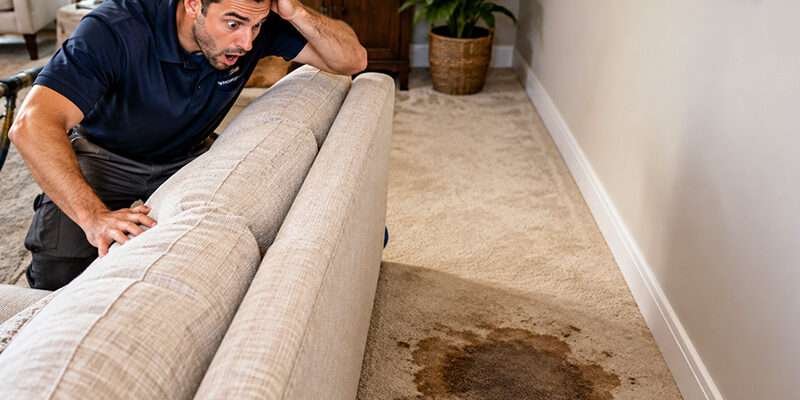
Pailliotet, known for his candor, challenged some industry norms about over-cleaning. “Too many of us try to do heroic jobs, going over a carpet 10 times with rotary extractors. All that does is over wet the carpet and create odor and bacteria,” he said. “Sometimes, you just need to skim the surface and make it look better without going too deep.”
He argued that many jobs involve long-neglected carpet that is too far gone for a full recovery. Instead of trying to restore them to like-new conditions, Pailliotet recommended cleaning for appearance and health without over-promising results. “We’re not doing anyone favors by making carpet take six days to dry,” he added.
The danger of selling the invisible
Pailliotet also expressed concern over the industry’s reliance on upselling invisible services like protectants and deodorizers. “There’s no long-term value the client can see or feel,” he said. “They might smell it for a day, but six weeks later, what do they have to show for that extra $300?”
He urged professionals to focus on delivering great cleaning from the start and to stop nickel-and-diming clients with every add-on. “Charge what you’re worth, do your best work, and don’t try to make a quick buck with invisible upgrades,” Pailliotet said.
Measurable progress in commercial cleaning
Meanwhile, Macgregor-Skinner returned to the commercial side, where metrics are beginning to drive decision-making. At one international airport where he consulted, sick leave among custodians was unusually high. By introducing safer products, standardized procedures, and real-time performance metrics, the airport achieved an 18% reduction in sick days—a measurable and meaningful improvement.
“Smell is not a proxy for clean,” he emphasized. “We need to focus on data and storytelling. Show what you did and why it matters.”
Bridging the gap between industry and client
Despite the different markets they serve, both experts agreed that education is key. Pailliotet wants manufacturers to offer better care instructions and support for proper cleaning methods—ideally before a customer even buys new flooring. Macgregor-Skinner echoed that call for standardization and collaboration across the entire value chain—from manufacturer to installer to cleaning technician.
“We need more evidence-based definitions of clean,” he said. “And more training that teaches people by doing—not just multiple-choice tests.”
The takeaway: Define, measure, and communicate
In the end, the definition of clean isn’t as simple as “looks good and smells nice.” It’s about removing what doesn’t belong—dirt, bacteria, allergens, chemical residues—and creating environments that support health, safety, and peace of mind.
Whether you’re cleaning an 8-million-passenger airport or a single-family home, the principles remain the same: educate your client, do the work right, and don’t underestimate the power of trust and transparency.
As Pailliotet concluded, “If you help someone keep their floor clean and teach them to do it right, they might not need you as often—but they’ll tell everyone about you.”

Jeff Cross
Jeff Cross is the ISSA media director, with publications including Cleanfax, Cleaning & Maintenance Management, and ISSA Today, as well as multimedia programs such as Straight Talk! and Take 5 With Cleanfax in video and podcast format. He can be reached at [email protected].