Navigating the Evolution of Modern Porcelain
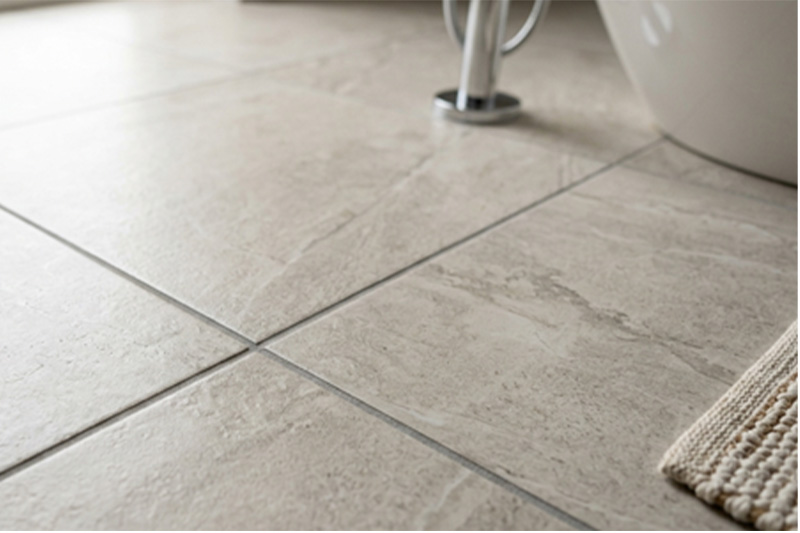
In my 25-plus years in this industry, I’ve watched hard-surface porcelain transform from basic 12-inch-by-12-inch squares to massive architectural panels that serve as dominant design elements. During that time, porcelain transitioned from being the “indestructible” darling of the maintenance world to sometimes becoming a source of intense frustration for facility managers.
The root of this frustration lies in a historical misunderstanding. For the end user, investing in this type of flooring often means relying on a preconceived notion that it is “indestructible and bulletproof.” To their credit, ceramic and porcelain products have been around for centuries worldwide, establishing a well-earned reputation for longevity.
But as my colleague Lloyd Cooper from Professional Testing Laboratories recently noted when discussing this ongoing challenge in the hard-surface world: “It is a durable product, but it is not maintenance-free.”
The reality is that we’ve seen a massive shift in how these floors are manufactured. If your maintenance program hasn’t evolved alongside the manufacturing technology, you’re likely fighting a losing battle. To bridge the gap between historical expectations and modern performance, the industry must adopt the right service equipment and chemicals.
Here is the reality of the “modern” porcelain landscape.
The “Texture Trap”
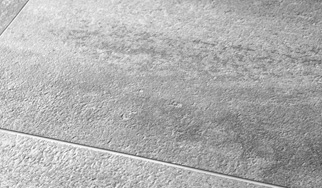 High-definition textures that mimic hand-scraped wood, tumbled stone, or industrial concrete are the current gold standard for design. They look incredible, but from a floor care service perspective, they can become a logistical nightmare.
- The Issue: These surfaces feature “micro-profiles”—microscopic nooks and crannies that act as reservoirs for dirty mop water. If you are still using a traditional string mop, you aren’t cleaning; you are essentially “grouting” the entire floor with a fine layer of biofilm and soil. Over time, that beautiful matte finish turns gray and dingy and can even become slip-prone if the pores fill with grease.
- The Fix: You must move toward mechanical agitation. A cylindrical brush machine is often the only way to reach into that profile and lift the soil out rather than just relocating it. If you can’t reach the bottom of the texture, you aren’t cleaning the floor.
The Great “Porcelain” Deception
- The Issue: To be certified as true porcelain, a tile must have a water absorption rate of 0.5% or less (as defined by ASTM C373). However, the market is currently flooded with “soft body” products that are far more porous than their labels suggest.
- The Reality: If your floor “shadows” (darkens) when wet or absorbs spills like a sponge, you aren’t dealing with true porcelain. You’ve got a higher-porosity ceramic masquerading as a high-performance material. Once contaminants penetrate the body of a soft tile, the stain can become permanent. This changes the chemistry required for cleaning; you may suddenly need a sealer on a product you were told would never need one.
Large Format and the “Haze” Factor
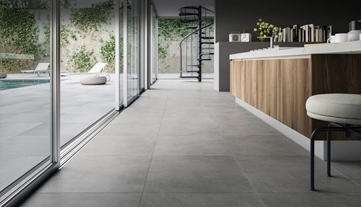 Gauged Porcelain Tile Panels (GPTP) are growing larger every year, with some slabs reaching sizes like 5′ x 10’. While designers love the seamless look, these massive, flat surfaces are optically unforgiving.
- The Issue: With fewer grout lines to break up the visual field, any residue left behind—whether from a subpar cleaner or mineral deposits in your tap water—creates a distracting optical haze. In the right light, an expensive installation can look smeared and oily regardless of how recently it was “cleaned.”
- The Fix: Eliminate “mop and shine” products or high-surfactant cleaners that leave behind a sticky residue. Use low-residue, pH-neutral chemistry and, most importantly, a clean water rinse. On large-format panels, the goal is “zero-film” maintenance.
The Precision Grout Problem
- The Issue: These tiny joints act like gutters for liquid and soil. Standard cleaning tools can’t penetrate these narrow gaps. When a spill occurs, it migrates into the joint and stays there.
- The Fix: Without vacuum extraction, you will never truly remove that soil. Relying on evaporation or “pushing” the dirt away only concentrates the grime in the joints. You aren’t just cleaning a floor; you’re managing a system of very tight tolerances that requires high-performance extraction.
The Overlooked Role of Grout and Deep Cleaning
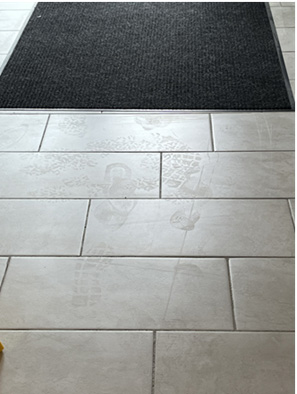 Expanding on these challenges, Jason Ruppel, Technical Manager with Solid Surface Care, points out that we often blame the wrong culprit when a flooring begins to fail in its acceptable appearance.
- The Insight: As Jason evaluates porcelain tile concerns, he notes that many are not actually tile issues at all; they are soiled grout and maintenance issues. While porcelain itself is typically resistant to staining, grout joints are often the first areas to show signs of soil accumulation, discoloration, and neglect.
- The Limitation of Daily Care: Daily maintenance plays an important role in maintaining appearance, but it has limitations. Over time, soils, oils, cleaner residues, and contaminants can become embedded within grout lines and textured tile surfaces. Once this buildup occurs, routine cleaning methods are simply not able to effectively remove it.
- The Restorative Solution: This is where periodic deep cleaning becomes critical. Deep cleaning utilizes specialized equipment, appropriate chemistry, mechanical agitation, and extraction to remove embedded soils from both the tile surface and the grout. Without periodic and restorative cleaning, even well-maintained porcelain installations can begin to show grout darkening, traffic-lane discoloration, and an overall loss of appearance.
Ultimately, facility managers should view porcelain tile and grout as a complete flooring system. While the porcelain may continue to perform as intended for decades, the visual success of the floor is often determined by the condition of the grout and the effectiveness of the maintenance program supporting it.
In many facilities, a properly executed deep cleaning process can restore appearance, improve cleanliness, and extend the life of the flooring system without requiring more aggressive corrective measures. The key is to address soil before it becomes permanently embedded and to ensure maintenance programs include both routine cleaning and periodic restorative services.
The Bottom Line
The “bulletproof” marketing of the 1990s has done a long-term disservice to the industry. Yes, porcelain is a high-performance material, but as Lloyd Cooper reminds us, “It is a durable product, but it is not maintenance-free.” It is a precision-engineered surface that requires a professionalized process.
If these cleanability issues are to be properly addressed and corrected, we must stop thinking about “mopping” and start thinking about the total removal of soil. To ensure these floors perform for the next 20 years, we must align our processes with the realities of independent laboratories: Verify your materials, upgrade to specialized equipment, and stop treating 21st-century technology with 20th-century tools.

Bill Luallen
Bill Luallen, the technical director for XL North, a division of the Textile Rubber and Chemical Co., has more than 25 years of experience in the floor care industry. He is the IICRC Technical Advisory Committee (TAC) Chair of the Commercial Carpet Maintenance Technician (CCMT) Committee and participates on the CRI 204/205 Carpet Maintenance and Cleaning Standards. Contact Luallen at 401-633-4656 or [email protected].