From the Jobsite to Capitol Hill: RIA Gives Restorers a Direct Line to Lawmakers
Every contractor, owner, estimator, and team leader in the restoration industry has an opportunity—and, many would argue, a responsibility—to help shape the policies that govern insurance claims, workforce issues, environmental regulations, and licensing. The future of the profession itself may depend on it.
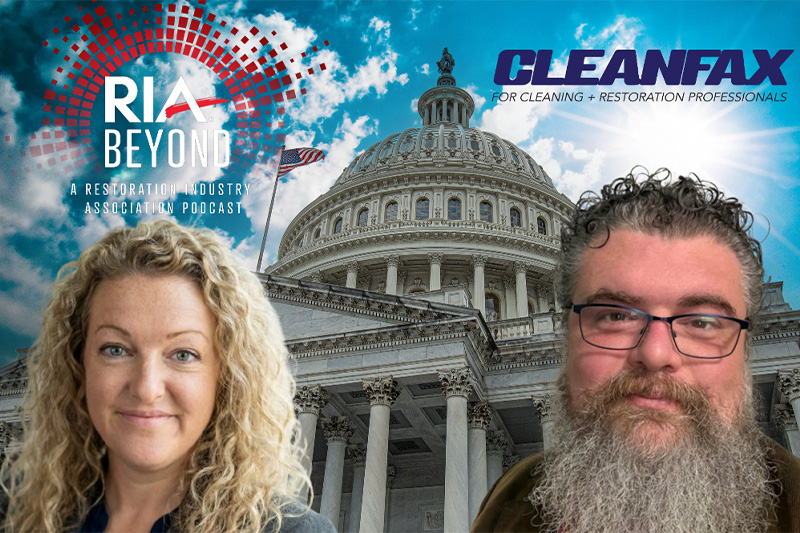
That message was front and center in a recent episode of RIA Beyond, which brought together Adam Campbell, team lead for Client Success Managers at VoterVoice, and Krystie Reeves, co-owner of BioTeam AZ and BioTeamOR and chair of the RIA Legislative Committee. The conversation covered the launch of the Restoration Industry Association’s Voter Voice Platform and Advocacy Action Hub, a tool designed to give restoration professionals a direct line to lawmakers and decision makers.
One industry, one voice
Reeves framed the stakes plainly. Too many decisions that directly affect restoration contractors, their employees, and their customers are being made without anyone from the industry at the table.
“We are all in this together, every single one of us throughout the United States,” Reeves said. “We are one restoration community. We need a voice when decisions are being made that could often impact employees, businesses, customers. Too often, laws and regulations are considered without emergency restoration services providers at the table.”
Campbell reinforced that concern from a broader vantage point, noting that states frequently look to each other when crafting new legislation. A poorly written regulation in one state can become the model for the next.
“If you have ever been in a position where you felt like you were wasting time and money jumping through unnecessary hoops put in place by people who didn’t understand what was and was not actually important or pertinent to the issue at hand,” Campbell said, “then it’s also worth being a little worried that someone in the next state over did that, and now your legislators are going to get a great idea.”
His point: this is not a partisan issue. “These are about helping the populace,” Campbell said. “These are about cutting out unnecessary red tape so that the entire industry is protected.”
What the platform does—and how easy it is to use
The Voter Voice platform, developed by FiscalNote—described as the world’s leading legislative intelligence platform—specializes in grassroots advocacy. That means getting the people who actually do restoration work to connect directly with their legislators, not relying on lobbyists or high-profile representatives.
“By reaching out en masse and sending timely, informative, specific messages, you can really have an enormously outsized impact compared to signing petitions, posting videos, or liking that Facebook article,” Campbell said. “Legislators aren’t really looking at public awareness to make a lot of decisions. They need to hear from the people who actually are in the know.”
Getting involved is designed to be nearly effortless. The RIA sends members an email—and optionally a text message—when a relevant bill comes up in their area. That communication explains why the legislation matters and links directly to an advocacy campaign within the platform. Members can see which legislators represent them, read a prepared form message, and send it in as little as 15 to 20 seconds.
That said, Campbell was quick to point out that a personalized message is significantly more powerful than a form letter. “Even if they would like you to place a phone call, we’ll provide the phone number and a phone script,” he said. “You really just have to leave a quick message.”
The issues that matter right now
Reeves identified several state-level concerns that restoration professionals should be watching closely.
Licensing and regulation tops the list. Restoration is not yet recognized as its own trade in many states, and regulators are trying to fit it into existing contractor or construction frameworks that simply don’t apply. “They’re trying to cookie-cutter it—sticking a square into a triangle,” Reeves said, “because they have existing contractor or construction rules that apply, and then they’re trying to put the restoration industry inside those, and it doesn’t work.”
Insurance claims and payment legislation is another active battleground. Assignment of benefits, contract regulations, UPPA, consumer disclosures, and the conditions under which contractors can be involved in a claim are all in play in multiple states. Louisiana recently passed legislation that the industry fought hard against, and similar efforts are moving elsewhere. Campbell specifically called out Iowa SSB 1188, a post-loss assignment of benefits and contract regulation bill that is currently active.
Consumer protection and solicitation laws round out the concerns. These laws are often well-intentioned—designed to protect property owners from bad actors following disasters—but Reeves said they are frequently written too broadly. A right-to-cancel window of three to five days for water damage, for example, doesn’t protect the consumer. It creates a mold problem. “I don’t see how that’s protecting the consumer at all,” she said.
Both Reeves and Campbell emphasized that the solution is not just reactive. Building relationships with lawmakers before a crisis arises—letting them know the industry exists, asking for a seat at the table early—is just as important as fighting bad legislation once it appears.
Small businesses do get heard
It is easy for a small restoration contractor to assume their voice won’t make a difference. Campbell pushed back on that assumption with examples drawn from other industries.
He pointed to a local Albany, New York, vote on raising the tobacco age to 21. Trinity Health identified 30 legislators who would be voting that Monday and sent a call to action to employees of St. Peter’s Health Partners on Monday morning. Every county council member received about a dozen messages from those employees. “A dozen doesn’t sound like a lot, right?” Campbell said. “This is a local county council. A dozen messages from employees on the same issue is huge.” The measure passed by a wide margin after previously stalling.
The Arthritis Foundation’s effort on a step therapy reform bill in Georgia in 2019 tells a similar story. With only 172 total messages—all targeted, timely, and personalized—and about six in-person conversations, they achieved passage of HB63 by a landslide.
Why personal stories outperform form letters by 56%
Campbell cited research from the Congressional Management Foundation, which surveys Capitol Hill staffers every few years on what does and doesn’t move the needle in advocacy.
Fifty-five percent of staffers say that petitions and form letters will help move legislators who aren’t already firmly committed to a position. But when a personal story is added to that message, 90% of staffers say it is effective—a 56% increase.
“Y’all are not dealing with hardline moral issues,” Campbell said. “People should be protected in times of need. Nine out of 10 would say, if you add a personal message, you are absolutely going to be significantly more effective than just sending a form letter.”
Restoration contractors have those stories. Every job site is evidence that speed matters, that regulations have real consequences for real people, and that the industry exists to protect property owners when they are most vulnerable.
Getting started: think small, then build
Reeves offered straightforward advice for contractors who feel unsure about where to begin.
“Start small,” she said. “Take 30 minutes next week, review the RIA’s advocacy and government affairs website. See what information is there. You can quickly learn that it doesn’t have to be complicated. It doesn’t have to be expensive at all to your business.”
Staying informed about local legislation, she argued, is simply part of operating a professional business—no different from staying current on industry standards or certification requirements. “If you change the mindset of ‘we’re going against the government,’ that’s not what this is about. It’s protecting your business.”
The RIA Legislative Committee is available to answer questions, provide context, and help members identify what they can do. But ultimately, Reeves said, it is the businesses themselves that will make the impact.
“We can only do so much because we aren’t the businesses,” she said. “As the legislative committee, it’s the businesses that will make the impact. We’re here to empower them.”
The message from Reeves as the conversation wrapped up was direct: the industry cannot afford to sit on the sidelines while legislation moves faster than it ever has.
“Getting informed, getting involved, and making your voice heard—and the more RIA members, the stronger and more credible our message becomes,” she said. “We will get invited to the seat. It starts with the grassroots efforts, and we are stronger together. We truly are.”
Watch the complete interview and listen to the podcast:

Jeff Cross
Jeff Cross is the ISSA media director, with publications including Cleanfax, Cleaning & Maintenance Management, and ISSA Today, as well as multimedia programs such as Straight Talk! and Take 5 With Cleanfax in video and podcast format. He can be reached at [email protected].