Battling Microbial Contaminants: The Hidden Risks Lurking Behind Every Water Loss
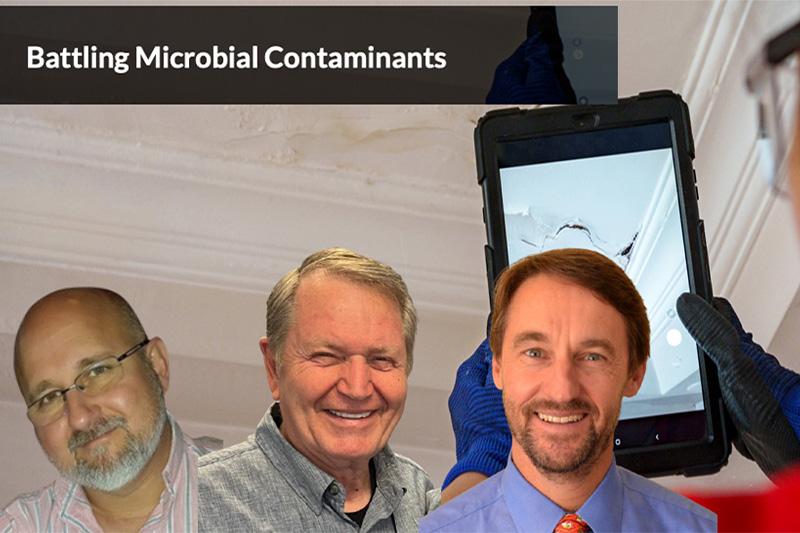
Assessment, containment, and cleaning techniques decide whether a job ends or comes back.
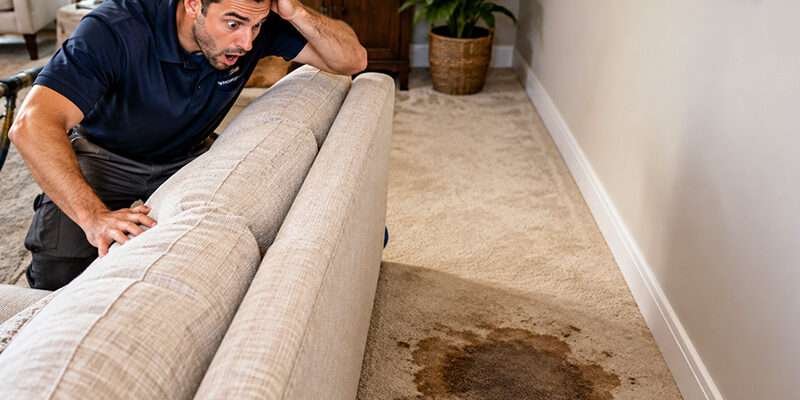
A supply line fails on the fifth floor of a seven-floor apartment building while the tenants are on vacation. Water runs for more than 30 hours. Tenants below report ceiling stains; a contractor found through a web search arrives about 36 hours after discovery, and the building sits wet for close to three days.
The crew takes a couple of moisture readings on visible drywall, sets air movers, and leaves. No moisture mapping. No readings inside the wall cavity. No thermal imaging. No sampling, because nothing was visible yet.
One event, three separate problems
Twenty-one days later, with the leak repaired and the invoice paid, Dr. Gavin Macgregor-Skinner walks into musty and sulfur odors. A resident below the loss has asthma and is reporting attacks in July, outside her pollen season.
Macgregor-Skinner, senior director of the Global Biorisk Advisory Council (GBAC), a division of ISSA, found growth behind a baseboard that the lab returned as Aspergillus and Penicillium type colonization, which covers more than 900 species. Wet insulation in the wall cavity held Actinobacteria, a gram-positive organism that favors moist, alkaline, cellulose-rich conditions and carries a sulfur odor. The fan coil unit ran through the whole event, and discoloration in the condensate pan and ducts turned out to be biofilm.
“We often go in with, in reality, a one-problem mindset. We’re looking for mold,” Macgregor-Skinner said. “When actually water is our enemy, and it leads to growth of mold and bacteria.”
Watch the complete webinar here
Prognosis without diagnosis is malpractice
Doug Hoffman hears that story as an argument for assessment. He is founder and executive director of NORMI, the National Organization of Remediators and Microbial Inspectors, named in the federal MOLD Act to train and certify assessors and remediators.
“Can you imagine going to a doctor … and saying, I got this pain in my back on my right side over here. Can you just take my kidney out?” Hoffman said. “Prognosis without diagnosis is malpractice.”
NORMI Professional Practices lays out 13 steps to an assessment, covering the subjective side, odors and what an inspector sees, and the objective side, diagnostics and third-party lab confirmation. The weak spot, Hoffman said, is the inspector who pulls two samples, hands over the lab report, and tells the customer there is no problem.
Moisture levels grow different organisms
Materials support growth at different water activity levels. Aspergillus species take hold on barely damp material. Stachybotrys and Chaetomium need sustained moisture. Cladosporium, Penicillium, and Alternaria fall in between and are the most common molds found indoors.
“The techs are going in right now, and they’re treating moisture damage as one category, when really we’ve got a whole range of conditions in the same job,” Macgregor-Skinner said. Baseboard, wall cavity, and HVAC coil in that building were wet in different ways, and each grew something different.
One building can hold separate environments, Hoffman added. He recently assessed a high school athletic center where three areas on three air conditioning systems each carried a different microbial load.
How much does a tech need to know
Alvaro “Moe” Zuluaga, who leads FPT Environmental in Davie, Florida, and teaches NORMI courses in English and Spanish, said technicians should know dry-tolerant molds from water-loving molds without memorizing every species. What they cannot skip is the substrate and the contaminant on it.
“You cannot clean a biofilm the same way that you would clean a mold job,” Zuluaga said. “You have to disrupt that matrix, which takes different chemistry and different processes.”
Remediation now draws people from construction, roofing, and claims adjusting, and Zuluaga said the part they skipped is the hardest. “We do need to go back to making sure that our technicians know how to clean professionally,” he said.
Tools decide what gets found
Hoffman carries a four-level pack-out box onto a project so he can evaluate bacteria growth, particulates, VOCs, and mold counts instead of one or two. An air cassette sent off for spore counts says nothing about bacteria in the space. A thermal imaging camera reports a temperature anomaly, which could mean missing insulation, water, or air infiltration.
“Practice doesn’t make perfect, practice makes permanent,” Hoffman said, quoting a college teacher.
Containment is a system
Zuluaga’s company stopped saying containment and now says engineering control system, because the old word points a technician toward poly and poles instead of the whole system. Sheeting gets secured to the building, even if that means screwing a board into a wall that needs repair anyway. Size accounts for what demolition will expose, not what shows on day one. Negative pressure goes in one corner, dictated fresh-air makeup in the other, and the work follows that airflow.
“If you don’t control the environment, the environment controls you,” Zuluaga said.
The failures he sees most: registers sealed without accounting for the whole HVAC system, gaps where extension cords cross the floor, negative pressure that never gets verified, and no decontamination chamber. Even a single-stage chamber creates two doors, so no opening stays permanently open.
Chemistry is not step one
Macgregor-Skinner wants the industry to borrow the hierarchy of hazard control, which runs from elimination and substitution through engineering and administrative controls, with personal protective equipment last. His concern is the reflex to answer microbial growth with a product. Manufacturer sales data he reviewed showed commercial buyers reaching for more toxic chemicals ahead of high-traffic summer events.
“We don’t kill, we remove,” he said. Surfactants do that work, and he wants contractors to understand them before comparing labels. “Chemistry selection is not your step number one,” Macgregor-Skinner said. “The product that you pick should really be nearly at the bottom, the last decision you make, not the first.”
An empty file is the risk
Six months out, an adjuster and an attorney may want the same file. The question no contractor wants, Hoffman said, is why one customer’s job was handled differently from every other job the company has run.
“You just can’t have enough documentation,” Hoffman said. Photos, notes dictated into a phone at day’s end, and paperwork from the contract through post-remediation verification all belong in the file.
One habit worth changing tomorrow
Zuluaga tells his team a good remediator needs two things: you cannot be lazy, and you have to care. The effect a crew leaves is never neutral. “You’re going to work with your heart, and you’re going to be that light for those people,” he said.
Hoffman would have every technician stop, take a breath, and plan before stepping onto a site. “We fix buildings, not people, but we’ve got to understand that we’re dealing with people’s health,” he said. NORMI members can now access a mold illness course from the George Washington University School of Medicine.
Macgregor-Skinner put his answer in just a few words: act as you work in a hospital. Occupants are not grading vocabulary or counting certifications. “What they want to know is they want reassurance,” he said. Take the science, get it onto one page, and tell the client what will happen and why.

Jeff Cross
Jeff Cross is the ISSA media director, with publications including Cleanfax, Cleaning & Maintenance Management, and ISSA Today, as well as multimedia programs such as Straight Talk! and Take 5 With Cleanfax in video and podcast format. He can be reached at [email protected].