
Rethink Carpet Fiber Durability
For decades, the commercial carpet industry has relied on the assumption that adding nylon to woven wool carpet makes it stronger and more durable. The most common construction, an 80/20 wool/nylon blend, remains widely specified in hospitality and contract projects worldwide.
However, a new study challenges long-standing beliefs. Using internationally recognized wear and soiling protocols, Dr. Ágnes Zsednai with the WoolSafe Organisation tested 100% wool woven carpet head-to-head against an identical 80/20 wool/nylon blend.
Key findings from the WoolSafe lab study:
- Pile retention: 100% wool held its pile thickness better in the critical early years of simulated use.
- Appearance retention: The 80/20 blend showed faster loss of pattern clarity and more flattening.
- Soiling: The nylon blend trapped more soil. While it released some during cleaning, it consistently showed higher residual soil levels.
- Shedding: No significant difference between the two constructions.
Overall, adding nylon did not extend the performance life. In fact, the blend showed disadvantages in both appearance and cleanliness.
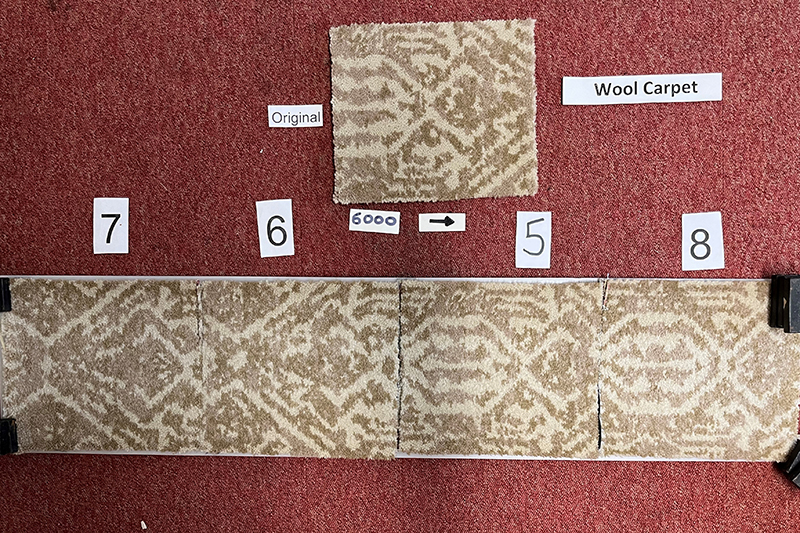
Wool sample out of the Hexapod after 6,000 revolutions. Samples were subjected to various stages of wear to demonstrate their performance over time. Sample 5 (3,000), sample 6 (4,000), sample 7 (5,000), and sample 8 (6,000).
This study provides the most substantial evidence to date that high-quality woven wool carpet performs better on their own, without synthetic reinforcement.
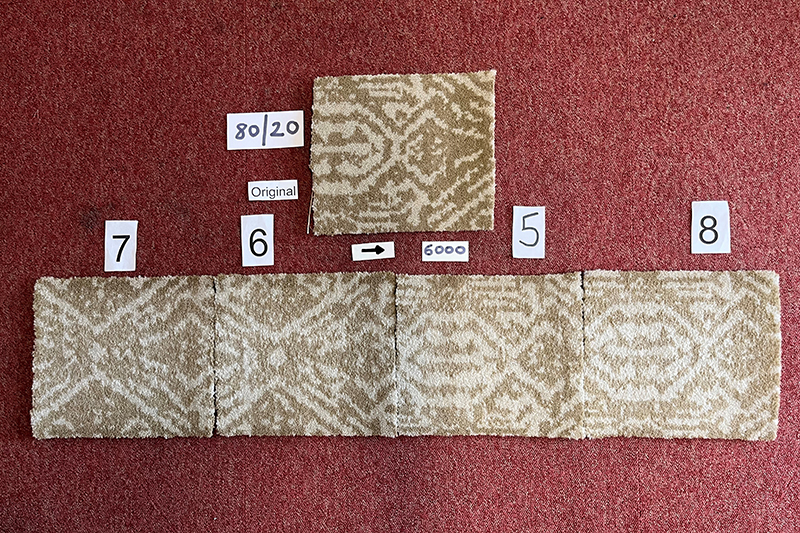
80/20 wool and nylon sample out of the Hexapod after 6,000 revolutions. Samples were subjected to various stages of wear to demonstrate their performance over time. Sample 5 (3,000), sample 6 (4,000), sample 7 (5,000), and sample 8 (6,000).
What this means for the U.S. cleaning market
Nylon dominates the installed carpet market in the U.S., with polyester making significant inroads in residential spaces. Wool is often seen as a niche or luxury fiber.
For cleaners, this new WoolSafe data has important implications:
- Wool is not a weakness; it is a strength. Many technicians assume that wool needs nylon blended in to stand up to traffic. This study shows otherwise. Pure woven wool not only competes, but it also excels in long-term appearance and soil management.
- Commercial clients benefit from longevity. In high-traffic spaces, such as hotels, offices, and public buildings, lifecycle costs matter more than initial costs. A carpet that keeps its appearance longer reduces replacement cycles, disruption, and environmental waste. Wool provides that durability.
- Cleaners can advise with confidence. As service providers, we frequently receive questions about which fibers to specify. With this study in hand, cleaners and consultants can recommend 100% wool woven products with evidence-based assurance of performance.
- Education matters. Cleaning wool requires a different approach than cleaning synthetic fibers. Technicians who complete the WoolSafe Fibre Care Specialist course gain the skills to care for wool safely and effectively in both commercial and residential settings. WoolSafe Approved Service Providers are listed in a global directory, making it easy for businesses and consumers to find trusted local professionals.
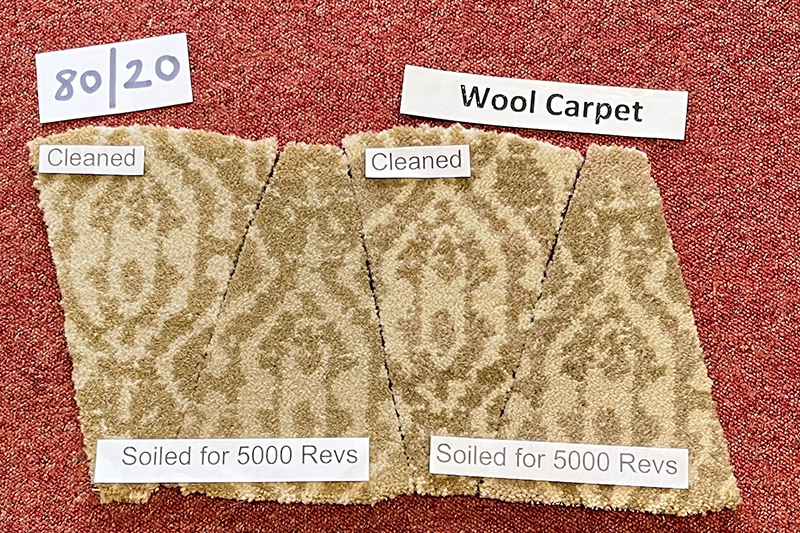
Comparison at 5,000 revolutions: Clean vs. soiled samples of 80/20 blend and 100% wool.
This research was conducted by Dr. Ágnes Zsednai, the WoolSafe Organisation, at the request of the International Wool Textile Organisation (IWTO). For more details about the WoolSafe Lab and the course to become a WoolSafe Approved Service Provider, visit www.woolsafe.org.

Lisa Wagner
Lisa Wagner is a second-generation rug care expert, NIRC Certified Rug Specialist, and an owner of K. Blatchford’s San Diego Rug Cleaning Company. She was recognized as the 2006 Cleanfax magazine Person of the Year for her industry contributions. For online rug course and training event details, visit www.RugClass.com.








 Loading ...