The Trust Factor: An Inside Look at RIA’s New Ethics Framework
Ethics can sound like a soft topic—until trust breaks down, claims get messy, and the reputation of an entire industry begins to feel the pressure.
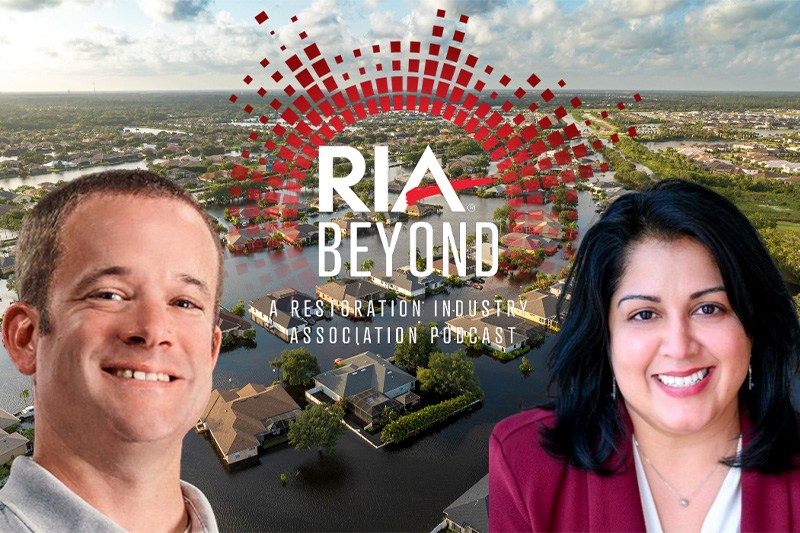
That is precisely the premise behind this inaugural episode of RIA Beyond, a new multimedia program from the Restoration Industry Association produced in collaboration with Cleanfax.
New voices, deep roots
Saima Hedrick, the RIA’s new CEO, is three months into her role, arriving with more than 20 years of experience in association management and a background in public health.
Justin Woodard, the organization’s president-elect, brings a different kind of history to the table. He is the owner and CEO of Woodard Cleaning and Restoration in St. Louis—a third-generation company—and he noted that both his grandfather and grandmother previously served as president of the RIA in the 1970s and 1980s, respectively.
“I kind of feel a sense of pride to be able to sit in the same seat, or follow in the footsteps, if you will, of my grandparents,” Woodard said.
That generational perspective matters in the context of their conversation. The RIA’s original code of ethics was developed in 2006—a document that reflected a membership that looked quite different from what it does today, before the rug cleaning segment broke off to form its own association in 2009. The industry has changed. The code needed to change with it.
More than words on a page
Hedrick described a deliberate, stakeholder-driven process behind the updated ethics framework. Rather than revising a list of principles in isolation, the RIA convened different groups—including a carrier relations task force and a carrier representative task force—to surface what each party actually needs from the others to build trust.
“We took a really holistic process in all of this,” Hedrick said. “This time we really took a point to have conversations with different stakeholders and really come to the table about, what do you need from restorers to build up trust?”
The result is not simply an updated document to post on a website. Hedrick said follow-up education, accountability structures, and ongoing dialogue are all part of the plan—something she called unlike anything she has seen in 20-plus years working in associations.
Woodard framed the ethics code in practical terms: not as a compliance statement, but as a list of behaviors that are critical to success. And he was direct about what it takes to make that kind of document work inside an organization.
“It takes incredible repetition of the expectations and those standards,” he said. “You have to repeat, repeat, repeat and talk about it all the time.” He also emphasized building those behaviors into the rhythms of meetings, gatherings, and day-to-day operations—and recognizing people when they demonstrate them. “We have to highlight and catch people and restorers doing the right things,” he said. “And we have to elevate those people.”
When it comes to accountability and consequences for ethical misses, Woodard’s view was measured. Consequences matter and provide protection, he said, but they are not the engine that drives a healthy ethical culture. “You don’t implement core values with a stick.” The real work is consistently encouraging people toward the right behaviors—starting with leaders who model them.
Watch the video here and listen to the podcast, and keep reading below:
Article continues:
Balancing advocacy and trust
One of the more pointed questions in the conversation concerned how the RIA can advocate for restorers while simultaneously building trust with carriers and other stakeholders who may see things differently. Woodard acknowledged the tension honestly.
“I’ve been on the side of the table where I feel like I am the little guy,” he said, where he felt taken advantage of, and where his instinct was to fight back and win by making the other side lose. He said that approach doesn’t work, and over time he has come to believe it doesn’t even feel as satisfying as expected.
His alternative is rooted in a principle his father instilled at Woodard for years: the win-win-win. “That’s a win for the customer. That’s a win for our employees. And that’s a win for Woodard or the shareholders.” Woodard argued that the same framework applies across the industry—that restorers, carriers, adjusters, and consultants are not adversaries, but parties who all need to arrive at outcomes that serve the homeowner or business owner who is trying to get their life back.
“We have to stop pretending like they’re the other side,” Woodard said. “We are all in this to help the customer get back to their life.”
Hedrick brought it back to a practical reality: ethics is good for business. A trusting relationship with carriers and other stakeholders is not a soft goal—it is a competitive and operational advantage.
The one standard the industry needs most
Asked to name a single ethical standard the industry should embrace more seriously right now, Woodard chose transparency—and he was specific about what that means in practice.
The restoration industry involves novel worksites on a regular basis. Restorers run into scenarios nobody has seen before. Consultants get assigned. Relationships with adjusters may or may not exist. Billing disputes loom in the background of jobs that are still in progress. Woodard’s contention is that the industry would be better served by more direct, upfront communication about those concerns—asking the questions that
feel uncomfortable, disclosing worries early, and negotiating clearly on the issues that tend to cause conflict later.
“If we could just have a little bit more transparency—if we could say, hey, I’m a little concerned about this one—that we’re going to do all this stuff upfront and we’re not going to be treated fairly on the back end,” Woodard said. “We might go just that much further in building trust between all the different people that have to come together to help customers.”
It is, he acknowledged, a nerve-wracking shift for an industry accustomed to holding cards close to the vest. But in his experience, a different result requires a different approach. “I really believe if we are able to do things in a more transparent way, communicate more clearly, we will increase trust in the ecosystem. We will be seen as the professionals that we are.”
The next step
The RIA plans to continue this conversation at its upcoming convention in Savannah, Georgia, where the new ethics framework and related projects will be presented to the broader membership. Hedrick and Woodard both encouraged industry professionals to get involved by participating on committees and task forces, joining the RIA, or simply referring a colleague who has not yet joined.
RIA Beyond will continue as a multimedia program with articles, videos, and podcasts. For an industry navigating significant strain in its relationships with carriers, TPAs, and other stakeholders, the hope is that a renewed foundation in ethics offers more than a good-looking document. It offers a way forward.
Don’t miss the RIA International Restoration Convention & Industry Expo. Click here.
Learn more about RIA membership. Click here.

Jeff Cross
Jeff Cross is the ISSA media director, with publications including Cleanfax, Cleaning & Maintenance Management, and ISSA Today, as well as multimedia programs such as Straight Talk! and Take 5 With Cleanfax in video and podcast format. He can be reached at [email protected].