See Something, Swab Something
Once a year, I have the privilege of meeting with first-time homeowners at our local Habitat for Humanity headquarters to talk about indoor air quality (IAQ) and mold. I usually begin by asking them to describe mold. The answers are predictable: “It’s ugly,” “It’s black,” or “It looks like slimy dirt.”
Then I show them a microscopic image of several slime molds. At that level, they’re surprisingly beautiful—pink, blue, green and yellow formations that look more like flowers than mold.
It makes my point perfectly: You can’t tell what something is just by looking at it.
Any professional who has spent time inspecting buildings has seen it. A dark spot on drywall. A suspicious discoloration around an air-conditioning register. Something growing on a floor joist. A strange-looking substance behind a cabinet.
And almost immediately, somebody says, “That’s mold.”
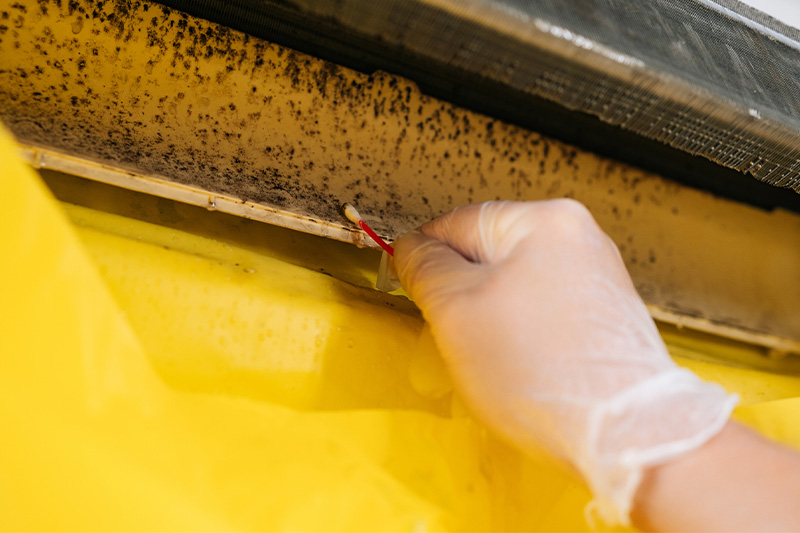
Maybe it is. But maybe it isn’t. That is exactly why I believe mold and indoor environmental professionals should adopt a simple rule: See something? Swab something!
You can’t diagnose mold by appearance alone
Experience matters. A trained professional can recognize conditions that suggest microbial growth and identify moisture problems that deserve further investigation. But there is a significant difference between saying, “This appears to be microbial growth,” and definitively identifying what that substance is. A laboratory can help answer that question.
When visible suspect growth is present and identification could affect the decisions that follow, a properly collected surface sample can be an inexpensive and valuable piece of evidence. Rather than making an assumption based solely on appearance, the professional can document the condition, collect the sample and submit it to a qualified third-party laboratory. Now we have information instead of speculation.
When sampling can prevent costly mistakes
As well-trained professionals, we need to consider the consequences of identifying something as mold when it isn’t. A remediation contractor may be called. Containment may be established. Building materials may be removed. Contents may be relocated. An occupant might temporarily leave the property. Work schedules may be disrupted. Insurance claims or disputes could follow. Somebody is going to pay for all of it.
If the original conclusion was based primarily on someone looking at a spot and saying, “Yep, that’s mold,” we have to ask an uncomfortable question: Was all of that really necessary? Realistically, the cost of a swab or tape-lift sample can be insignificant compared with the cost of unnecessary remediation, relocation and disruption.
But there is another side to this issue that may be even more important. What if the professional looks at something suspicious and decides it is not microbial growth when it actually is? Guessing works both ways and could be costly.
Sampling is evidence, not the entire assessment
A good assessment isn’t about collecting samples everywhere. It is about knowing when sampling will provide useful information and how the results will affect your decisions. That distinction is important and sampling should never replace a thorough visual assessment, moisture investigation, building history or understanding of potential exposure pathways. Laboratory results are another piece of the puzzle—not the entire puzzle.
But when the identity of visible suspect material matters to the conclusions you are going to draw, third-party laboratory analysis can provide valuable documentation. Interpret those results within the context of the entire assessment and that is a much more defensible process than guessing and recognize that presence is not the same as exposure and, therefore, not equal to it.
From mold identification to professional judgment
This is another reason professionals need better training in this subject. Finding mold does not automatically establish exposure, and exposure does not automatically establish a health effect. Those are quite different questions.
The responsibility of the environmental professional is to gather reliable information about the building and its conditions—not to draw or suggest medical conclusions. Gathering reliable information requires understanding moisture, building science, microbial contamination, sampling strategy, potential exposure pathways and the limitations of the testing methods being used. That’s the big picture and identifying a substance as mold doesn’t tell us everything we need to know. But correctly identifying what we are looking at can be an important starting point.
When you encounter what appears to be microbial growth, the professional should know that swabbing it and getting the third-party confirmation could:
- Help prevent unnecessary remediation.
- Help prevent unnecessary disruption for occupants.
- Provide documentation supporting your recommendations.
- Help protect the property owner, contractor and assessor.
- Replace an assumption with evidence.
Today’s mold and indoor environmental professionals need more than a moisture meter and a sampling pump. We need to understand building science, microbial ecology, sampling methodology, exposure pathways, documentation and the reasoning behind the recommendations we make.
Turn evidence into better decisions
At the National Organization of Remediators and Microbial Inspectors (NORMI), our goal has always been to raise that level of professionalism.
Make sure you have the training necessary to understand what the diagnosis results actually mean. Put the information in the context of the use of the built environment, building performance, the lifestyle of the client, the complaints they are expressing and your subjective big picture evaluation. By doing so, you will not be using indefensible guess work but the right solution for a cleaner, safer and healthier environment.

Doug Hoffman
Doug Hoffman is the founder and Executive Director of the National Organization of Remediators and Microbial Inspectors (www.normi.org), a not-for-profit training and certification organization for IAQ professionals. His passion has been helping people understand how to live healthier lives indoors and empowering them with the ability to have clean air. Get more information from his book, Mold-Free Construction, at www.moldfreeconstruction.com.
Doug can be reached via e-mail at [email protected].