
How to Clean and Maintain Luxury Vinyl Tile
For cleaning professionals willing to adapt, luxury vinyl tile and plank (LVT/LVP) represent one of the most significant growth opportunities the industry has seen in decades. But we must know how to clean and maintain it.
Maintenance of LVT/LVP is more comparable to finished wood floors than to carpet or traditional vinyl composition tile (VCT). Like wood, LVT/LVP:
- Has a factory-applied surface layer.
- Shows cosmetic wear before structural failure.
- Benefits from surface protection.
- Responds best to controlled enhancement rather than repeated aggressive cleaning.
Best-practice maintenance typically includes:
- Regular vacuuming or dust mopping to remove abrasive soils.
- Neutral-pH cleaning to protect the wear layer.
- Controlled moisture—never flooding the floor.
- Periodic restorative maintenance instead of constant deep cleaning.
This framework aligns closely with how professionals already approach engineered wood and specialty hard surfaces.
The role of professional floor finish on LVT/LVP
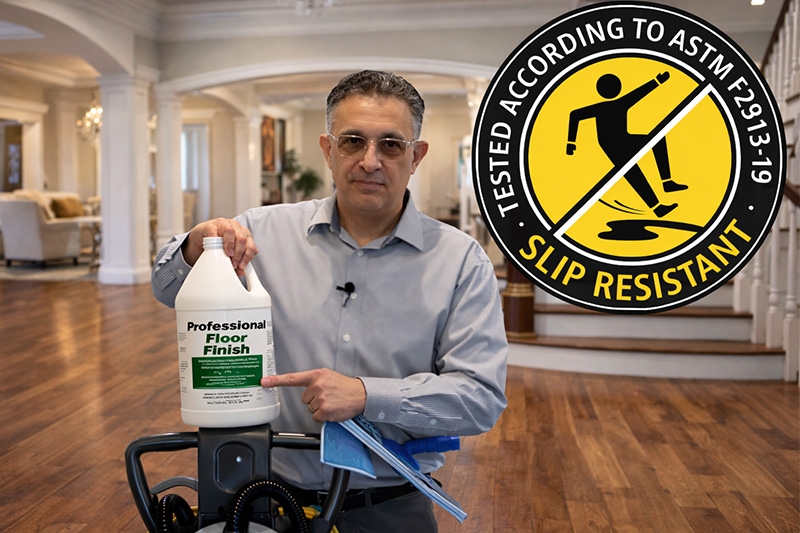
Whether professional floor finish should be applied to LVT/LVP is a frequent point of debate. Manufacturers often state that finish is not required, which is typically accurate from a warranty standpoint. From a performance and appearance standpoint, field experience presents a more nuanced reality. When LVT/LVP is left unprotected:
- Micro-scratching accumulates.
- Soils embed into surface texture.
- Visual clarity diminishes over time.
- The oleophilic plastic wear layer can retain oily residues and appear dingy.
When a compatible, professional acrylic floor finish is applied:
- A sacrificial wear layer absorbs abrasion.
- Soils remain on the surface rather than embedding.
- Visual “dinginess” from oily residues is significantly reduced.
- Resistance to moisture intrusion is improved.
- Visual clarity and controlled sheen are restored.
- Chemical exposure to seams and edges is reduced.
A properly applied finish acts as a sacrificial barrier above the factory wear layer, allowing wear to occur in the finish rather than the floor itself. The finish can be refreshed through recoating rather than replacement.
Appearance drives client satisfaction
While protection is necessary, appearance ultimately defines success in the client’s eyes.
In both residential and commercial environments, clients tend to associate:
- Clean floors with brightness
- Well-maintained floors with controlled sheen.
Cleaning alone often leaves LVT/LVP technically clean but visually flat. Two thin coats of professional floor finish typically:
- Restore depth and clarity.
- Improve reflectivity without excessive gloss.
- Enhance perceived cleanliness
- Add protection against moisture and abrasion.
This approach is not about creating a high-gloss floor in every environment. It is about meeting expectations consistently.
A practical professional workflow
A typical professional LVT/LVP maintenance cycle includes:
- Dry soil removal through vacuuming or dust mopping.
- Use a neutral cleaner that can break the oily bond on the wear layer, then rinse and recover.
- Use of purpose-built wood floor cleaning machines that scrub, recover, and squeegee in a single pass.
- Application of two thin coats of a compatible professional floor finish.
Finish chemistry matters. Well-formulated acrylic finishes abrade evenly rather than peeling, allowing restoration through recoating instead of stripping. Cleaner formulation also matters, as the vinyl wear layer attracts oily residues that require specific chemistry to remove.
This process is not strip-and-wax and does not rely on aggressive chemicals, and it is well within the skill set of most professional cleaners.
The business opportunity
As LVT/LVP continues to expand, cleaning companies focused exclusively on carpet risk becoming less relevant. Those who understand how to clean, protect, and enhance LVT/LVP position themselves as comprehensive floor-care providers.
Key advantages include:
- A rapidly expanding market.
- Higher average ticket values than carpet cleaning.
- Reduced labor intensity.
- Predictable maintenance intervals.
- Strong commercial demand.
- Higher perceived value.
- Less physical strain on technicians.
For new businesses, LVT/LVP offers an accessible entry into hard-surface care. For established carpet cleaners, it represents a logical and profitable expansion.
It’s here to stay
LVT/LVP are not passing trends—they represent a structural shift in the flooring market. Carpet remains widely used, but the future of professional floor care is multi-surface by default.
LVT/LVP is easy to care for—but only when maintained correctly. Cleaning alone often falls short of client expectations. Thoughtful professional finishing bridges the gap between technical cleanliness and visual satisfaction while protecting the floor in the long term.

Taf Baig
Taf Baig, owner of Magic Wand Co., is a flooring-care industry professional with over 35 years of experience. He is an approved IICRC instructor with more than 20 years of teaching experience. Baig also hosts the Magic Taf YouTube channel, where he shares technical training and industry insights. Readers with technical questions are encouraged to contact him through MagicWandCompany.com.




 Loading ...