From Classroom Kid to IICRC-Approved Instructor
Most restoration technicians can point to the first job that hooked them. Zane Reets can point to his first burn.
He was somewhere between three and five years old when his father, Jeremy Reets, brought him along to check on a water loss after hours. The damage was in a kitchen with hardwood floors, and the elder Reets was drying them with directed heat from the thermal exchange system (TES) he developed. The early version ran water from an outside boiler through radiators, with an air mover blowing through them.
A preschooler had no idea what any of that meant. He reached out and touched a brass quick-connect fitting carrying 230-degree water.
“I just remember Dad getting on me. He’s like, ‘I shouldn’t have you out here,’ just because I was so young,” Reets said. His father pulled something cold from the customer’s fridge to soothe his fingers, and the moment stuck. It remains his earliest memory of working in restoration.
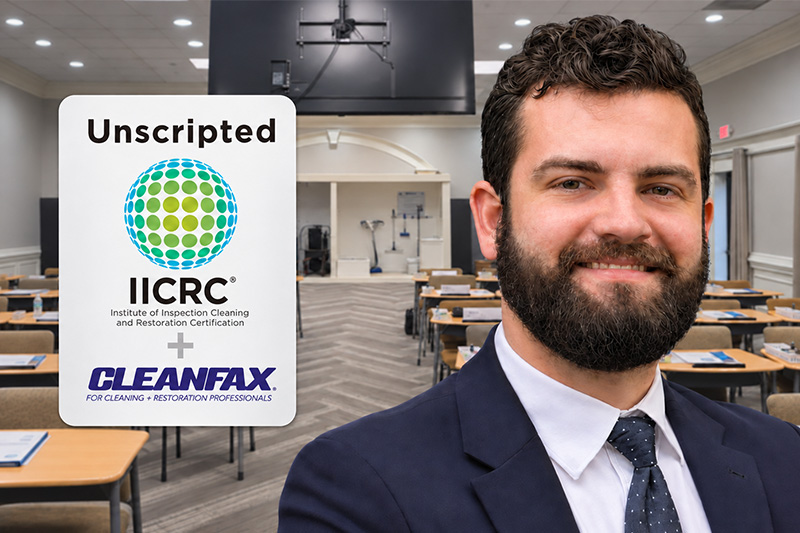
Today, at 24, Reets is an IICRC-approved instructor at Reets Drying Academy in Sharpsburg, Georgia, and one of the youngest people the organization has ever approved to teach.
Growing up in the family trade
The Reets name runs deep in water damage work. Zane’s grandfather started the family restoration company in 1970, and the business grew right along with the industry. Jeremy Reets began riding the truck after school as a kid and, by his son’s account, was sent out on a job alone for the first time at 16. He went on to develop drying methods built around vapor pressure differentials, direct heat and airflow, and has operated Reets Drying Academy since 2005. The academy now offers IICRC water, fire, mold and trauma cleanup courses, plus health and safety training, both in person and by livestream.
Zane didn’t get handed the keys at 16. He was homeschooled, which gave him the flexibility to work part time at the academy through his teen years and do schoolwork the rest of the time. He kept equipment maintained and the building in shape. Later he spent several years as a course assistant alongside instructor David Hodge, building wall assemblies and drying scenarios for students, replacing missing ground plugs, repairing cords and swapping out pumps on dehumidifiers.
He took his first IICRC course in October 2012, a month after his 10th birthday.
A goal that wasn’t on his radar
Teaching wasn’t part of the plan.
“Being an instructor wasn’t really on my radar. I didn’t think about doing that necessarily. I knew the information and such,” Reets admitted.
One early influence was Joe Dobbins, the longtime IICRC instructor who later served as the organization’s president and chairman. Dobbins taught Reets’ WRT/ASD combo course and, according to Reets, taught with Reets Drying Academy for many years. Reets grew up listening to his classes and described him as a legendary instructor who is widely respected across the industry.
Once the idea of instructing was put in front of him, Reets treated it the way he had treated certification as a kid. He had set out to become the youngest WRT/ASD-certified technician, and teaching simply became the next target.
“It was a goal that was set out, and I was going to achieve it,” Reets said. “Once the thought had been put to me about becoming an instructor, I was like, all right, that’s going to be my next goal. So I started working towards that.”
He was approved to teach WRT at 23. About a month after turning 24, he received approval for ASD as well. He currently teaches WRT online. The only other young instructor he has heard of was a few years older, around 26 or 27.
Yes, people have questioned whether someone his age is ready. Reets’ answer has been to keep setting goals and meeting them.
Every student reflects on the industry
Reets teaches knowing that whatever students take from his class ends up inside someone’s home or business. Some are brand new to the trade. Others have 10 years in the field and still walk out having learned something they never knew.
“I take that responsibility seriously,” he said. “They are a reflection on our industry, on the water damage restoration industry, and so having people who do the right job the right way shows that care and keeping up a high standard of work is something that I take seriously because it reflects on all of us as an industry.”
He is careful not to oversell his own ambitions.
“I don’t want to say the best because that sounds bad, but I want to do the best that I can,” Reets explained. “I want to be the best instructor that I can to be able to help people.”
When the student passes the teacher
Picture one of his former students eventually becoming a better technician and a better instructor than he is. Reets would count that as a win.
“Being able to say I was able to help them get things going, to help them build a love for the industry, that would mean a lot,” he said.
He compared it to raising kids. “Every parent wants their child to succeed and to be better than they are,” Reets noted. “I’d view it as a huge accomplishment if I had a student who went on to be an amazing technician, an amazing instructor.”
Borrow someone else’s experience
His advice for anyone in the field who might want to teach someday starts simple: “Get into it and start learning.”
The industry needs more young people, Reets added, though he urged them to seek out experienced technicians, lead techs and managers.
“If we don’t, as younger ones, continue to learn and to better ourselves, to build off the experience of others, it’s a lot harder to learn from our own mistakes,” he said. “They say experience is the best teacher, but I prefer to learn from other people’s experience.”
Becoming an instructor, he shared, “requires experience and dedication, but it’s definitely an achievable goal, and it’s a worthwhile goal.”

Jeff Cross
Jeff Cross is the ISSA media director, with publications including Cleanfax, Cleaning & Maintenance Management, and ISSA Today, as well as multimedia programs such as Straight Talk! and Take 5 With Cleanfax in video and podcast format. He can be reached at [email protected].