Where Researchers and Restorers Finally Talked Shop
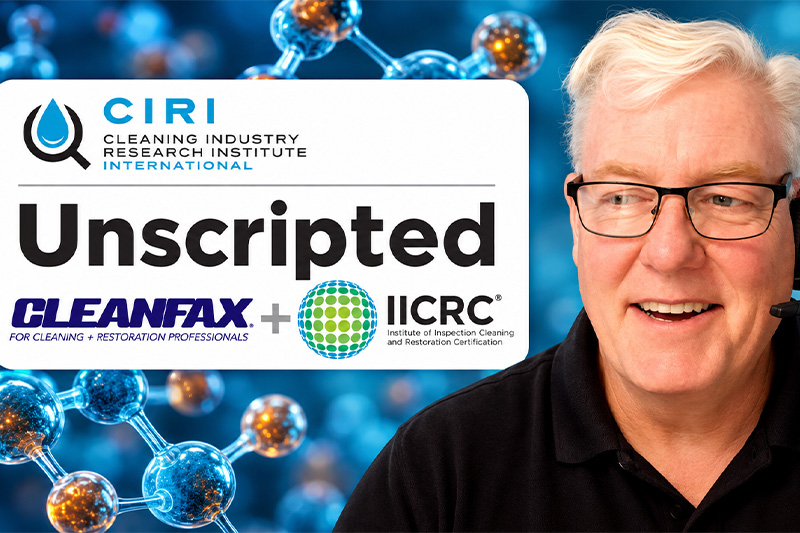
Research only earns its keep in this industry when it changes something on the next job. That idea sits at the center of the CIRI Science Symposium, held Sept. 28-29 at the Palms Hotel in Las Vegas.
The two-day event drew 115 people and put speakers from institutions including Yale University, the University of Toronto, Lawrence Berkeley National Laboratory and the National Institute of Standards and Technology in the same room with the professionals who clean, dry and restore buildings for a living.
Kevin Pearson chairs the Cleaning Industry Research Institute (CIRI), the nonprofit focused on the science behind cleaning and restoration. Pearson came up through the field. He started as a technician in 1992, built and later sold Pearson Carpet Care, and went on to serve as IICRC chairman. CIRI came under the IICRC umbrella after a period of uncertainty at the end of 2023. Since then, it has rebuilt its structure and published three issues of the Journal of Cleaning Science.
The role grew into more than Pearson expected. “I had no idea there was going to be a journal involved and now a symposium and all this other stuff,” he admitted. “You know, sometimes you volunteer without thinking.”
Making the science relatable
The first goal was the simplest one. “I think first, we just wanted attendees to show up and speakers to show up,” Pearson said. “I think that was kind of the initial goal.”
The bigger aim is making research usable for people who don’t work in a lab. “What we wanted to convey was that science doesn’t have to be this thing that most people don’t understand. It can be relatable,” he explained. “We can have scientists come in and they can talk to a level that most people can understand and follow and get something out of. If you come to the event and you don’t understand it, and you don’t take anything home with you, then what good was it going to do you to go?”
Nobody wanted to leave
For Pearson, the biggest win happened between sessions. “I think the biggest win was having the researchers and the restorers in the same room together, having them be able to talk with each other at breaks and dinner and lunch,” he said.
The curiosity ran both directions. During planning, researchers told CIRI they wanted to hear how restoration work actually gets done, so their future studies would reflect real job conditions. Restorers showed up with questions of their own, asking researchers whether anyone had studied the problems they run into week after week.
“We really had two groups that were really interested in the other group,” Pearson noted. “People didn’t want to leave. They kept wanting to talk to the people they had just met.”
How long should equipment really run?
If Pearson could retire one piece of “we’ve always done it this way” thinking, it would involve air scrubbers, hydroxyl generators and ozone machines that stay on jobs far longer than anyone can justify.
“I think we’ve always done it a certain way. And there’s got to be a better way because a lot of times you see those machines out on jobs for ridiculously long amounts of time,” he said. “You could buy the machine two and three times over a lot of times for what those machines get left on jobs for.”
He wants research that defines when run time stops helping. “There’s got to be some kind of research to go on that says, hey, past a certain time frame, you just probably didn’t clean it very well,” Pearson added. “You need to go back and reclean rather than, hey, let’s just run this thing for 30 days.” It’s exactly the kind of field question the symposium was built to put in front of researchers.
Soap and water beats the sprayer
The takeaway that stayed with Pearson most is a basic one. Physically removing contamination outperforms fogging a job site with antimicrobial products.
“You have to physically go in, soap and water,” he said. “It’s kind of like when you go on a cruise and they have the hand-washing station at the buffet and you have to physically wash your hands and rinse them. It’s way better than just going into the job and spraying a bunch of antimicrobial everywhere.”
The point lines up with the IICRC S520 standard for mold remediation, which has long treated physical removal as the primary means of dealing with contamination.
A college senior worked the room
One of the event’s bright spots was also its youngest attendee. CIRI awarded a scholarship to Maya Lopez, a senior at the University of Nevada, Las Vegas (UNLV), who spent the symposium collecting business cards and connecting with researchers on social media.
“She’s in a room with all these companies, and she’s a senior, so she made the most of it,” Pearson shared. “It was really cool to see that you had somebody that young so into the science of cleaning.”
Lopez has already told Pearson she plans to return next year, and he is working on getting her IICRC certified. For an industry that openly worries about attracting younger talent, that kind of early connection counts for a lot.
CIRI’s research library, the Journal of Cleaning Science and information on future events are available at ciriscience.org.
Watch the complete interview with Kevin Pearson or listen to the podcast below:

Jeff Cross
Jeff Cross is the ISSA media director, with publications including Cleanfax, Cleaning & Maintenance Management, and ISSA Today, as well as multimedia programs such as Straight Talk! and Take 5 With Cleanfax in video and podcast format. He can be reached at [email protected].