Before the Trucks Roll: Inside Disaster Communications
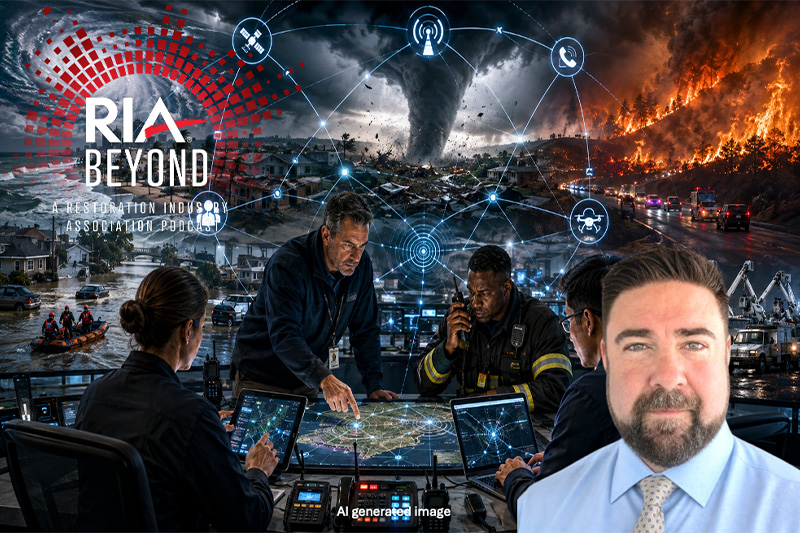
When a hurricane makes landfall, a tornado tears through a community, or floodwaters overtake a town, disaster restoration contractors are ready to help.
But before that first truck rolls in, an enormous communication network is already working to hold the response together, built by emergency managers, first responders, government agencies and technology providers coordinating decisions that restoration professionals rarely see before they reach the job site.
Kacy Greene has spent almost 30 years learning how that network functions and where it breaks down. Greene is vice president of Strategic Partnerships and Accounts at Intrepid Networks, a company that builds communication and situational awareness tools for public safety agencies. He arrived there by way of public safety itself, starting in search and rescue at 16 years old and moving through paramedic work, firefighting and law enforcement before landing at Intrepid.
That background shapes how Greene talks about the problem Intrepid Networks exists to solve: agencies with different radios, different priorities and little regular contact with each other, all forced to work as one team the moment disaster strikes.
Chaos is the starting point
Ask Greene what the first hours after a major disaster look like, and he starts with one word: chaos.
“It’s either chaos or controlled chaos,” Greene said. Anyone who hasn’t stood inside a command post during an active emergency will struggle to describe what that looks like, he added.
The response, however chaotic, still follows a structure. An incident commander gets named, an emergency operations center spins up, and agencies run on the incident command system, or ICS, the standardized framework most public safety organizations use to organize a response. The goal, Greene said, comes down to three things: keep people alive, stabilize the incident and figure out what’s happening on the ground.
The hard part is getting agencies that rarely interact onto the same page. A single incident can suddenly pull in local law enforcement, state agencies, federal responders, EMS, fire departments, emergency management, and IT teams working overnight shifts to keep infrastructure running. Those groups tend to operate in silos, Greene said, and a disaster forces that to change fast.
“None of those groups on a regular basis can, or normally do, talk to each other,” Greene said. “In an emergency, that silo has got to die.”
Restoration crews typically arrive after that structure has already taken shape, Greene noted, which means they’re plugging into a system that may only be hours old. No matter how much a company has planned or how experienced its crews are, every incident is different, and everyone is in chaos, he said.
Restoration crews step into an information vacuum
Greene pointed to interoperability as the biggest and most persistent communication problem in large-scale disasters. It isn’t only a technology issue, he said; it’s a culture issue, since agencies with incompatible radios end up leaning on the same crowded voice channels.
That creates a bottleneck. Only one person can talk on a channel at a time, and when several agencies have something urgent to report, information queues up rather than reaching the people who need it. Requests for help also often must pass through a relay point, from field radio to command to dispatch to the responding unit, by which point circumstances on the ground may have already changed.
Command centers frequently lose track of where their own people are located across a disaster zone, Greene said, which creates its own safety risk. Layer documentation gaps on top of that, and restoration crews often show up without a clear picture of what’s already happened.
“When the restoration crew rolls in, they’re rolling potentially into an information vacuum,” Greene said. Crews arrive wondering who’s in charge, where to stage, and whether it’s safe or disruptive to start working, he explained … uncertainty that compounds the same communication breakdowns already slowing the broader response.
Poor documentation carries consequences well past the first few hours, too. Greene said it ranks among the most common things that can derail a FEMA reimbursement or an insurance claim later.
Tools are moving past radios and paper
Much of the field still runs on radios, phone trees and paper forms, Greene said, even though the technology available now has moved well past that. Agencies tend to stick with familiar systems until an incident forces a change.
The alternative, Greene said, is a shared live map that updates for everyone the moment a person in the field adds information, eliminating the relay delay that slows voice communication. Agencies can stand up secure digital channels without tearing down their existing radio systems, and paper forms can be replaced with digital ones that timestamp and geofence entries automatically. Photos, files and before-and-after documentation can attach directly to that shared map in real time.
Connectivity itself is also becoming more resilient. Mobile carriers now deploy cell towers on trucks after a disaster, drones can restore coverage and satellite service can reach a phone directly when towers are down, technology Greene said is proving its value in conflict zones like Ukraine as well as domestic disasters.
Four ways contractors can prepare
Greene offered restoration companies four pieces of advice for working more effectively alongside emergency managers and other response partners.
First, build relationships before a disaster hits. Getting known and credentialed by local emergency managers, responders, and council members ahead of time matters, Greene said, because introducing a company for the first time during a disaster can come across as predatory.
Second, learn the basics of ICS. FEMA’s ICS Resource Center offers free courses that teach the terminology used on scene, from staging areas to logistics officers, and Greene said that vocabulary alone can remove a communication barrier and help a contractor avoid sounding like an outsider.
Third, get onto the shared operational picture rather than working blind on the margins. “Don’t be the vendor working blind in the corner,” Greene said. “Be a partner that’s on the map.”
Fourth, document everything, cleanly. Timestamped, location-tagged records of labor, equipment, materials, and before-and-after photos protect the agency’s FEMA funding, the contractor’s invoice, and the homeowner’s claim all at once, Greene said. He also suggested volunteering for or sponsoring local Community Emergency Response Teams and damage assessment teams, whose members often field questions about which contractors and services are available.
Looking ahead, resilience and convergence
Asked where disaster communication is headed over the next five to 10 years, Greene pointed to two trends: resilience and convergence.
Connectivity is being built to survive the disaster itself, he said, citing satellite-to-phone service and the FirstNet Authority’s ability to deploy backup communication gear within an hour of towers going down. Radio and broadband networks are also converging, narrowing the old divide between app-based and radio communication.
Drones are becoming standard equipment for damage assessment. Greene said three out of four agencies already use them, and he expects that number to reach four out of four within five years. Paired with artificial intelligence, that data could eventually generate claim-ready documentation automatically, flagging downed power lines, blocked roads and safe passage routes, and pointing both emergency responders and restoration crews toward the areas that need immediate attention.
The common thread, Greene said, is that disaster response is moving toward one shared, connected operational picture. For restoration companies, getting ready for that means choosing tools that integrate with others, building relationships and documentation habits before a storm hits rather than after, and training crews on ICS now.
“Build those relationships before you need them,” Greene said.
Watch or listen to the interview

Jeff Cross
Jeff Cross is the ISSA media director, with publications including Cleanfax, Cleaning & Maintenance Management, and ISSA Today, as well as multimedia programs such as Straight Talk! and Take 5 With Cleanfax in video and podcast format. He can be reached at [email protected].