Cleaning’s New Essentials
As carpet materials and fibers continue to evolve, so must the equipment, tools, and solutions used to care for them. Additionally, poor cleaning schedules, no action plan, irregular maintenance, high expectations, and quality-versus-cost client concerns continue to be some of the most frustrating carpet care challenges, explained Marty Jollette, general manager and director of training at Renue Systems in Lombard, Illinois.
“Carpet cleaning and stains can be handled,” he said. “It’s just these intangibles that are really hard to get through to your customers.”
Renue Systems serves the hospitality and commercial industries, but its carpet cleaning challenges are similar to those of other residential and commercial carpet cleaners. Possibly different than residential cleaning, before the COVID-19 pandemic, the hospitality industry wanted to keep carpet cleaners out of sight as much as possible. Carpet cleaners would have an uphill battle to get access to guest rooms. “Now, they’re happy to put notices in guest rooms, saying, ‘On Tuesday, all the carpets are being cleaned in the hotel,’” Jollette explained.
While hotels are proud to market their cleanliness to guests, most still only care about what can be seen by hotel guests and aren’t concerned about anything microscopic and wouldn’t be covered on a hotel review, he added.
Overlooked steps
The most overlooked step in carpet care is having a maintenance plan.
“A maintenance plan is essential in providing good carpet care, and also at the same time, when you’re putting together a maintenance plan with a customer, what you’re doing is ensuring future business with that customer,” Jollette explained.
While most clients don’t think about a maintenance plan for their carpet, they also often have high expectations for poorly maintained carpets. Jollette shared the example of petroleum yellowing on carpet, which is often trekked into buildings by people walking through asphalt oils. Most petroleum yellowing won’t come out of carpet, especially synthetic carpet, because they are oleophilic or oil-attracting fibers. Customers would need to be informed of the situation because many customers would believe a cleaner is going to get everything out of the carpet, Jollette explained.
“You need to set expectations very carefully before you start cleaning as to what they can expect, and then it’s also a good time to ask questions,” he added.
When training team members, Jollette always tells them that what they think the problem is and what the customer might think the problem is can be two completely different things. “You think you did a great job, and then they’re looking around the baseboards and see dust, and you miss it because you didn’t talk to them,” he said.
Regular vacuuming is also often overlooked. “The majority of the soil is dry soil in the carpet,” Jollette said. “It can be vacuumed out, and the carpet will last longer. Because dust particles are sharp, they cut the fibers, and it causes matting. It causes irreversible damage, but if you regularly vacuum the carpet, then you know you’re going to get better results.”
The last thing that Jollette always stresses to people is following the manufacturer’s guidelines. “Find out who the manufacturer is and follow their guidelines for daily, interim, and professional deep cleaning,” he explained. “A lot of people don’t ever reference the manufacturer’s guidelines.”
Void warranties
Common mistakes that often damage carpet or void warranties include poor or incorrect carpet installation. The installer may point back to the manufacturer and sometimes even the carpet cleaner. Still, Jollette said that poor or incorrect installation, coupled with a lack of regular maintenance, often voids the warranty.
Regarding the carpet cleaner, improper chemicals, such as too high or low a pH, or improper equipment, can cause irreversible damage to the carpet.
Additionally, a warranty can be voided through a lack of cleaning documentation and proof of receipts. Many warranties also call for proper walk-off matting based on the size of the building.
Must-haves
Many carpet cleaners know about essential equipment, such as a counter-rotating brush (CRB) machine and high-quality vacuum. Jollette said air movers and measuring cups might be deemed non-essential by some, but he views them as invaluable. For example, he often sees people just put out wet floor signs instead of also using an air mover whenever a floor or carpet is cleaned. Measuring cups are also essential to measure chemicals. People think they can estimate by pouring out of a jug, Jollette explained, which isn’t accurate for effective carpet cleaning.
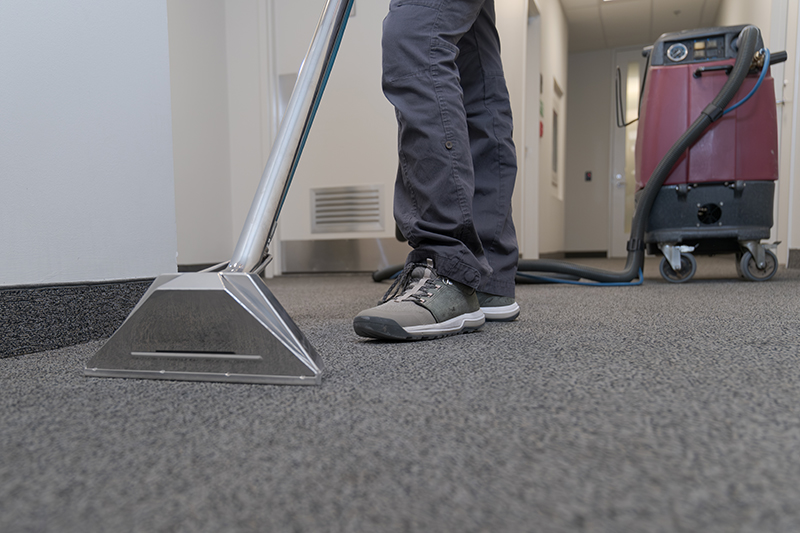
A quality carpet wand with a Teflon glide also is of the utmost importance.
“If you think about it, the only piece of equipment that actually is touching the carpet the entire time is the carpet wand, and then at the end of that wand is a Teflon glide,” Jollette said.
A Teflon glide works better for extraction, he explained, and they also make it easier for the technician to push the wand across the carpet.
Like how tires are important to a vehicle because they are the only part that contacts the surface of the road, carpet wands with Teflon glides operate that same way.
“Carpet wands and Teflon glides are often overlooked,” Jollette explained. “People will buy the cheapest they can get their hands on.”
Auto-sprayers also make cleaning jobs much easier, he added. Prespraying lays down an even amount of chemical. Automated sprayers are sometimes hooked up to a truckmount’s solution line, or one can buy electric sprayers to lay down prespray.
At some point, most professional carpet cleaners also purchase a truckmount because of the reach, heat, and vacuum lift that make cleaning easier, Jollette added.
Worth looking into
One newer carpet care tool worth looking into is a flood spotter. The small tool increases vacuum lift for extracting stains that are beneath the surface of the carpet, even in the padding.
For example, a spot can be flooded with a cleaning solution, and then a spot extractor can be placed on top to create a concave vortex that increases the vacuum’s lift. If a client has spilled a large amount of liquid on a spot, the surface tension of the carpet fiber only holds that stain on top for a very small amount of time before it starts to soak into the fiber through the primary backing into the padding of the carpet and possibly even beyond into the concrete, Jollette explained. If you have a spot extractor, you can saturate that spot. Drop the tool on it, and it pulls all that staining liquid from the backing all the way up to the top of a carpet.
“You get fewer recalls for spots reappearing,” Jollette said.
A 40-power microscope also is a good tool to have in the field, Jollette said. “With a 40-power microscope you can get down and actually see what’s in fibers,” he explained. “Is it a spot or a stain? A spot is typically something that’s on the outside of the fiber, or a stain is typically something that’s had color transfer. So, instead of just trying to verbally tell a customer what that is, you pull out a 40-power microscope, and you get down, and you look at it, and it’s amazing. You see right into the fibers, and you can explain it better. You look like a rocket scientist versus the schlub, because now you’ve made that tangible for them.”
If a carpet cleaner does not have a CRB machine, Jollette suggests purchasing one to scrub in prespray and for encapsulation cleaning. Additionally, a CRB machine can be used to remove loose fibers from wool carpet and to clean tile and grout.
While chemistry doesn’t change dramatically, new products always hit the market and are worth looking into, Jollette said. Many cleaners also have not tried encapsulation chemicals, which are also worth trying, as they are low moisture and usually dry within an hour.
“It’s a nice regular maintenance or interim method of cleaning,” Jollette said.
Jollette also suggested a vacuum gauge tester to test the vacuum strain on your extractors.
“A lot of people don’t do this,” he explained. “They don’t realize that these vacuums lose power over time. And if you’re not having the proper vacuum, you’re not taking all that dirty water out of the carpet. Your carpet’s taking longer to dry. You’ve removed less soil.”
Additionally, vacuum gauges are inexpensive. Jollette suggested testing your machine when it is brand new and logging how many inches of water lift is measured every month or two. This will allow the operator to register if something is wrong or if the machine is falling behind from when it was brand new.
Above all else, Jollette urged owners to educate their technicians and continue to educate them.
“Most people learn hands-on,” he explained. “There are theory and practice, and most people don’t learn well from theory. They learn well from practice, so getting them involved in continuing education through the IICRC and reading trade publications is really important.”