The Four Pillars of Effective Floor Maintenance
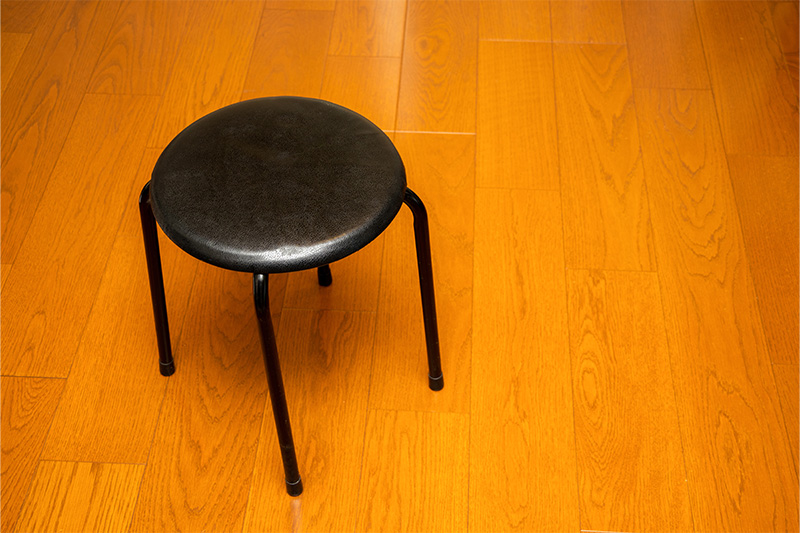
Four-legged stool
- correct chemicals
- correct pads
- correct equipment
- employees
We’ve all enjoyed walking in and beholding pristine floors. The correct chemical system is the first part of our answer. A compatible chemical system includes the correct stripper/remover, a pH-balanced neutral cleaner, an appropriate floor finish and a cleaner/maintainer that cleans and enhances the finish’s slip resistance. Cheaper-priced products aren’t always best.
The second leg of this process is selecting the right maintenance pads. For automatic scrubbers, attach red pads for daily maintenance. Green or blue pads are best for deep wet work before recoating. Heavy wet work, such as stripping wax buildup, requires a more aggressive, open-weave strip pad. These are more efficient with labor-saving results. For buffing, a light hog hair pad works well on freshly coated floors and for daily burnishing. Higher hog hair content generates more heat for a higher-solids floor finish.
The third leg of the process is selecting the right equipment. Again, don’t focus on price alone. Consider the floor surface and square footage. If a 20-inch autoscrubber has a lower price tag but you need to maintain 100,000 square feet, a 28-inch or 32-inch autoscrubber is the better choice. Both save labor and deliver cleaner, safer floors.
Buffing versus burnishing
Quality floor finishes require the heat of a turning pad for proper curing, shine and slip resistance. A buffer indicates lower revolutions per minute (RPMs), as it’s simply polishing. A century ago, the 175 RPM cord electric buffer got janitors off their hands-and-knees hand polishing. In the 1950s, RPMs increased to 350 plus or minus for cord electric buffers. In the early 1980s, propane burnishers were introduced. Propane burnishers enhance shine and slip resistance through higher RPMs and pad pressure. Buffing polishes the surface with minimal heat transfer from the turning pad and requires multiple passes. Burnishing involves more heat transfer from increased RPMs and pad pressure, so it requires one pass.
Each machine fits our industry. Comparing production:
A cleaning time estimator rates the time per 1000 square feet to be polished hourly:
+175 RPM @ 45 minutes +350 RPM @ 30 minutes +1500 RPM @ 15 minutes
+ 2000 RPM propane @ 3.5 minutes
Let’s now translate this into labor dollars:
Based on 1000 square feet at a $20 hourly labor rate:
20-inch cord electric buffer:
175 RPM @ 45 minutes = $15 for labor 350 RPM @ 3 minutes = $10 for labor
1,500 RPM @ 15 minutes = $5 for labor
21-inch propane burnisher:
2,000 RPM @ 3.5 minutes = $1.18 for labor
Let’s focus on two of these machines. The 1,500 RPM high-speed electric buffer. It can polish up to 3,500 to 5,000 square feet per hour. The 50-foot cord limits the operator, and the electric motor is usually 1.5 horsepower. The 21-inch propane burnisher can burnish 20,000 to 25,000 square feet hourly, powered by a 603 cubic centimeter/18 horsepower propane motor.
Established regulations for safe indoor use
Electric, battery and propane floor machine manufacturers follow industry regulations to ensure safe operator use. Two of these regulations are:
- Leadership in Energy and Environmental Design (LEED) does not recommend any manufacturer. “The intent of LEED for Existing Buildings: Operations & Maintenance” is to provide a global comprehensive framework for green building practices. Equipment listed together includes vacuum cleaners, autoscrubbers, propane-powered floor machines and others.
- The National Fire Protection Agency (NFPA) pertains to safe indoor use of propane floor machines: NFPA No. 58: “These machines (propane) shall be permitted to be used in buildings frequented by the public, including times when the public occupies such buildings.” Common sense dictates working in less congested areas away from the public, students and staff.
Other agencies, including the Compressed Gas Association, Occupational Safety and Health Administration, Department of Transportation, and UL Solutions, may also have regulations. Local fire marshals also rely on these regulations, along with independent labs, when establishing local fire codes.
In conclusion, the fourth and most important leg of floorcare is your employee. Value their input, remembering the four Cs: commend, commend, commend and commend.